
Genuine Toyota Parts vs Third-Party Parts: Why It Matters
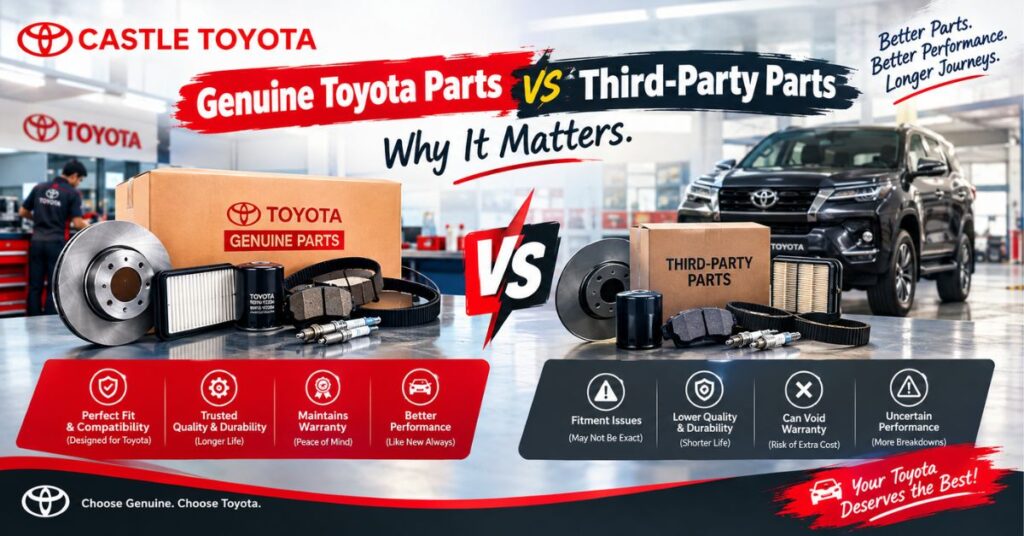
All cars will eventually need replacement parts. Oil filters, brake parts, belts, suspension parts, body parts, and many other parts wear out or get damaged over time. Then, Toyota owners usually have a choice to make: buy a Toyota Genuine Part or a part made by another manufacturer. Especially when the car is older, the price difference can make a third-party component tempting. But the purchase price is only part of the story. The real cost of a replacement can be affected by fit, material qucastality, expected life, warranty, installation, vehicle safety, and compatibility. A fair comparison of genuine Toyota parts vs third-party parts should also differentiate between reputable aftermarket parts and counterfeit parts. That’s not the same thing. A legitimate aftermarket company can manufacture and sell a part under its own name. A fake part is a copy of branding or packaging and may be sold as if it were an original Toyota part when it is not. For many years, Toyota has been warning Indian car owners about counterfeit automotive parts. Fake parts may lead to vehicle faults, poorer performance, higher fuel consumption, sudden breakdowns, and road-safety concerns, Toyota says. So as a Toyota owner, this is what you need to know before you decide on replacement parts. Genuine Toyota Parts vs Third-Party Parts: Quick Comparison If you want a quick answer, this comparison will help: Factor Toyota Genuine Parts Third-Party Parts Vehicle fit Made for applicable Toyota vehicles Depends on manufacturer and product Toyota-backed parts warranty Toyota states 6 months or 10,000 km for genuine service parts. Depends on seller or manufacturer Testing Toyota states its genuine parts undergo testing under simulated conditions. Testing differs between manufacturers. Purchase source Toyota dealers and authorised distribution routes Parts shops, garages, online sellers, manufacturers Price May cost more for some components Can be lower, similar, or higher Compatibility check Part identification can be matched through Toyota channels. Requires careful verification Counterfeit risk Lower when bought through authorised Toyota channels Depends heavily on source Suitable choice Owners seeking manufacturer-specified replacement parts May suit some applications when the part comes from a known maker and fits the exact vehicle Toyota says its genuine parts are designed and engineered for Toyota vehicles and are backed by a six-month or 10,000 km warranty subject to Toyota’s applicable terms. Toyota also says these parts are tested for quality, durability and reliability under simulated conditions. That doesn’t mean that every non-Toyota-branded part will fail. Therefore, buyers should look at the manufacturer, specification, warranty, seller and fit rather than just the price of a component. What Are Toyota Genuine Parts? Toyota Genuine Parts are replacement parts offered through Toyota’s authorised parts network for use in qualifying Toyota vehicles. “The genuine parts we have involve standard design, material choice and internal construction,” Toyota says. Its service information also says these parts are simulated-tested before sale. Toyota Genuine Parts can be parts fitted during repairs or items used during routine servicing. This may include, depending on the vehicle: Owners should still verify the exact part number. Different Toyota models may use different parts, and the same model may have part differences depending on the engine, build date, grade, or gearbox. Buying an original part does not mean all Toyotas have the same part. What Are Third-Party or Aftermarket Parts? Third-party parts are parts made by companies other than Toyota and sold for use in Toyota vehicles. Quality is all over the place. Some manufacturers make quality replacement parts and actually list the vehicles and specs their parts will fit. Other products may have questionable origins, questionable testing, poor warranty support, or poor fit. So the word “aftermarket” itself tells you nothing about quality. Before you buy one, check out: If a workshop recommends a certain component, don’t accept a vague statement that it is “just as good”. Ask why. Third-Party Parts and Counterfeit Parts Are Not the Same That distinction is important. Also, a 3rd-party component could have the branding of its manufacturer. A counterfeit part might try to look like a genuine Toyota part. The Japanese automaker launched a “No to Counterfeit” education campaign in India to warn motorists against fake automotive components. Toyota says counterfeit products can look similar to genuine ones but do not meet the standards used for Toyota Genuine Parts. Counterfeit packaging can be difficult for the average buyer to visually detect. A safer way to buy is to buy from a traceable seller, ask for an invoice, verify the correct part number, and keep the purchase records. Toyota says genuine parts are sold through Toyota dealerships in India and recognised parts distribution channels. 1. Correct Fit Can Affect More Than Installation Time A replacement part must match the vehicle it was made for. Even minor differences in shape, dimensions, connectors, mounting points, material thickness, or operating specification can be significant. A part that physically fits doesn’t always mean it matches the intended specification. Pick up an oil filter. It can seem like the right thread size, but the internal filter makeup and pressure characteristics also play a role. This also affects electrical sensors, brake components, lamps, suspension parts, and many other systems. Toyota’s genuine service parts are designed for Toyota vehicles. When buying replacement parts, be sure to provide the requested information to the seller. Some workshops may ask for the VIN, model, model year, engine, gearbox, or grade of the item so that they can help identify the correct part. Don’t pick a part just because some online title says “fits Toyota”. 2. Material and Manufacturing Quality Can Affect Service Life Sometimes two parts that look almost identical on the outside can be made of different materials on the inside. The rubber compounds, filter media, friction material, metal grades, electrical components, surface coatings, seals, and manufacturing tolerances may differ. Those distinctions might matter: Toyota claims its genuine parts are tested to mimic extreme conditions. For a non-Toyota part, look for a named manufacturer and good technical information. Don’t pick by looks.
Toyota Fortuner vs Ford Endeavour (or MG Gloster): SUV Comparison 2026
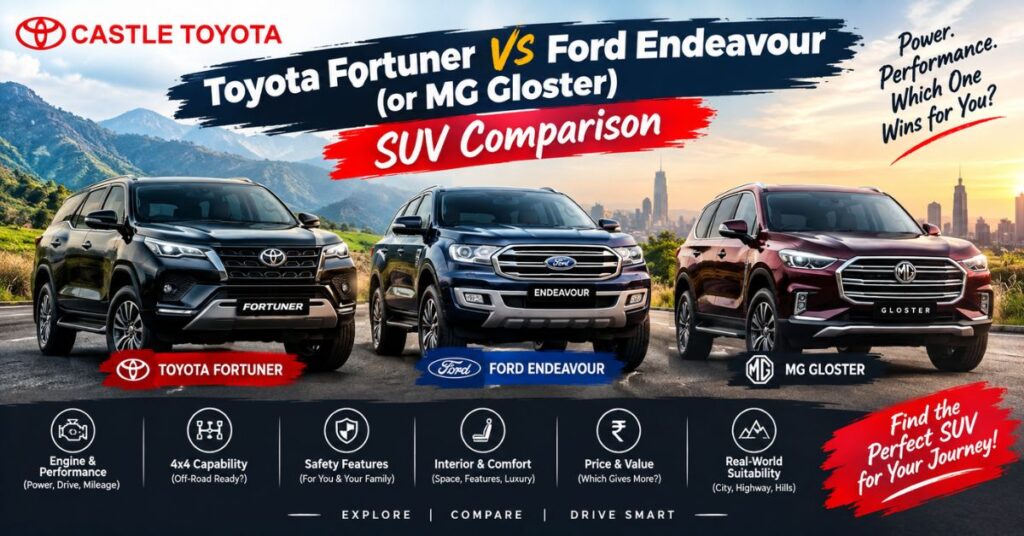
Choosing a big SUV is more than just comparing engine power or counting screens. You also need to think about who is coming with you, where you park, how often you leave paved roads, and how much uncertainty your budget can take. That’s crucial when you compare the Fortuner, Endeavour and Gloster in 2026. A showroom vehicle and a used SUV with several years of service history need different checks for the buyer. This Castle Toyota guide covers manufacturer specs, ownership questions, and family needs. It doesn’t offer a back-to-back road test, nor does it assume that one badge fits all buyers. Are All Three SUVs Available New in India in 2026? Don’t think of this as a direct comparison of three new 2026 vehicles. Ford said in September 2021 it would stop making cars for sale in the U.S. Its current Indian website is service, parts, and owner support focused. The official Indian pages checked for this story did not verify a new Endeavour retail launch. The comparison uses the India-specification 2.0-litre version from Ford’s 2020 brochure, tested as a used buy. The MG situation also needs attention. The former Gloster product URL now redirects to the Majestor that MG unveiled in May 2026. Check any Gloster offer as a private seller used car or possible remaining dealer stock. A live advertisement alone does not confirm a newly manufactured auto. The Fortuner continues to be available through Toyota’s sales network in India. So know the overview of the Fortuner model first and then ask for the current details for the exact version you are considering. How to Choose Between These SUVs Here’s a three-step comparison before you check out the discounts: A clean inspection and an affordable payment plan are more important than winning a specifications argument. Price Comparison: Use Matching Vehicles and Written Quotes The Toyota Fortuner is listed online with a starting reference of ₹34.76 lakh, ex-showroom. The current page for MG’s Majestor has a starting price tag of ₹43.49 Lakh. These headline numbers exclude equivalent variants or Punjab on-road quotes. Get quotes related to the real vehicle for the Endeavour and Gloster. Please be aware of the year of registration, mileage, number of owners, repair history, etc. Don’t take an old launch price as today’s used-car value. Castle Toyota lists the Toyota Legend range separately from the normal Fortuner. Compare two offers for the same version. Ask sellers to itemise the cost of the vehicle, registration fees, insurance, accessories and service packages. Toyota itself recommends that buyers contact their dealer for the latest prices and details before placing an order. Toyota Fortuner vs Ford Endeavour: Engines and Gearboxes Below is a comparison of Indian published specifications. It doesn’t mean that every car you see here is still available. Specification Fortuner 2.8 diesel automatic Endeavour 2.0 diesel, 2020 India model Gloster 2.0 twin-turbo diesel Engine size 2,755 cc 1,996 cc 1,996 cc Maximum power 204 PS 170 PS 215.5 PS Maximum torque 500 Nm 420 Nm 478.5 Nm Transmission Six-speed automatic Ten-speed automatic Eight-speed automatic Length 4,795 mm 4,903 mm 4,985 mm Width 1,855 mm 1,869 mm 1,926 mm Wheelbase 2,745 mm 2,850 mm 2,950 mm Figures from Toyota, Ford and MG brochures. The Gloster column is for the twin-turbo version, not the single-turbo version with lower output. PS = hp of the engine; Nm = torque The highest quoted power here is of the Gloster, while the highest quoted torque is of the Fortuner automatic. Neither figure tells you which SUV is faster off the queue with your passengers and luggage. Assessment includes gear ratios, weight, response, and condition. On a road test, check gentle acceleration, passing response at legal speeds and gearbox behaviour once the vehicle has warmed up. For a used automatic, have a technician check for hesitation, harsh shifts or unusual noises. Older versions of Endeavour require a separate specification check. Don’t use this 2.0-litre comparison and apply it to every used Ford you see, nor use the specs of the overseas Everest instead of the one you’re being offered in India. What About the Fortuner’s 48V Versions? Toyota launched the Fortuner and the Legender in 48V-assisted variants in June 2025. The system utilises the diesel engine with a starter-generator and a lithium-ion battery. The grades also received a 360-degree camera and wireless charging. Do not assume that every Fortuner is equipped with this. Don’t compare an older car to a newer one with a list of features and not address the differences. Ask what features are included in the quoted trim. Cabin Comfort, Third-Row Space, and Daily Parking Fortuner: Check the Seats and Luggage Layout The specification sheet of Toyota has seven seats, ventilated front seats, and third-row seats that fold to the sides. No panoramic sunroof is listed. Don’t judge the practicality of the empty cabin; fill it up with your usual luggage. Older passengers should be asked to rate entrance, exit, and second-row comfort. Cruise the back seats over your normal local route, not just when the vehicle sits outside the showroom. Endeavour: Check Which Features the Used Car Has Ford’s 2020 brochure boasts a panoramic sunroof, power folding third-row and an electrically adjustable front passenger seat on Titanium+ versions. The lower titanium trim does not get that equipment list. Before you settle on a used-car price, try every seat motor, window, roof function, and air-conditioning setting. Don’t promise to repair bad equipment later; put it in the repair estimate. Gloster: Consider the Seating Arrangement MG’s brochure lists six- and seven-seat layouts, three-zone air conditioning and a panoramic sunroof. And it’s also bigger than the other two vehicles we’re comparing here. And that makes it worth a look for a passenger room. But outside dimensions don’t always mean third-row comfort. Sit in each row with the front seats in their normal position. Test out whether a six-seat configuration is really right for your family. For all three, measure your parking entrance, and leave room for open doors. And if
Best Toyota Cars for Long-Distance Driving in India: Comfort, Mileage and Performance Compared
Planning a long road trip changes the way you look at a car. City comfort and highway comfort are not the same thing, and a car that feels fine on a 20-minute commute can feel tiring after five hours on the same seat. This is where the right pick matters. Toyota cars for long-distance driving in India come up again and again in road-trip forums and owner reviews, and there is a clear reason for that. Toyota builds its cars around ride quality, cabin space, and long-term reliability, three things that matter more on a highway stretch than a spec sheet ever will. In this post, we will look at five Toyota models that Indian drivers actually take on long trips: the Innova Hycross, Innova Crysta, Fortuner and Legender, Camry, and Urban Cruiser Hyryder. We will compare their mileage, seating comfort, boot space, and highway manners so you can match the right car to your own driving needs. Why Toyota Cars for Long-Distance Driving in India Work So Well Here is why Toyota keeps showing up on long-drive shortlists across India: Let’s break it down model by model. Toyota Innova Hycross: The Highway-Ready Family MPV The Innova Hycross is the newer sibling of the Crysta, and it was built with families and long drives in mind. It comes with two petrol engine options: a strong-hybrid 2.0-litre unit that makes 184 bhp and 188 Nm, and a non-hybrid 2.0-litre petrol that makes 172 bhp and 209 Nm for buyers who want a simpler, lower-cost setup. Mileage and running cost The hybrid variant carries an ARAI-certified figure of 23.24 km/l, and owners report real-world numbers in the 18 to 20 km/l range on mixed routes. That is a strong number for a car this size, and it means fewer fuel stops between cities. Comfort and cabin space The Hycross measures 4755 mm in length with a 2850 mm wheelbase, which gives the second and third rows real legroom. Ground clearance sits at 185 mm, so speed bumps and rough patches do not knock the underbody around. Boot space is 300 litres with all seats up, and it grows to 991 litres once the third row folds flat, which works well for a family with luggage. The fuel tank holds around 52 litres, so a single fill can cover a long day’s drive. Higher variants add Toyota Safety Sense, which brings adaptive cruise control, lane-keep assist, and pre-collision warning, features that lower driver fatigue on long highway runs. Toyota Innova Crysta: The Old-School Road-Trip Workhorse The Innova Crysta has been a road-trip staple in India for close to a decade, and plenty of taxi fleets and families still swear by it. It runs a 2.4-litre diesel engine paired with either a manual or automatic gearbox. The ARAI-claimed mileage sits at around 16 km/l, with real-world figures usually landing between 9 and 13 km/l depending on load and driving style. The diesel engine gives it strong pulling power on inclines and while carrying a full load, which is why it stays popular for hill routes and long family trips. The cabin has a low floor, wide middle row, and a suspension that absorbs rough patches calmly, so long drives feel relaxed rather than tiring. Fuel tank capacity is 55 litres, which keeps range comfortable between stops. Toyota Fortuner and Legender: Built for Power on Long Highway Runs If your road trips mix highway stretches with rough terrain, the Fortuner and its sportier Legender trim are worth a look. Both run a 2.8-litre turbo diesel engine that makes 201 bhp and 500 Nm, paired with a six-speed automatic and paddle shifters on the Legender. ARAI mileage for the diesel automatic comes in at 14.2 to 14.4 km/l, and the fuel tank holds 80 litres, so you can cover close to 1,000 km before you need to refuel. Ground clearance stands at 225 mm, which is the highest of any car on this list, and boot space comes in at 296 litres. This is the pick for anyone who wants a commanding driving position and confidence over uneven roads on long inter-state drives. Toyota Camry Hybrid: Comfort-First Choice for Highway Cruising The Camry sits in a different category. It is not built for rough roads, but it is one of the smoothest highway cruisers Toyota sells in India. The 2025 model runs a 2.5-litre hybrid engine that produces 230 PS and 221 Nm through an e-CVT gearbox. Fuel use is where the Camry stands out. ARAI rates it at 25.49 km/l, and owners report 21 to 22 km/l in real-world mixed driving, numbers that beat most SUVs and MPVs in this price bracket. The 50-litre tank and quiet hybrid running make it a natural fit for chauffeur-driven trips or long highway runs where cabin refinement matters more than ground clearance. Rear-seat passengers get reclining seats and generous legroom, and the car comes with nine airbags along with a full ADAS suite for added confidence at highway speeds. Toyota Urban Cruiser Hyryder: Best Mileage Pick for Long Drives For drivers who want SUV looks with hatchback-like running costs, the Urban Cruiser Hyryder is worth a serious look. It comes in mild-hybrid, strong-hybrid, and CNG options, giving buyers real choice based on how they plan to use the car. The strong-hybrid automatic variant returns an ARAI figure of up to 27.97 km/l, which makes it the car with the best mileage in this list by a wide margin. The petrol manual variant still manages 21.12 km/l, and the CNG version delivers 26.6 km/kg for buyers focused purely on running cost. Ground clearance comes in at 210 mm, and boot space runs from 373 litres on the mild-hybrid variant to 265 litres on the strong-hybrid variant, since the battery pack sits under the boot floor. Owners note that the hybrid drivetrain stays quiet and stable on highways, and one common piece of feedback is that it feels highly comfortable for long drives despite its compact SUV size. Quick
Reasons to Buy Toyota Hyryder in 2026: Is This SUV Worth Your Money?

If you’re shopping for a compact SUV this year, chances are the Toyota Urban Cruiser Hyryder has already popped up on your list. It sits in one of the busiest segments in the Indian car market, right next to the Hyundai Creta, Kia Seltos, and Honda Elevate. So what makes it worth a closer look in 2026? Let’s break it down. From its hybrid powertrains to its cabin space and running costs, here are the real reasons to buy Toyota Hyryder this year, based on facts, not sales talk. What Makes the Toyota Hyryder Different The Hyryder is Toyota’s first proper compact SUV built for India, and it shares its platform with the Maruti Suzuki Grand Vitara. But Toyota built its own identity around it. You get three engine choices (a mild hybrid, a strong hybrid, and a CNG option), a design that leans more premium than most rivals, and Toyota’s long-standing name for building cars that keep running with minimal fuss. Here’s why that combination matters if you’re comparing SUVs right now. Know More : Toyota Hyryder VS Maruti Grand Vitara Top Reasons to Buy Toyota Hyryder in 2026 1. A Hybrid Engine That Actually Saves Fuel Fuel prices aren’t dropping anytime soon, and this is where the Hyryder pulls ahead of most petrol-only rivals. The strong hybrid version can return up to 27.97 kmpl on the ARAI test cycle, while even the mild hybrid petrol variants land between 19.39 and 21.11 kmpl. The Petrol models have mileage range between 19.39 kmpl to 27.97 kmpl with manual/automatic. In daily city driving, real owners report figures closer to 24 kmpl, which is still strong for a car this size the mileage came to be 24 kmpl in the real world. The strong hybrid setup also switches to electric-only mode in slow traffic, so the engine shuts off and you save fuel without doing anything different behind the wheel. 2. Toyota’s Reputation for Reliability and Resale Value Toyota cars have built their name on durability, and that reputation carries a lot of weight when it comes time to sell. Owners consistently point to low maintenance needs and cars that keep running well past the 100,000 km mark. This reliability also means the Hyryder tends to hold its resale value better than several rivals in the segment, which matters when you’re calculating the real cost of ownership over five or six years. One of the biggest advantages of Toyota cars is their durability. Many owners say their vehicles run smoothly for years with very few mechanical problems. Toyota also has a strong resale value, making it a smart long-term investment. 3. A Cabin Built for Comfort, Not Just Looks Step inside and you’ll find a 9-inch touchscreen with wireless Apple CarPlay and Android Auto, ventilated front seats, a head-up display, and a panoramic sunroof The interior offers a good number of features such as ventilated seats, 360-camera, wireless Apple CarPlay & Android Auto, panoramic sunroof and more. The rear seat reclines, splits 60:40, and gets its own AC vents and USB ports, so passengers in the back aren’t an afterthought. Toyota also added wireless phone charging and remote AC control through its app, so you can cool the cabin down before you even step in on a hot day. 4. A Safety Package That Covers the Basics Well Safety features across the Hyryder lineup include up to 6 airbags on higher variants, ABS with EBD, electronic stability control, hill hold assist, ISOFIX child seat anchors, and a 360-degree camera system This SUV comes with advanced safety features like six airbags, ABS with EBD, and ISOFIX mounts, offering reliable protection for families and professionals. Front seatbelts come with pretensioners and force limiters, which tighten automatically during a collision to keep occupants in place. It’s worth checking the exact safety kit on your chosen variant, since features like the extra airbags and 360-degree camera aren’t standard across the entire range. Know More : Toyota Hyryder VS Creta Safety Rating 5. An All-Wheel Drive Option You Won’t Find on Most Rivals Here’s something the Creta and Seltos don’t offer: an AWD variant. The Hyryder gives you the choice of an all-wheel-drive setup, paired with a manual gearbox, on select trims While the Toyota Hyryder goes up in a strongly contested segment with nameplates like the Hyundai Creta, Kia Seltos and Honda Elevate, the Japanese compact SUV manages to stand out with its powertrain options. There’s no diesel or turbo-petrol engine on offer, but the Hyryder offers mild and strong-hybrid self-charging petrol powertrains. Moreover, it also offers the option of an all-wheel setup, something which is unique to the Hyryder and Grand Vitara. If you regularly drive on loose gravel, wet roads, or light off-road trails, that added traction is a real advantage over a front-wheel-drive-only competitor. 6. A CNG Variant for Lower Running Costs Not everyone needs a hybrid. If your priority is cutting fuel bills without paying a hybrid premium, the Hyryder’s CNG variant returns around 26.6 km/kg The CNG model has a mileage of 26.6 km/kg. That’s a practical option for buyers who drive long daily distances and want to keep running costs down without changing how they drive. Toyota Hyryder Price and Value in 2026 The Hyryder’s price starts under Rs 11 lakh (ex-showroom) for the base petrol variant and climbs into the low twenties for the fully loaded hybrid with AWD-level features. Toyota Hyryder Price in India starts at Rs. 11.31 Lakh. Prices have moved slightly through the year as Toyota adjusted its lineup, so it’s worth checking the current on-road price for your city before you finalize a variant. Service costs also stay reasonable. Owners can expect to spend around Rs 11,313 across a 5-year service package, regardless of whether they pick the petrol or hybrid version The approximate service costs for Toyota Urban Cruiser Hyryder range between ₹11,313 to ₹11,313, depending on the fuel type. Buying Your Toyota Hyryder from Castle Toyota If you’re based in and around
Maintenance Tips and Cost of Ownership for Toyota Hyryder and Camry Owners

Buying a Toyota is usually the easy part. The real question most owners ask later is, how much will it cost to keep this car running well for the next five or ten years? Whether you drive a Hyryder for your daily commute or a Camry for long highway trips, understanding the maintenance routine and the real cost of ownership helps you plan better and avoid surprises. Let’s break down what owning each of these cars actually involves, from service schedules to warranty coverage and a few practical tips that can lower your running costs over time. Why Maintenance Costs Matter More Than the Sticker Price A lot of buyers focus heavily on the on-road price and forget to factor in what happens after the first year. Servicing, fuel, insurance, tyres, and depreciation all add up over time, and hybrid cars come with their own set of considerations, mainly around the battery system. Here is why this matters for both the Hyryder and Camry. Both cars use Toyota’s hybrid technology, which means lower fuel costs but also a few extra checks during routine servicing. Knowing what to expect ahead of time helps you budget properly and keeps small issues from turning into expensive repairs. Toyota Hyryder Maintenance Schedule and Service Costs The Toyota Hyryder is built to be a low-maintenance SUV, and the numbers back that up. Here is what the service schedule generally looks like: Over a 10-year period, the approximate maintenance cost for the Hyryder comes to around ₹48,700. For a 5-year period, periodic servicing expenses are estimated at around ₹26,500, with the total cost of ownership, including fuel, insurance, tyres, servicing, and depreciation, falling between ₹13.49 lakh and ₹13.69 lakh. Warranty Coverage for the Hyryder The Hyryder comes with a standard warranty of 3 years or 1,00,000 km, covering manufacturing defects in major mechanical and electrical components. The hybrid battery gets a separate, much longer warranty of 8 years or 1,60,000 km, which reflects how confident Toyota is in this technology. Owners can also opt for Toyota’s Extended Warranty or the Toyota Timeless Warranty Plan, which can stretch coverage up to 7 years from the date of registration. For most owners, this extra protection costs very little compared to the peace of mind it offers. Toyota Camry Maintenance Schedule and Service Costs The Toyota Camry follows a similar pattern to the Hyryder, but with slightly higher costs given its larger engine, premium components, and more advanced features. Here is the general service routine: The five-year service cost for the Camry is estimated at around ₹26,700, which is understandably higher than the Hyryder given the size of the vehicle and the cost of parts. That said, this is still considered reasonable for a premium sedan in this segment. What Makes the Camry’s Hybrid System Different The Camry uses Toyota’s fifth-generation hybrid system, paired with a 2.5-litre petrol engine and an e-CVT transmission. During servicing, technicians check the hybrid battery’s health, coolant levels for the battery cooling system, and the condition of the brake fluid, since the regenerative braking system places different demands on these components compared to a conventional car. Common Maintenance Tasks for Both Cars Regardless of which Toyota you drive, a few maintenance basics apply across the board: Sticking to these basics, even between scheduled services, goes a long way in avoiding bigger repair bills later. Tips to Lower Running Costs for Hybrid Owners If you want to get the most out of your Hyryder or Camry’s hybrid system, here are a few habits worth building: None of these tips require any extra spending. They are simply about driving and maintenance habits that protect your investment over the years. Total Cost of Ownership: Hyryder vs Camry Here is a simple way to look at it. The Hyryder, with its lower purchase price, lower service costs, and excellent mileage, ends up being significantly cheaper to own over five to ten years compared to the Camry. The Camry, while more expensive to service and maintain, still compares well against other premium sedans in its segment, thanks to its hybrid powertrain and Toyota’s reputation for reliability. If you are budgeting for either car, it helps to factor in: Where to Get Your Hyryder or Camry Serviced Sticking to authorized service centers matters, especially for hybrid vehicles, since technicians there are trained specifically on Toyota’s hybrid systems and have access to genuine parts. This keeps your warranty intact and ensures any issues with the battery or hybrid components are diagnosed correctly. Castle Toyota provides servicing for both the Hyryder and Camry, along with access to genuine parts and Toyota’s maintenance packages. If you are due for a service or want to understand what your specific variant’s schedule looks like, reaching out to Castle Toyota’s service team is a good starting point. They can also walk you through extended warranty options if you want additional coverage beyond the standard terms. Final Thoughts Owning a Toyota Hyryder or Camry comes with the advantage of Toyota’s long-standing reputation for reliability and reasonable running costs, especially with hybrid variants. The Hyryder is the more budget-friendly option overall, while the Camry, despite higher service costs, still holds up well against other premium sedans. The biggest factor in keeping costs down for either car comes down to consistency. Stick to the service schedule, build a few good driving habits, and use authorized service centers for anything related to the hybrid system. Do that, and both the Hyryder and Camry should give you many years of dependable driving without unexpected expenses. If you have questions about service packages, warranty extensions, or upcoming maintenance for your Hyryder or Camry, Castle Toyota’s service desk can help you plan ahead and keep your car in good shape for the long run. Frequently Asked Questions 1. How much does a Toyota Hyryder service cost in India? The first service is usually free, and the average cost for subsequent services is around ₹10,000, depending on the dealership. Over 10 years, total
Toyota Hyryder vs Toyota Camry: Which Sedan Suits Your Lifestyle Best?

If you are shopping for a Toyota and trying to decide between two very different cars, you have probably typed “Toyota Hyryder vs Toyota Camry” into Google more than once. It is a fair comparison to make, even though these two cars sit in completely different price brackets and serve different kinds of buyers. One is a compact SUV built for daily city life, and the other is a premium hybrid sedan built for comfort and long drives. Let’s break it down so you can figure out which one actually fits how you live, drive, and spend. A Quick Overview of Both Cars The Toyota Urban Cruiser Hyryder is a compact SUV. It comes with a 1.5-litre petrol engine, a strong hybrid version, and even a CNG option for buyers who want lower running costs. Prices for the Hyryder start around ₹11 lakh and go up to roughly ₹20 lakh, depending on the variant and transmission. The Toyota Camry, on the other hand, is a full-size premium sedan. It comes only with a 2.5-litre strong hybrid powertrain paired with an e-CVT transmission. Pricing starts around ₹48 lakh, placing it firmly in the luxury sedan segment, closer to entry-level European cars than to anything in the SUV space. So right away, this is not really an apples-to-apples comparison. It is more about understanding what each car is meant to do, and which one matches your daily needs and budget. Toyota Hyryder: Built for Everyday City Driving The Hyryder was designed with practicality in mind. Here is what makes it work for most Indian families and first-time SUV buyers: The Hyryder shares its platform with the Maruti Suzuki Grand Vitara, but Toyota has given it its own styling, hybrid tuning, and badge value. It rides on a raised stance, which helps with Indian road conditions, speed bumps, and the occasional flooded street during monsoon. If your daily routine involves school runs, office commutes, weekend trips to the in-laws, and the occasional highway drive, the Hyryder handles all of that without asking much of your wallet. Toyota Camry: Built for Comfort and Long-Distance Ease The Toyota Camry is a different story altogether. It is Toyota’s longest-running sedan nameplate in India, and the current generation leans heavily into comfort, refinement, and low-effort driving. Here is what stands out: The Camry is aimed at buyers who already own an SUV or two and want a quieter, more relaxed car for long drives or for being driven around. It is also a popular choice for business use, where the rear seat experience matters as much as the driving experience. Toyota Hyryder vs Toyota Camry: Price and Running Costs Here is where the gap becomes obvious. The Hyryder starts at roughly ₹11 lakh and tops out at ₹20 lakh (ex-showroom). The Camry starts at around ₹48 lakh and the Sprint Edition variant is priced close to ₹48.5 lakh. Running costs follow a similar pattern. The Hyryder’s five-year service cost is estimated at around ₹7,200, while the Camry’s comes in closer to ₹26,700. Both cars are hybrids in their top trims, so fuel costs stay reasonable for their respective categories, but the overall cost of ownership for the Camry sits in a completely different league. If budget is your main concern, the Hyryder gives you hybrid efficiency and SUV practicality without stretching into luxury car territory. Which One Fits Your Lifestyle? Ask yourself these questions: For most buyers comparing these two cars, the decision usually comes down to budget and use case rather than features alone. The Hyryder serves as a daily driver that handles Indian roads with ease, while the Camry serves as a refined sedan for those who have already settled into a higher budget bracket and want comfort above everything else. A Word on Test Drives Specifications and brochures only tell part of the story. The way a car feels on your regular commute, how it handles a speed breaker near your house, or how comfortable the seats are after an hour on the highway can only be judged in person. If you are seriously considering either the Hyryder or the Camry, a test drive helps you confirm whether the cabin space, ride quality, and driving position actually work for you. At Castle Toyota, you can book a test drive for both the Urban Cruiser Hyryder and the Camry, and get a closer look at the variants, colour options, and on-road pricing for your city. Castle Toyota also has finance and insurance services available if you want to explore your options before making a decision. Final Thoughts The Toyota Hyryder vs Toyota Camry comparison is less about which car is “better” and more about which car matches your life right now. The Hyryder is built for everyday practicality, hybrid efficiency, and a budget that most middle-class Indian families can work with. The Camry is built for those who have moved past the practicality stage and want a sedan that prioritises comfort, refinement, and a quieter ride. Both cars carry Toyota’s reputation for reliability and low maintenance, so whichever one you pick, you are getting a car built to last. The real question is simply: what does your daily life look like, and which car fits into it without friction? If you are still unsure, visiting a showroom and sitting in both cars for ten minutes each will often tell you more than any spec sheet can. Castle Toyota’s team can walk you through both models and help you compare them based on your actual driving needs rather than just numbers on paper. Frequently Asked Questions 1. Is the Toyota Hyryder available with a hybrid engine? Yes. The Hyryder comes with a strong hybrid powertrain that delivers up to 27.97 kmpl, along with a regular petrol option and a CNG variant for buyers focused on lower running costs. 2. What is the price difference between the Toyota Hyryder and Toyota Camry? The Hyryder starts around ₹11 lakh and goes up to about ₹20 lakh, while
Toyota Service Cost Guide 2026: Fortuner, Hycross, Crysta and Glanza Maintenance Explained

Buying a Toyota is one decision. Owning one for the next five to ten years is another. Most buyers research the purchase price in detail but give very little thought to what they will spend keeping the car running. That gap in planning can add up to anywhere from Rs 17,000 to over Rs 30,000 over the first five years for routine servicing alone, depending on which model sits in your garage. This Toyota service cost guide covers the four most popular models at Castle Toyota in Jalandhar: the Fortuner, Innova Hycross, Innova Crysta, and Glanza. You will find service intervals, per-visit cost estimates, five-year totals, and a few things to watch at the major service milestones. Let’s break it down. What Every Toyota Service Actually Includes Before getting into model-specific numbers, here is what a standard periodic service covers across all Toyota models. Every service visit involves an engine oil change with the grade specified for that model, an oil filter replacement, a visual inspection of brakes and tyres, fluid level checks, and a general health scan. Depending on the service interval, additional items rotate in: air filter replacement, cabin pollen filter, fuel filter, coolant, brake fluid, and transmission oil at the major intervals. Authorized Toyota service centres charge for parts separately from labour; both figures are worth asking about upfront. Toyota’s service schedule in India runs on a kilometre or time basis, whichever comes first. The standard interval across most models is every 10,000 km or 12 months. Toyota Fortuner Service Cost 2026 The Fortuner is the most capable and the most expensive Toyota to service in this group. Its 2.8-litre diesel engine runs on longer oil drain intervals than smaller petrol cars, but the parts cost more and the labour for a larger SUV runs higher. Service Schedule and Estimated Costs (Diesel Automatic, Authorized Centre): Service No. Mileage / Time Estimated Cost 1st Service 10,000 km / 12 months Rs 2,430 (free labour) 2nd Service 20,000 km / 24 months Rs 5,560 3rd Service 30,000 km / 36 months Rs 6,500 4th Service 40,000 km / 48 months Rs 8,780 5th Service 50,000 km / 60 months ~Rs 8,454 Five-year estimated service total: approximately Rs 31,724 (parts only; GST and additional labour charges are extra). The first service at 10,000 km is complimentary for labour. Owners only pay for parts such as engine oil and filter. From the second service onward, labour charges apply. The Fortuner diesel MT variant has a running cost of approximately Rs 6.02 per km, making it the most economical Fortuner option for buyers covering high annual distances. What to watch at 40,000 km: This is the Fortuner’s most expensive service interval. Transmission oil, brake fluid, and coolant all come due together. Budget Rs 10,000 to Rs 14,000 for this visit at an authorized centre. Common additional costs outside routine service: Toyota Innova Hycross Service Cost 2026 The Innova Hycross sits on Toyota’s TNGA platform with a 2.0-litre petrol or 2.0-litre strong hybrid powertrain. The hybrid variant adds a battery health check and high-voltage system inspection to the standard service, but these add minimal cost at authorized centres. Key service policy: Toyota offers three complimentary services for the Hycross at 1,000 km, 10,000 km, and 20,000 km. Labour is free for all three; owners pay only for parts. Five-year estimated service total: approximately Rs 32,514 (routine servicing, all variants). This figure includes hybrid battery health checks as part of the standard visit. A real-world ownership report on Team-BHP noted that a 10,000 km service on the Hycross ZX(O) with the Toyota Smiles package cost the owner approximately Rs 2,000 overall, which included a wheel alignment request. This reflects how the pre-paid service package can meaningfully lower per-visit costs for Hycross owners. What changes on the hybrid variant: The strong hybrid system uses regenerative braking, which noticeably reduces brake pad wear. The 4th year, 8th year, and 10th year services are the heavier intervals, with the 10th year service also requiring spark plug replacement, making it the most expensive single visit over the ownership cycle. Running cost advantage: At real-world mixed mileage of 17 to 20 kmpl, the hybrid variant’s annual fuel bill for 12,000 km per year runs significantly lower than the petrol-only Hycross and, over time, offsets the slightly higher purchase price. Toyota Innova Crysta Service Cost 2026 The Innova Crysta runs the 2.4-litre diesel engine exclusively in 2026 and is available only with a 5-speed manual gearbox. Diesel servicing involves marginally higher costs than comparable petrol models due to engine oil grade, fuel filter requirements, and EGR system upkeep. Estimated service cost range per interval (2.4L Diesel, 2026): Service No. Mileage / Time Authorized Centre Multi-brand / Doorstep 1st Service 5,000 km / 2 months Free (labour only) Rs 500–1,000 (consumables) 2nd Service 10,000 km / 12 months Rs 4,500–6,500 Rs 3,500–5,000 3rd Service 20,000 km / 24 months Rs 5,500–7,500 Rs 4,000–5,500 4th Service 40,000 km / 48 months Rs 12,000–16,500 Rs 9,000–12,000 5th Service 50,000 km / 60 months Rs 5,000–7,000 Rs 3,500–5,000 The 40,000 km service is the Crysta’s most expensive regular interval. Transmission oil, brake fluid, coolant, and all filters come due together. Missing it on a diesel Crysta that runs high mileage can affect transmission longevity. For private family owners covering 12,000 to 20,000 km per year, budget approximately Rs 18,000 to Rs 25,000 annually for service and wear items including tyres. For fleet and taxi operators covering 60,000 to 100,000 km per year, the annual maintenance budget rises to Rs 90,000 to Rs 1,30,000, which includes multiple sets of tyres, two to three brake pad changes, and five to six filter replacements per year. The Crysta consistently holds 60 to 72 percent of its purchase price after five years, among the best resale retention figures in the MPV segment. Keeping a clean service history can add 5 to 10 percent to the resale value. Toyota Glanza Service Cost 2026 The Glanza is the entry
Toyota Hybrid Cars in India: Benefits, Mileage and Maintenance Costs Explained
If you have been watching petrol prices climb and wondering whether a hybrid makes sense for your daily driving, you are not alone. Toyota hybrid cars in India have moved from a niche product to a genuine mainstream option, with four hybrid models currently on sale ranging from Rs 10.99 lakh to over Rs 1.2 crore. Each one uses a slightly different version of Toyota’s hybrid technology. Before you decide whether a hybrid fits your life, it helps to understand exactly how the system works, what mileage you can realistically expect, and whether the service and maintenance costs live up to the promises. Let’s break it down. How Toyota’s Hybrid System Works in India Toyota sells two types of hybrid systems in India, and confusing them is easy. Here is the distinction. Most buyers asking about Toyota hybrid cars in India are asking about the strong hybrid. That is the system that delivers the headline mileage numbers. Toyota Hybrid Cars in India: Full Lineup and Mileage in 2026 Here is the current range of Toyota hybrids available at dealerships in India, with ARAI-certified mileage figures. Model Hybrid Type Engine ARAI Mileage Price Range (Ex-showroom) Urban Cruiser Hyryder Strong Hybrid 1.5L Petrol + Electric 27.97 kmpl Rs 16.77 lakh onwards Innova Hycross Strong Hybrid 2.0L Petrol + Electric 23.24 kmpl Rs 19.53 lakh onwards Camry Strong Hybrid 2.5L Petrol + Electric 25.49 kmpl Rs 47.48 lakh onwards Vellfire Strong Hybrid 2.5L Petrol + Electric Available on request Rs 1.2 crore onwards Fortuner (Neo Drive) Mild Hybrid 2.8L Diesel + 48V 14.6 kmpl Rs 34.76 lakh onwards Next steps: once you have the model in mind, it is worth looking at real-world numbers rather than just the ARAI figure. Real-World Mileage: What to Actually Expect ARAI-certified figures are recorded under controlled lab conditions. Real roads, real traffic, and air conditioning produce different numbers. Here is what owners and independent tests report across the Toyota hybrid range. The key pattern: Toyota’s strong hybrid system works better in city traffic than on open highways. If your daily commute involves significant urban congestion, the real-world numbers will come close to or even match the ARAI figures. The Real Financial Case for a Toyota Hybrid Here is why the mileage matters in rupees. Take a buyer covering 1,500 km per month in a city. At petrol prices of around Rs 94 per litre in Jalandhar in 2026, a regular petrol SUV returning 13 kmpl spends roughly Rs 10,846 per month on fuel. The same distance in an Innova Hycross Hybrid at 17 kmpl costs around Rs 8,294 per month. That is a saving of around Rs 2,500 to Rs 3,000 per month, or Rs 30,000 to Rs 36,000 per year. Over five years, that saving compounds to Rs 1.5 lakh to Rs 1.8 lakh in fuel costs alone, before accounting for any maintenance differences. Owners of the Hyryder Hybrid specifically report monthly fuel savings of Rs 3,000 to Rs 5,000 compared to their previous petrol cars. At those savings rates, the hybrid premium over a standard petrol variant pays itself back within two to three years for buyers who drive regularly in the city. Toyota Hybrid Maintenance Costs: What Changes and What Does Not This is the question that most buyers do not ask until after purchase. Here is how servicing a Toyota hybrid actually differs from a conventional car. What stays the same: Engine oil changes, air filter replacements, cabin filter changes, and tyre rotations follow the same schedule as any petrol car. Spark plugs, coolant, and brake fluid checks happen at the same intervals. Toyota’s service schedule for hybrid models does not require more frequent visits than conventional vehicles. What changes: Toyota hybrids add a hybrid battery health check and a high-voltage system inspection to the service routine. These checks are part of the standard service and do not add significant time or cost when done at an authorised dealership. The hybrid battery in strong hybrid models carries a warranty of 8 years or 1,60,000 km from Toyota. The brake pad advantage: Regenerative braking recovers energy during deceleration and feeds it back into the battery. Because the car uses the electric motor to slow down before the mechanical brakes engage, brake pad wear is significantly lower on hybrids. Industry data for 2026 shows hybrid brake pads typically last considerably longer than those on conventional cars of similar size and weight. This translates to lower brake replacement costs over the life of the vehicle. Service cost benchmark: A 2026 guide on car service costs in India places hybrid vehicle servicing in the range of Rs 3,500 to Rs 7,000 per service visit, noting fewer moving parts than diesel engines and the brake pad longevity advantage. Diesel vehicles in a comparable segment typically cost Rs 25,000 to Rs 40,000 more in cumulative service costs over five years compared to petrol variants. Toyota’s strong hybrid, which requires no diesel particulate filter, injector cleaning, or turbocharger maintenance, sits closer to the lower end of the maintenance cost spectrum. GST on Toyota Hybrid Cars in India: The Tax Picture in 2026 The 56th GST Council meeting in September 2025 changed the tax structure for cars in India. The compensation cess was abolished and replaced with a two-tier system. Here is what that means for Toyota hybrid buyers: Small hybrids with petrol engines up to 1,200 cc and measuring under 4 metres now attract 18% GST, down from the earlier 28% plus cess structure. This benefits entry-level hybrid buyers in other brands but does not apply to most Toyota hybrids, which are larger vehicles. For larger hybrids above 4 metres, including the Innova Hycross Hybrid, Camry Hybrid, Hyryder Hybrid, and Vellfire, the new structure places them in the 40% GST slab. The removal of the cess, however, provided a marginal 3% net relief compared to the old combined rate. What this means practically: the Innova Hycross Hybrid, Grand Vitara Hybrid, and Honda City Hybrid all received a modest price
Toyota Vellfire Vs Kia Carnival: Which One Is Better

When you’re shopping for a luxury MPV in India, two names keep popping up: the Toyota Vellfire and the Kia Carnival. Both promise comfort, space, and features that make long drives feel like first-class travel. But here’s the thing: they’re worlds apart in price, powertrain, and purpose. So which one should you pick? Let’s break it down. Understanding The Price Gap The first thing you’ll notice when comparing the Toyota Vellfire Vs Kia Carnival is the massive price difference. The Vellfire starts at Rs 1.20 crore and goes up to Rs 1.30 crore (ex-showroom), while the Carnival is priced at Rs 59.42 lakh. That’s more than double the price. Why such a huge gap? The Vellfire comes to India as a completely built unit (CBU), which means higher import duties. The Carnival, on the other hand, is also a CBU but positioned differently in the market. If you’re visiting Castle Toyota in Jalandhar, the team can walk you through the pricing details and help you understand what you’re paying for. Design And Road Presence Both MPVs command attention, but in different ways. The Toyota Vellfire stands tall at 1,895mm with a bold chrome grille and sharp LED headlights. It looks imposing, almost intimidating. The 19-inch alloy wheels and the overall boxy design give it a presence that’s hard to miss. If you want people to turn their heads, the Vellfire delivers. The Kia Carnival is longer at 5,155mm and features Kia’s signature Tiger Nose grille. It has a more flowing design with sleek lines and 18-inch diamond-cut alloy wheels. Many people find the Carnival better-looking because it balances elegance with practicality. The sliding doors on both vehicles make entry and exit easy, especially in tight parking spots. Here’s a quick comparison: The Carnival’s longer wheelbase translates to more cabin space, which matters when you’re carrying a full load of passengers. Engine And Performance: Hybrid Vs Diesel This is where the Toyota Vellfire Vs Kia Carnival debate gets interesting. In short, the Vellfire is ideal for those seeking luxury, refinement, and efficiency, while the Fortuner Legender appeals to buyers who prioritise performance, robustness, and SUV versatility—both representing Toyota’s engineering strengths in very different ways. The Carnival features a 2.2-litre turbo diesel engine making 190 bhp and a hefty 441 Nm of torque. It’s paired with an 8-speed automatic transmission. The claimed mileage is 14.85 kmpl, which is respectable for a vehicle this size. What does this mean for you? The Vellfire offers a more refined, silent driving experience. The engine is whisper-quiet, and the hybrid system delivers power smoothly. If you do a lot of city driving, the electric-only mode at low speeds is a nice bonus. The Carnival feels more responsive and eager, especially when you need to overtake or merge on highways. That extra torque from the diesel engine gives it better pulling power. For long-distance trips with heavy loads, many drivers prefer the diesel’s grunt. Interior Comfort: Where Both Excel Step inside either vehicle, and you’ll understand why people spend this kind of money on an MPV. The Toyota Vellfire interior is finished in tan brown or neutral beige leather with wooden accents. The dashboard is clean with a large touchscreen. But the real star is the second row. The VIP Executive Lounge variant offers Ottoman-style captain seats with massage functions, heating, ventilation, and electric adjustment. It’s like having your own personal spa on wheels. The Carnival matches this with its own VIP lounge seats in the second row. These feature 14-way adjustment, leg support, heating, and ventilation. The dual 12.3-inch displays (one for the driver, one for infotainment) give the cabin a modern feel. The three-zone climate control means everyone can set their preferred temperature. Both vehicles seat seven people in a 2+2+3 configuration. The third row is actually usable in both, though the Vellfire offers slightly more legroom by sacrificing boot space. Speaking of boot space, here’s a major difference: the Carnival offers 540 litres with all seats up, while the Vellfire provides just 148 litres. If you travel with luggage, the Carnival makes more sense. Features That Matter When you’re spending this much, you expect every bell and whistle. Both vehicles deliver, but with different strengths. The Vellfire comes with a 14-inch touchscreen, JBL premium audio with 15 speakers, wireless charging, dual sunroofs (fixed glass panels), 360-degree camera, and Toyota Safety Sense. The head-up display projects speed and navigation onto the windshield, which is handy. The Carnival counters with dual 12.3-inch displays, a 12-speaker Bose sound system, wireless charging, dual electric sunroof (both panels open), 360-degree camera, and Level 2 ADAS with 33 autonomous features. The ADAS suite includes adaptive cruise control, lane-keeping assist, blind-spot monitoring, and automatic emergency braking. Both have 8 airbags (Vellfire has 6), both have powered sliding doors, and both offer connected car technology. If you stop by Castle Toyota, you can experience the Vellfire’s features firsthand and see how they compare to what you’ve read about the competition. Ride Quality And Driving Dynamics The Toyota Vellfire prioritizes comfort above all else. Its suspension effortlessly soaks up bumps and potholes, allowing you to glide over poor road surfaces while passengers barely feel a thing. The cabin remains exceptionally quiet thanks to excellent sound insulation. Body roll is noticeable around corners due to the soft suspension tuning, but that’s expected in a vehicle designed primarily for rear-seat comfort and chauffeur-driven use. On the other hand, buyers considering premium sedans often ask what safety features are available in the Toyota New Camry Hybrid. The Camry Hybrid comes equipped with Toyota Safety Sense, which includes advanced driver-assistance systems such as: The Carnival has firmer suspension tuning. It still rides comfortably, but you’ll feel a bit more of what’s happening on the road. The lower center of gravity helps reduce body roll, making it feel more car-like to drive. Some people prefer this, especially if they do a lot of highway driving. For city use, both handle well considering their size. The light steering
Toyota Vellfire Vs Toyota Alphard: Know the Difference

Choosing between two premium MPVs from the same manufacturer can feel overwhelming, especially when they share so much DNA. The Toyota Vellfire and Toyota Alphard are both luxury people movers that promise spacious cabins, cutting-edge technology, and that unmistakable Toyota reliability. But which one deserves a spot in your driveway? If you’re shopping at Castle Toyota, you’ll find these models represent the pinnacle of what a luxury MPV can offer. Both vehicles cater to buyers who refuse to compromise on comfort, whether they’re transporting family, entertaining clients, or simply enjoying the journey. Let’s break down the differences so you can make the right choice. Design Philosophy: Elegance vs Sportiness When you first see the Toyota Alphard and Vellfire side by side, the front fascia tells the story. The Toyota Alphard follows a “Bravely Magnificent” design language. It features a massive, shield-like chrome grille that commands attention without being overly aggressive. The front end exudes prestige and sophistication, with elegant LED headlamps and distinctive J-shaped daytime running lights. Chrome detailing around the fog lamps further enhances its upscale appearance. In comparison, the Toyota Camry reflects a more understated, executive form of luxury—sleek, refined, and focused on timeless elegance rather than sheer presence. If you value bold visual authority and limousine-like road presence, the Alphard delivers; if you prefer subtle sophistication with a premium sedan profile, the Camry represents Toyota’s luxury philosophy just as convincingly. The Vellfire takes a different approach with its “Bold and Fearless” aesthetic. It sports a more aggressive front with a six-bar horizontal chrome grille and sleeker headlamps. The fog lamp housings are L-shaped with chrome finishes, giving the Vellfire a sportier, more youthful character. This MPV appeals to buyers who want their vehicle to make a bold statement on the road. At the rear, both models share the same bumper and roof spoiler design. The main difference lies in the tail lamps. The Alphard features layered horizontal segments with wing-like styling for a refined look, while the Vellfire opts for clean rectangular tail lamps connected by an LED light bar for a more modern appearance. Interior Comfort: First-Class Experience on Wheels Step inside either vehicle and you’ll understand why these MPVs cost what they do. Both the Vellfire and Alphard offer interiors wrapped in premium Nappa leather, with captain seats in the second row that rival business-class airline seating. The second-row captain seats are the showpiece. They’re electrically adjustable in 10 directions, complete with ottoman footrests, seat ventilation, massage functions, and memory settings. All these features can be controlled via a detachable tablet, making it easy for passengers to customize their comfort. An overhead console integrates a 14-inch rear entertainment display with smart comfort programs. The Alphard typically offers a beige color theme with brown woodgrain trim, creating a warm and inviting atmosphere. The Vellfire, on the other hand, presents a black color theme with black woodgrain trim for a more contemporary feel. Both vehicles feature ambient lighting with 16 color options, allowing you to set the mood for any journey. Dual moonroofs and electric sunshades on the side and third-row windows ensure natural light fills the cabin while passengers maintain privacy. The third-row seats in both vehicles offer surprising comfort for adults, a rarity in this segment. Power and Performance: Hybrid Efficiency Meets Performance The Toyota Vellfire available in India comes with a 2.5-liter four-cylinder petrol engine paired with a strong hybrid system. This setup produces 190 horsepower and 240 Nm of torque, delivering smooth and refined performance. The hybrid system uses an underfloor battery pack and pairs with an e-CVT automatic transmission in an all-wheel-drive configuration. The claimed fuel efficiency stands at an impressive 19.28 km/l according to ARAI certification, making the Vellfire one of the most efficient vehicles in the premium MPV segment. In real-world conditions, owners typically see around 14-16 km/l depending on driving conditions and load. Global markets offer both vehicles with multiple engine options, including a 2.4-liter turbocharged petrol engine in some variants. The Alphard, in markets where it’s sold alongside the Vellfire, may come with similar powertrains or larger displacement options depending on the region. What makes these vehicles special is how the hybrid system operates. The electric motor assists during acceleration, the petrol engine handles highway cruising, and regenerative braking helps recharge the battery. The transition between electric and petrol power is seamless, creating a remarkably quiet and smooth driving experience. Technology and Safety Features Both vehicles come loaded with technology that makes every journey safer and more convenient. Toyota Safety Sense 3.0 serves as the foundation, providing an advanced driver assistance system. A 360-degree camera system gives full surround visibility, while automatic parking assist makes maneuvering these large MPVs in tight spaces effortless. The head-up display projects driving information directly in your line of sight. The T-Connect infotainment system includes a 14-inch touchscreen with Apple CarPlay and Android Auto integration. Audio duties are handled by a 15-speaker JBL sound system that creates an immersive listening experience. Four-zone automatic climate control with nanoe X air purification keeps the cabin fresh and comfortable for all passengers. Safety equipment includes multiple airbags, ABS with EBD, vehicle stability control, hill-start assist, and blind spot monitoring. Lane departure warning, rear cross-traffic alert, and tire pressure monitoring add extra layers of protection. The ISOFIX child seat mounts make it easy to install child safety seats properly. Pricing and Value Proposition To put this into perspective, the Toyota Camry vs Toyota Corolla comparison highlights just how wide Toyota’s product range really is. While the Toyota Camry caters to buyers seeking executive luxury, hybrid efficiency, and chauffeur-driven comfort at a far lower price point, the Toyota Corolla focuses on affordability, reliability, and everyday practicality. The Vellfire sits at the very top of this spectrum—offering limousine-like space, exclusivity, and comfort that go well beyond what even the Camry delivers. The Toyota Alphard, while previously available in India through grey imports, is not currently part of Toyota’s official lineup in the country. You can find used Alphard