
Toyota Hybrid Cars in India: Benefits, Mileage and Maintenance Costs Explained
If you have been watching petrol prices climb and wondering whether a hybrid makes sense for your daily driving, you are not alone. Toyota hybrid cars in India have moved from a niche product to a genuine mainstream option, with four hybrid models currently on sale ranging from Rs 10.99 lakh to over Rs 1.2 crore. Each one uses a slightly different version of Toyota’s hybrid technology. Before you decide whether a hybrid fits your life, it helps to understand exactly how the system works, what mileage you can realistically expect, and whether the service and maintenance costs live up to the promises. Let’s break it down. How Toyota’s Hybrid System Works in India Toyota sells two types of hybrid systems in India, and confusing them is easy. Here is the distinction. Most buyers asking about Toyota hybrid cars in India are asking about the strong hybrid. That is the system that delivers the headline mileage numbers. Toyota Hybrid Cars in India: Full Lineup and Mileage in 2026 Here is the current range of Toyota hybrids available at dealerships in India, with ARAI-certified mileage figures. Model Hybrid Type Engine ARAI Mileage Price Range (Ex-showroom) Urban Cruiser Hyryder Strong Hybrid 1.5L Petrol + Electric 27.97 kmpl Rs 16.77 lakh onwards Innova Hycross Strong Hybrid 2.0L Petrol + Electric 23.24 kmpl Rs 19.53 lakh onwards Camry Strong Hybrid 2.5L Petrol + Electric 25.49 kmpl Rs 47.48 lakh onwards Vellfire Strong Hybrid 2.5L Petrol + Electric Available on request Rs 1.2 crore onwards Fortuner (Neo Drive) Mild Hybrid 2.8L Diesel + 48V 14.6 kmpl Rs 34.76 lakh onwards Next steps: once you have the model in mind, it is worth looking at real-world numbers rather than just the ARAI figure. Real-World Mileage: What to Actually Expect ARAI-certified figures are recorded under controlled lab conditions. Real roads, real traffic, and air conditioning produce different numbers. Here is what owners and independent tests report across the Toyota hybrid range. The key pattern: Toyota’s strong hybrid system works better in city traffic than on open highways. If your daily commute involves significant urban congestion, the real-world numbers will come close to or even match the ARAI figures. The Real Financial Case for a Toyota Hybrid Here is why the mileage matters in rupees. Take a buyer covering 1,500 km per month in a city. At petrol prices of around Rs 94 per litre in Jalandhar in 2026, a regular petrol SUV returning 13 kmpl spends roughly Rs 10,846 per month on fuel. The same distance in an Innova Hycross Hybrid at 17 kmpl costs around Rs 8,294 per month. That is a saving of around Rs 2,500 to Rs 3,000 per month, or Rs 30,000 to Rs 36,000 per year. Over five years, that saving compounds to Rs 1.5 lakh to Rs 1.8 lakh in fuel costs alone, before accounting for any maintenance differences. Owners of the Hyryder Hybrid specifically report monthly fuel savings of Rs 3,000 to Rs 5,000 compared to their previous petrol cars. At those savings rates, the hybrid premium over a standard petrol variant pays itself back within two to three years for buyers who drive regularly in the city. Toyota Hybrid Maintenance Costs: What Changes and What Does Not This is the question that most buyers do not ask until after purchase. Here is how servicing a Toyota hybrid actually differs from a conventional car. What stays the same: Engine oil changes, air filter replacements, cabin filter changes, and tyre rotations follow the same schedule as any petrol car. Spark plugs, coolant, and brake fluid checks happen at the same intervals. Toyota’s service schedule for hybrid models does not require more frequent visits than conventional vehicles. What changes: Toyota hybrids add a hybrid battery health check and a high-voltage system inspection to the service routine. These checks are part of the standard service and do not add significant time or cost when done at an authorised dealership. The hybrid battery in strong hybrid models carries a warranty of 8 years or 1,60,000 km from Toyota. The brake pad advantage: Regenerative braking recovers energy during deceleration and feeds it back into the battery. Because the car uses the electric motor to slow down before the mechanical brakes engage, brake pad wear is significantly lower on hybrids. Industry data for 2026 shows hybrid brake pads typically last considerably longer than those on conventional cars of similar size and weight. This translates to lower brake replacement costs over the life of the vehicle. Service cost benchmark: A 2026 guide on car service costs in India places hybrid vehicle servicing in the range of Rs 3,500 to Rs 7,000 per service visit, noting fewer moving parts than diesel engines and the brake pad longevity advantage. Diesel vehicles in a comparable segment typically cost Rs 25,000 to Rs 40,000 more in cumulative service costs over five years compared to petrol variants. Toyota’s strong hybrid, which requires no diesel particulate filter, injector cleaning, or turbocharger maintenance, sits closer to the lower end of the maintenance cost spectrum. GST on Toyota Hybrid Cars in India: The Tax Picture in 2026 The 56th GST Council meeting in September 2025 changed the tax structure for cars in India. The compensation cess was abolished and replaced with a two-tier system. Here is what that means for Toyota hybrid buyers: Small hybrids with petrol engines up to 1,200 cc and measuring under 4 metres now attract 18% GST, down from the earlier 28% plus cess structure. This benefits entry-level hybrid buyers in other brands but does not apply to most Toyota hybrids, which are larger vehicles. For larger hybrids above 4 metres, including the Innova Hycross Hybrid, Camry Hybrid, Hyryder Hybrid, and Vellfire, the new structure places them in the 40% GST slab. The removal of the cess, however, provided a marginal 3% net relief compared to the old combined rate. What this means practically: the Innova Hycross Hybrid, Grand Vitara Hybrid, and Honda City Hybrid all received a modest price
Toyota Vellfire vs Mercedes-Benz V-Class – Which luxury MPV is better?
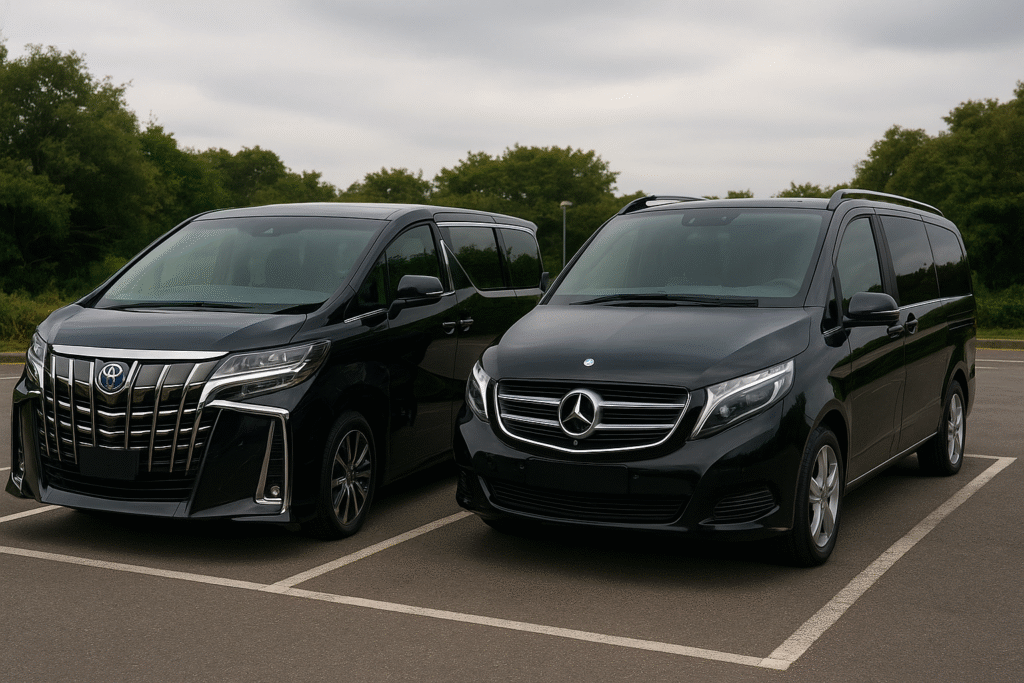
Choosing between the Toyota Vellfire and Mercedes-Benz V-Class is no small decision. Both luxury MPVs promise comfort, space, and prestige, but they take different approaches to delivering these qualities. If you’re shopping for a premium people mover in India, understanding the strengths and trade-offs of each model will help you make the right choice. The 2025 Toyota Vellfire starts at Rs. 1.20 crore and tops out at Rs. 1.30 crore for the Lounge variant, while the Mercedes-Benz V-Class is expected to be priced around Rs. 1 crore when it returns to the Indian market. This puts both vehicles in the ultra-premium category, competing for buyers who want the best in space and comfort. Let’s break down how these two luxury MPVs stack up. Design and Dimensions: Size Matters When it comes to exterior design, the Toyota Vellfire vs Mercedes-Benz V-Class comparison reveals distinct personalities. The Vellfire features an aggressive styling theme with sharp, pointed LED taillights and bold design language that creates a strong road presence. Built on the TNGA-K platform, it gets a large grille with chrome detailing, swept-back LED headlamps, side steppers, and sliding doors. The Japanese MPV measures 4,935mm in length, 1,850mm in width, and 1,895mm in height, with a 3,000mm wheelbase. The Mercedes-Benz V-Class takes a different approach. The 2025 V-Class features a striking new radiator grille and adaptive MULTIBEAM LED headlights that give the vehicle an elegant appearance. The V-Class is 205mm longer, 78mm wider, and gets a 200mm longer wheelbase than the Vellfire, though the Vellfire is 15mm taller. This makes the V-Class the physically larger option, offering more interior space. For buyers visiting Castle Toyota in Jalandhar, the Vellfire’s dimensions make it easier to maneuver in Indian traffic conditions while still providing ample space for passengers. Engine and Performance: Hybrid vs Diesel The powertrain choice is where the Toyota Vellfire vs Mercedes-Benz V-Class debate gets interesting. Toyota Vellfire Powertrain The Vellfire is powered by a 2.5-litre strong hybrid engine that produces 190bhp and 240Nm of torque, paired with an e-CVT unit. This hybrid system delivers an ARAI-claimed mileage of 19.28 kmpl, which is remarkable for a vehicle of this size. The hybrid setup allows brief pure EV mode driving with gentle throttle inputs, and the system operates quietly, making it perfect for chauffeur-driven applications. The hybrid powertrain is a refined and silent unit, which boosts comfort levels for owners who prefer being driven. Real-world fuel efficiency typically ranges from 14-16 km/l depending on driving conditions and traffic. Mercedes-Benz V-Class Powertrain The V-Class comes with a 2.0-litre four-cylinder diesel engine that makes 163bhp and 380Nm of torque in the 220d format, with higher variants offering 239bhp and 500Nm. The diesel mill is paired with a 9-speed automatic transmission and sends power to the front wheels. While the diesel engine provides strong low-end torque that’s helpful for highway cruising and carrying heavy loads, it doesn’t match the refinement and fuel efficiency of the Vellfire’s hybrid system. The V-Class also lacks the environmental benefits and whisper-quiet operation that hybrid technology provides. Interior Comfort and Features Both luxury MPVs excel in creating premium cabin experiences, but they take different approaches to achieving this goal. Toyota Vellfire Interior The Vellfire’s cabin is finished in a tan brown shade with subtle wooden highlights on the doors and dashboard, though buyers can also choose Neutral Beige or all-black themes. The Vellfire offers 16-colour roof ambient illumination, VIP spotlight with welcome function, sunblinds in second and third rows, rear ceiling screen with HDMI and WiFi, and a 17-speaker JBL system. The middle row captain seats with Ottoman features provide excellent cushioning and support with generous legroom. Features include power-adjustable front and rear seats, three-zone climate control, dual sunroof, rear-seat entertainment unit, memory seats, ventilated seats, and ambient illumination. The Vellfire’s second-row experience embodies Toyota’s “Omotenashi” hospitality philosophy, making passengers feel truly pampered. At Castle Toyota, customers often cite the middle-row comfort as a deciding factor when choosing the Vellfire. Mercedes-Benz V-Class Interior The V-Class gets a spacious six-seater cabin with a minimalist all-black dashboard, ventilated front seats, 64-color ambient lighting, dual electric sunroofs, and a dual 12.3-inch screen setup. The second row seats are power-adjustable and can be reclined up to 49 degrees, with ventilation and massage functions. The V-Class offers flexibility with both six and seven-seating configurations. Higher trims can be equipped with a central table where passengers in the second and third rows face each other, creating a conference-room-like setup that appeals to business users. The Burmester premium 15-speaker audio system is available as an optional extra, adding to the luxury quotient. Want to know what safety features the Toyota New Camry Hybrid offers? Read this blog to uncover all the top safety features you’ll get! Safety and Technology Modern luxury MPVs need to deliver on safety just as much as comfort. Toyota Vellfire Safety The Vellfire includes six airbags, a 360-degree camera, hill-assist control, and ADAS features like lane keep assist, adaptive cruise control, blind spot monitor, and high beam assist. Additional safety features include seven airbags, ABS with EBD, ESC, hill hold and descent control, TPMS, all-wheel disc brakes, ISOFIX, front and rear parking sensors with cameras, E-Call and SOS Switch, and driver drowsiness detection. Mercedes-Benz V-Class Safety The V-Class safety features include Anti-Lock Braking System, parking sensors, child safety locks, driver and passenger airbags, side airbags, curtain airbags, rear seat belts, seat belt warning, brake assist, crash sensor, 360 camera, hill-start assist control, park assist, blind spot monitor, and speed sensing door locks. Systems such as Pre-Safe, Active Parking Assist, and Attention Assist give the V-Class a higher edge in advanced driver assistance. Both vehicles offer comprehensive safety packages, though the V-Class edges ahead with more advanced driver assistance systems. Price and Value Proposition Here’s where the Toyota Vellfire vs Mercedes-Benz V-Class comparison gets really interesting. The Vellfire is priced between Rs. 1.20 crore and Rs. 1.30 crore (ex-showroom), making it one of the most expensive Toyotas you can buy in India. The Mercedes-Benz V-Class