
Genuine Toyota Parts vs Third-Party Parts: Why It Matters
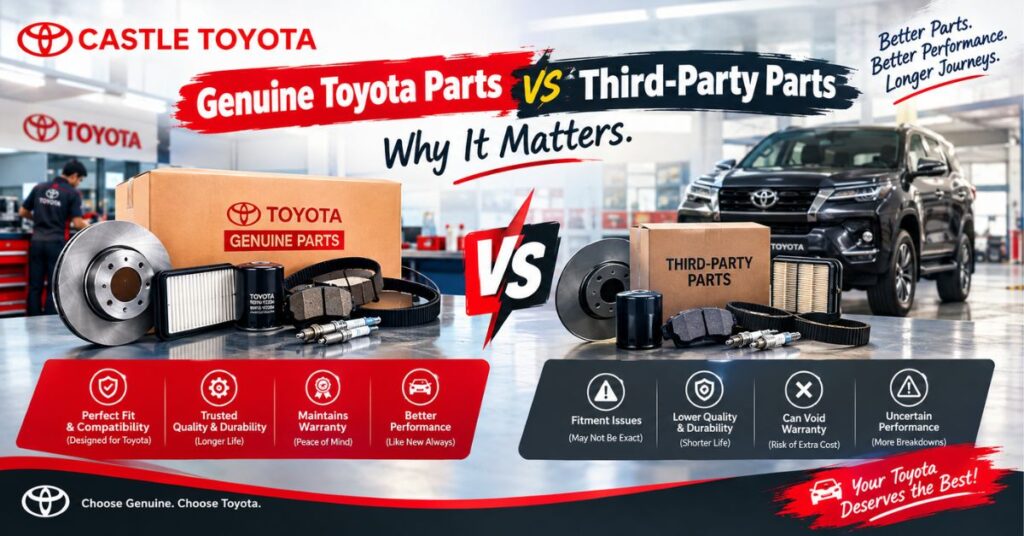
All cars will eventually need replacement parts. Oil filters, brake parts, belts, suspension parts, body parts, and many other parts wear out or get damaged over time. Then, Toyota owners usually have a choice to make: buy a Toyota Genuine Part or a part made by another manufacturer. Especially when the car is older, the price difference can make a third-party component tempting. But the purchase price is only part of the story. The real cost of a replacement can be affected by fit, material qucastality, expected life, warranty, installation, vehicle safety, and compatibility. A fair comparison of genuine Toyota parts vs third-party parts should also differentiate between reputable aftermarket parts and counterfeit parts. That’s not the same thing. A legitimate aftermarket company can manufacture and sell a part under its own name. A fake part is a copy of branding or packaging and may be sold as if it were an original Toyota part when it is not. For many years, Toyota has been warning Indian car owners about counterfeit automotive parts. Fake parts may lead to vehicle faults, poorer performance, higher fuel consumption, sudden breakdowns, and road-safety concerns, Toyota says. So as a Toyota owner, this is what you need to know before you decide on replacement parts. Genuine Toyota Parts vs Third-Party Parts: Quick Comparison If you want a quick answer, this comparison will help: Factor Toyota Genuine Parts Third-Party Parts Vehicle fit Made for applicable Toyota vehicles Depends on manufacturer and product Toyota-backed parts warranty Toyota states 6 months or 10,000 km for genuine service parts. Depends on seller or manufacturer Testing Toyota states its genuine parts undergo testing under simulated conditions. Testing differs between manufacturers. Purchase source Toyota dealers and authorised distribution routes Parts shops, garages, online sellers, manufacturers Price May cost more for some components Can be lower, similar, or higher Compatibility check Part identification can be matched through Toyota channels. Requires careful verification Counterfeit risk Lower when bought through authorised Toyota channels Depends heavily on source Suitable choice Owners seeking manufacturer-specified replacement parts May suit some applications when the part comes from a known maker and fits the exact vehicle Toyota says its genuine parts are designed and engineered for Toyota vehicles and are backed by a six-month or 10,000 km warranty subject to Toyota’s applicable terms. Toyota also says these parts are tested for quality, durability and reliability under simulated conditions. That doesn’t mean that every non-Toyota-branded part will fail. Therefore, buyers should look at the manufacturer, specification, warranty, seller and fit rather than just the price of a component. What Are Toyota Genuine Parts? Toyota Genuine Parts are replacement parts offered through Toyota’s authorised parts network for use in qualifying Toyota vehicles. “The genuine parts we have involve standard design, material choice and internal construction,” Toyota says. Its service information also says these parts are simulated-tested before sale. Toyota Genuine Parts can be parts fitted during repairs or items used during routine servicing. This may include, depending on the vehicle: Owners should still verify the exact part number. Different Toyota models may use different parts, and the same model may have part differences depending on the engine, build date, grade, or gearbox. Buying an original part does not mean all Toyotas have the same part. What Are Third-Party or Aftermarket Parts? Third-party parts are parts made by companies other than Toyota and sold for use in Toyota vehicles. Quality is all over the place. Some manufacturers make quality replacement parts and actually list the vehicles and specs their parts will fit. Other products may have questionable origins, questionable testing, poor warranty support, or poor fit. So the word “aftermarket” itself tells you nothing about quality. Before you buy one, check out: If a workshop recommends a certain component, don’t accept a vague statement that it is “just as good”. Ask why. Third-Party Parts and Counterfeit Parts Are Not the Same That distinction is important. Also, a 3rd-party component could have the branding of its manufacturer. A counterfeit part might try to look like a genuine Toyota part. The Japanese automaker launched a “No to Counterfeit” education campaign in India to warn motorists against fake automotive components. Toyota says counterfeit products can look similar to genuine ones but do not meet the standards used for Toyota Genuine Parts. Counterfeit packaging can be difficult for the average buyer to visually detect. A safer way to buy is to buy from a traceable seller, ask for an invoice, verify the correct part number, and keep the purchase records. Toyota says genuine parts are sold through Toyota dealerships in India and recognised parts distribution channels. 1. Correct Fit Can Affect More Than Installation Time A replacement part must match the vehicle it was made for. Even minor differences in shape, dimensions, connectors, mounting points, material thickness, or operating specification can be significant. A part that physically fits doesn’t always mean it matches the intended specification. Pick up an oil filter. It can seem like the right thread size, but the internal filter makeup and pressure characteristics also play a role. This also affects electrical sensors, brake components, lamps, suspension parts, and many other systems. Toyota’s genuine service parts are designed for Toyota vehicles. When buying replacement parts, be sure to provide the requested information to the seller. Some workshops may ask for the VIN, model, model year, engine, gearbox, or grade of the item so that they can help identify the correct part. Don’t pick a part just because some online title says “fits Toyota”. 2. Material and Manufacturing Quality Can Affect Service Life Sometimes two parts that look almost identical on the outside can be made of different materials on the inside. The rubber compounds, filter media, friction material, metal grades, electrical components, surface coatings, seals, and manufacturing tolerances may differ. Those distinctions might matter: Toyota claims its genuine parts are tested to mimic extreme conditions. For a non-Toyota part, look for a named manufacturer and good technical information. Don’t pick by looks.
Toyota Fortuner vs Ford Endeavour (or MG Gloster): SUV Comparison 2026
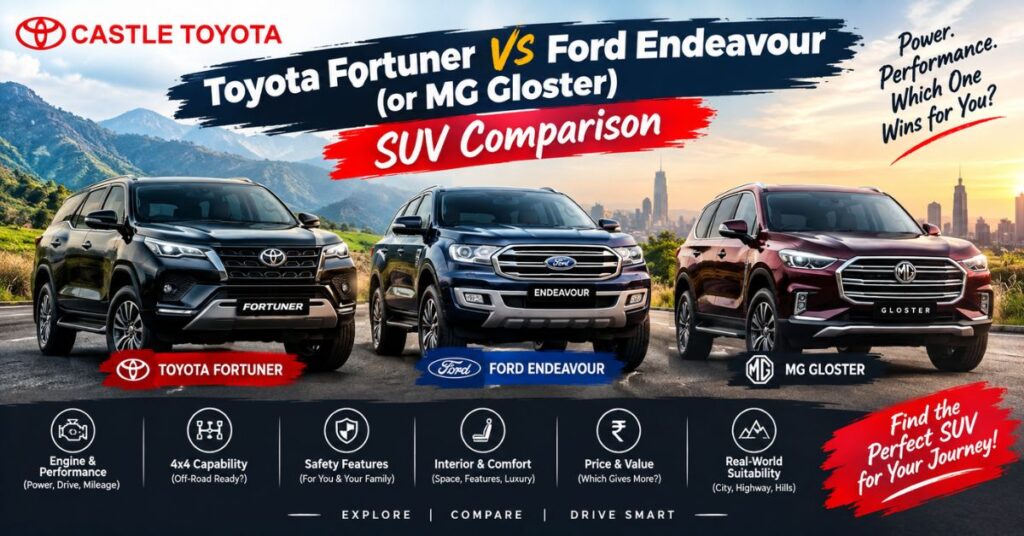
Choosing a big SUV is more than just comparing engine power or counting screens. You also need to think about who is coming with you, where you park, how often you leave paved roads, and how much uncertainty your budget can take. That’s crucial when you compare the Fortuner, Endeavour and Gloster in 2026. A showroom vehicle and a used SUV with several years of service history need different checks for the buyer. This Castle Toyota guide covers manufacturer specs, ownership questions, and family needs. It doesn’t offer a back-to-back road test, nor does it assume that one badge fits all buyers. Are All Three SUVs Available New in India in 2026? Don’t think of this as a direct comparison of three new 2026 vehicles. Ford said in September 2021 it would stop making cars for sale in the U.S. Its current Indian website is service, parts, and owner support focused. The official Indian pages checked for this story did not verify a new Endeavour retail launch. The comparison uses the India-specification 2.0-litre version from Ford’s 2020 brochure, tested as a used buy. The MG situation also needs attention. The former Gloster product URL now redirects to the Majestor that MG unveiled in May 2026. Check any Gloster offer as a private seller used car or possible remaining dealer stock. A live advertisement alone does not confirm a newly manufactured auto. The Fortuner continues to be available through Toyota’s sales network in India. So know the overview of the Fortuner model first and then ask for the current details for the exact version you are considering. How to Choose Between These SUVs Here’s a three-step comparison before you check out the discounts: A clean inspection and an affordable payment plan are more important than winning a specifications argument. Price Comparison: Use Matching Vehicles and Written Quotes The Toyota Fortuner is listed online with a starting reference of ₹34.76 lakh, ex-showroom. The current page for MG’s Majestor has a starting price tag of ₹43.49 Lakh. These headline numbers exclude equivalent variants or Punjab on-road quotes. Get quotes related to the real vehicle for the Endeavour and Gloster. Please be aware of the year of registration, mileage, number of owners, repair history, etc. Don’t take an old launch price as today’s used-car value. Castle Toyota lists the Toyota Legend range separately from the normal Fortuner. Compare two offers for the same version. Ask sellers to itemise the cost of the vehicle, registration fees, insurance, accessories and service packages. Toyota itself recommends that buyers contact their dealer for the latest prices and details before placing an order. Toyota Fortuner vs Ford Endeavour: Engines and Gearboxes Below is a comparison of Indian published specifications. It doesn’t mean that every car you see here is still available. Specification Fortuner 2.8 diesel automatic Endeavour 2.0 diesel, 2020 India model Gloster 2.0 twin-turbo diesel Engine size 2,755 cc 1,996 cc 1,996 cc Maximum power 204 PS 170 PS 215.5 PS Maximum torque 500 Nm 420 Nm 478.5 Nm Transmission Six-speed automatic Ten-speed automatic Eight-speed automatic Length 4,795 mm 4,903 mm 4,985 mm Width 1,855 mm 1,869 mm 1,926 mm Wheelbase 2,745 mm 2,850 mm 2,950 mm Figures from Toyota, Ford and MG brochures. The Gloster column is for the twin-turbo version, not the single-turbo version with lower output. PS = hp of the engine; Nm = torque The highest quoted power here is of the Gloster, while the highest quoted torque is of the Fortuner automatic. Neither figure tells you which SUV is faster off the queue with your passengers and luggage. Assessment includes gear ratios, weight, response, and condition. On a road test, check gentle acceleration, passing response at legal speeds and gearbox behaviour once the vehicle has warmed up. For a used automatic, have a technician check for hesitation, harsh shifts or unusual noises. Older versions of Endeavour require a separate specification check. Don’t use this 2.0-litre comparison and apply it to every used Ford you see, nor use the specs of the overseas Everest instead of the one you’re being offered in India. What About the Fortuner’s 48V Versions? Toyota launched the Fortuner and the Legender in 48V-assisted variants in June 2025. The system utilises the diesel engine with a starter-generator and a lithium-ion battery. The grades also received a 360-degree camera and wireless charging. Do not assume that every Fortuner is equipped with this. Don’t compare an older car to a newer one with a list of features and not address the differences. Ask what features are included in the quoted trim. Cabin Comfort, Third-Row Space, and Daily Parking Fortuner: Check the Seats and Luggage Layout The specification sheet of Toyota has seven seats, ventilated front seats, and third-row seats that fold to the sides. No panoramic sunroof is listed. Don’t judge the practicality of the empty cabin; fill it up with your usual luggage. Older passengers should be asked to rate entrance, exit, and second-row comfort. Cruise the back seats over your normal local route, not just when the vehicle sits outside the showroom. Endeavour: Check Which Features the Used Car Has Ford’s 2020 brochure boasts a panoramic sunroof, power folding third-row and an electrically adjustable front passenger seat on Titanium+ versions. The lower titanium trim does not get that equipment list. Before you settle on a used-car price, try every seat motor, window, roof function, and air-conditioning setting. Don’t promise to repair bad equipment later; put it in the repair estimate. Gloster: Consider the Seating Arrangement MG’s brochure lists six- and seven-seat layouts, three-zone air conditioning and a panoramic sunroof. And it’s also bigger than the other two vehicles we’re comparing here. And that makes it worth a look for a passenger room. But outside dimensions don’t always mean third-row comfort. Sit in each row with the front seats in their normal position. Test out whether a six-seat configuration is really right for your family. For all three, measure your parking entrance, and leave room for open doors. And if
New vs Used Toyota: What’s the Better Deal in Punjab Right Now?
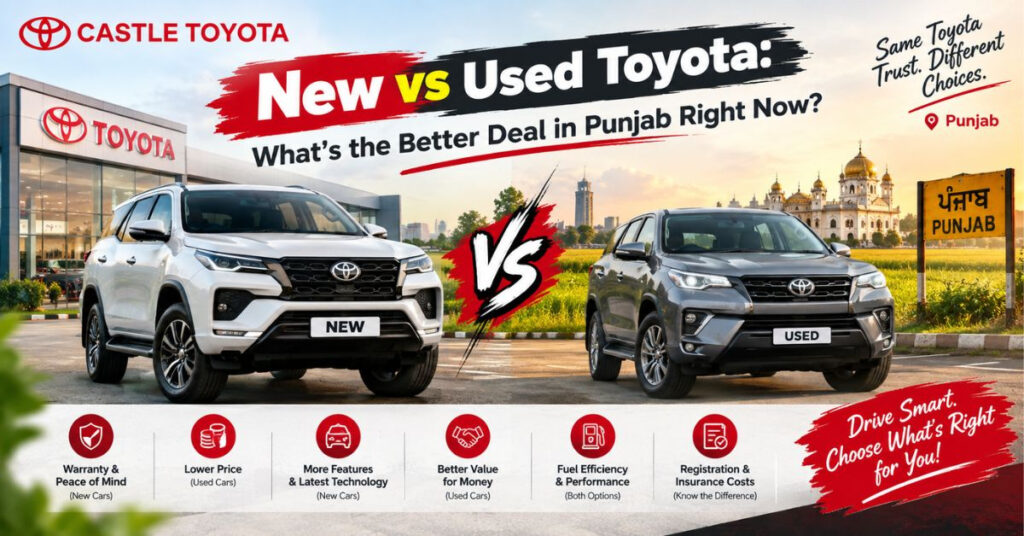
Sometimes a lower asking price doesn’t mean a cheaper car to own. A used car might save you money today, but repairs and borrowing costs can eat away at those savings. A new car may cost more upfront, but it does come with a more complete maintenance history and a new warranty. If you are comparing Toyota cars in Punjab, the right car for you will depend on the specific model and not just the badge. This Castle Toyota guide balances current price references, finance, paperwork, and ownership costs, without assuming either option always wins. New vs Used Toyota: Which Makes More Financial Sense? Choose new if the price difference is small and you want fresh warranty cover. Select ‘used’ if inspection, service records, and written cost estimates show a substantial saving. Don’t just compare the showroom prices or monthly instalments; compare like-for-like variants and overall ownership costs. Begin with what you truly need. How many people go on trips often? How long are you going to keep the car? Can your household afford a surprise repair? Those answers are more important than the last registration year your budget can afford. What Current Toyota Prices Tell Punjab Buyers Toyota’s Glanza configurator lists the E manual at Rs 6.73 lakh, ex-showroom. This is to be taken as an initial reference and not a Punjab on-road quote. Toyota also advises buyers to check current prices and variant details with their dealer. This review shows the extent to which used-car asking prices can fluctuate from the public Toyota U Trust listings: Advertised vehicle Location Listed distance Asking price 2022 Glanza V manual Mohali 46,977 km ₹5.00 lakh 2025 Glanza V AMT Ludhiana 3,087 km ₹7.68 lakh 2023 Innova Hycross Hybrid ZX Mohali 30,742 km ₹25.00 lakh These are individual advertised listings, not average Punjab prices, confirmed sale prices, or guarantees of availability. AMT = automated manual gearbox That’s why the detail matters. A used Glanza V AMT and a new entry-level Glanza don’t get matched equipment or transmissions. It would be the wrong question to look at their headline prices. Request a new-car quote that is as close as possible to the used car. Then, compare its registration date, equipment, warranty balance, condition, and payment terms. Don’t assume the ad includes all charges – ask the used seller the total amount payable as well. Compare Punjab On-Road Costs, Not Just Asking Prices If you are buying a new vehicle, break down the vehicle price, registration, road tax, insurance, finance charges, and any optional extras. The requirements for new registration include insurance, a dealer invoice, registration documents, and applicable one-time road tax, according to the Transport Department of Punjab. Ask the seller to clearly mark optional accessories and service packages. Ask for an insurance quote that shows cover, deductibles, and add-ons separately. This helps compare two offers more easily, without treating different packages as equal. Check the registration certificate, insurance, ownership transfer requirements, and any finance recorded against a secondhand vehicle. Parivahan’s guidance lists Form 29 as the seller’s transfer report and Form 30 as the buyer’s application. It also differentiates between same-state and out-of-state transfers. If a good car is advertised outside Punjab, you need your own paperwork estimate. Before you agree to buy, check with the registering authority that any necessary no-objection certificate, registration changes, and any applicable taxes are in place. Never assume the price charged in another state is final. Car Loan Rates Can Change the Answer SBI’s rate page, last updated 16 September 2026, shows that new-car loans are between 8.40% and 9.35% a year. Certified pre-owned car loan rates are between 10.45% and 15.60%. The bank links the appropriate rates to the credit ratings of the borrowers. These are ranges published by one lender, not a guaranteed personal offer. You borrow less, so even a used car can be cheaper in the end. But a higher rate eats away at its advantage. Compare the down payment, loan tenor, interest to be paid, processing charges & early repayment terms. Request from each lender a full repayment schedule. A lower monthly installment does not translate into a lower cost of loan when one agreement is for a longer tenure. What Warranty Do You Get With Each Option? Toyota offers three years or 100,000 km of new-vehicle cover, whichever is sooner. It also says that the remaining portion passes to the next owner. Buying used doesn’t reset that clock. Toyota includes the high-voltage battery cover for eligible privately used hybrid vehicles of 8 years or 160,000 km, whichever occurs first. Commercial use conditions are different. Confirm the vehicle’s actual original date of sale, mileage, applicable terms, and service records. Don’t confuse a warranty with free service. Toyota does not cover filters and brake pads under the standard warranty, as these are normal wear and tear items. Toyota U Trust provides a 203-point inspection process and warranty support for certified vehicles. Don’t assume all used listings are equally protected; ask for the specific car’s certificate and written warranty terms. A Five-Year Ownership Cost Comparison Let’s take an example to make things clear. The figures below are fictional planning assumptions and are not quotes, repair estimates, or resale predictions for a Toyota. Assuming you keep each car for 5 years and drive the same distance. Price includes the first year of insurance and initial paperwork. Later insurance is shown separately. Five-year cost item New car Used car Purchase and initial costs ₹12.00 lakh ₹9.00 lakh Loan interest and charges ₹1.60 lakh ₹1.50 lakh Fuel ₹3.00 lakh ₹3.00 lakh Servicing, repairs, and worn items ₹0.90 lakh ₹1.50 lakh Insurance after the first year ₹0.60 lakh ₹0.50 lakh Less assumed resale proceeds −₹6.00 lakh −₹4.20 lakh Net ownership cost ₹12.10 lakh ₹11.30 lakh In this illustration, the pre-owned car costs ₹3 lakh less at purchase but only ₹80,000 over five years. An extra repair bill or a lower resale price might nullify any remaining advantage. It would increase with cheaper borrowing or better conditions.
Best Toyota Cars for Long-Distance Driving in India: Comfort, Mileage and Performance Compared
Planning a long road trip changes the way you look at a car. City comfort and highway comfort are not the same thing, and a car that feels fine on a 20-minute commute can feel tiring after five hours on the same seat. This is where the right pick matters. Toyota cars for long-distance driving in India come up again and again in road-trip forums and owner reviews, and there is a clear reason for that. Toyota builds its cars around ride quality, cabin space, and long-term reliability, three things that matter more on a highway stretch than a spec sheet ever will. In this post, we will look at five Toyota models that Indian drivers actually take on long trips: the Innova Hycross, Innova Crysta, Fortuner and Legender, Camry, and Urban Cruiser Hyryder. We will compare their mileage, seating comfort, boot space, and highway manners so you can match the right car to your own driving needs. Why Toyota Cars for Long-Distance Driving in India Work So Well Here is why Toyota keeps showing up on long-drive shortlists across India: Let’s break it down model by model. Toyota Innova Hycross: The Highway-Ready Family MPV The Innova Hycross is the newer sibling of the Crysta, and it was built with families and long drives in mind. It comes with two petrol engine options: a strong-hybrid 2.0-litre unit that makes 184 bhp and 188 Nm, and a non-hybrid 2.0-litre petrol that makes 172 bhp and 209 Nm for buyers who want a simpler, lower-cost setup. Mileage and running cost The hybrid variant carries an ARAI-certified figure of 23.24 km/l, and owners report real-world numbers in the 18 to 20 km/l range on mixed routes. That is a strong number for a car this size, and it means fewer fuel stops between cities. Comfort and cabin space The Hycross measures 4755 mm in length with a 2850 mm wheelbase, which gives the second and third rows real legroom. Ground clearance sits at 185 mm, so speed bumps and rough patches do not knock the underbody around. Boot space is 300 litres with all seats up, and it grows to 991 litres once the third row folds flat, which works well for a family with luggage. The fuel tank holds around 52 litres, so a single fill can cover a long day’s drive. Higher variants add Toyota Safety Sense, which brings adaptive cruise control, lane-keep assist, and pre-collision warning, features that lower driver fatigue on long highway runs. Toyota Innova Crysta: The Old-School Road-Trip Workhorse The Innova Crysta has been a road-trip staple in India for close to a decade, and plenty of taxi fleets and families still swear by it. It runs a 2.4-litre diesel engine paired with either a manual or automatic gearbox. The ARAI-claimed mileage sits at around 16 km/l, with real-world figures usually landing between 9 and 13 km/l depending on load and driving style. The diesel engine gives it strong pulling power on inclines and while carrying a full load, which is why it stays popular for hill routes and long family trips. The cabin has a low floor, wide middle row, and a suspension that absorbs rough patches calmly, so long drives feel relaxed rather than tiring. Fuel tank capacity is 55 litres, which keeps range comfortable between stops. Toyota Fortuner and Legender: Built for Power on Long Highway Runs If your road trips mix highway stretches with rough terrain, the Fortuner and its sportier Legender trim are worth a look. Both run a 2.8-litre turbo diesel engine that makes 201 bhp and 500 Nm, paired with a six-speed automatic and paddle shifters on the Legender. ARAI mileage for the diesel automatic comes in at 14.2 to 14.4 km/l, and the fuel tank holds 80 litres, so you can cover close to 1,000 km before you need to refuel. Ground clearance stands at 225 mm, which is the highest of any car on this list, and boot space comes in at 296 litres. This is the pick for anyone who wants a commanding driving position and confidence over uneven roads on long inter-state drives. Toyota Camry Hybrid: Comfort-First Choice for Highway Cruising The Camry sits in a different category. It is not built for rough roads, but it is one of the smoothest highway cruisers Toyota sells in India. The 2025 model runs a 2.5-litre hybrid engine that produces 230 PS and 221 Nm through an e-CVT gearbox. Fuel use is where the Camry stands out. ARAI rates it at 25.49 km/l, and owners report 21 to 22 km/l in real-world mixed driving, numbers that beat most SUVs and MPVs in this price bracket. The 50-litre tank and quiet hybrid running make it a natural fit for chauffeur-driven trips or long highway runs where cabin refinement matters more than ground clearance. Rear-seat passengers get reclining seats and generous legroom, and the car comes with nine airbags along with a full ADAS suite for added confidence at highway speeds. Toyota Urban Cruiser Hyryder: Best Mileage Pick for Long Drives For drivers who want SUV looks with hatchback-like running costs, the Urban Cruiser Hyryder is worth a serious look. It comes in mild-hybrid, strong-hybrid, and CNG options, giving buyers real choice based on how they plan to use the car. The strong-hybrid automatic variant returns an ARAI figure of up to 27.97 km/l, which makes it the car with the best mileage in this list by a wide margin. The petrol manual variant still manages 21.12 km/l, and the CNG version delivers 26.6 km/kg for buyers focused purely on running cost. Ground clearance comes in at 210 mm, and boot space runs from 373 litres on the mild-hybrid variant to 265 litres on the strong-hybrid variant, since the battery pack sits under the boot floor. Owners note that the hybrid drivetrain stays quiet and stable on highways, and one common piece of feedback is that it feels highly comfortable for long drives despite its compact SUV size. Quick
Toyota Safety Features Explained: ADAS, Airbags, ABS and Driver Assistance Technologies
Buying a car is not just about mileage and looks. Safety is the part that only matters until the day it matters a lot, and by then it is too late to wish you had checked the spec sheet more carefully. This guide has Toyota Safety Features Explained in plain terms, covering airbags, ABS, ADAS, and the other driver assistance systems fitted across the Toyota lineup sold in India. By the end, you will know exactly what these terms mean and which Toyota models carry which safety kit. Why Safety Features Deserve More Attention Than They Get Most buyers spend hours comparing mileage figures and engine numbers, then glance at the safety section for a few seconds. That is backwards. Here is why it matters: Let’s break it down system by system, starting with the basics. What Is ABS with EBD, and Why Every Toyota Gets It ABS, or Anti-lock Braking System, stops your wheels from locking up when you brake hard. Without ABS, a locked wheel skids in a straight line no matter which way you turn the steering wheel, and you lose control of the car exactly when you need it most. EBD, or Electronic Brakeforce Distribution, works with ABS to send the right amount of braking force to each wheel based on load and road grip. A fully loaded Innova Crysta heading downhill needs different brake force at the rear than an empty hatchback, and EBD handles that automatically. Every Toyota model sold in India today comes with ABS and EBD as standard fitment, across all trims, not just the top ones. This is not a premium add-on. It is the baseline Toyota builds every car around. Airbags: How Many Does Your Toyota Actually Need Airbags cushion occupants during a collision by deploying instantly and absorbing impact force before it reaches the body. The number and placement of airbags change how much protection you get in different types of crashes. Here is how airbag counts stack up across popular Toyota models in India: More airbags help, but they work best alongside a strong body structure. Toyota builds several of its India models on the TNGA platform, which the brand designs for crash energy absorption and cabin rigidity, so the airbags and the structure work as one system rather than in isolation. ADAS Explained: What Toyota Safety Sense Actually Does ADAS stands for Advanced Driver Assistance Systems, a group of technologies that use cameras and radar to watch the road and step in before a crash happens. Toyota packages its ADAS features under the name Toyota Safety Sense, or TSS. The main features inside Toyota Safety Sense Here is a numbered walkthrough of what each TSS feature actually does on the road: The Innova Hycross carries the fuller version of this suite, with Toyota confirming that its ADAS setup includes Pre-Collision System, Lane Trace Assist, Dynamic Radar Cruise Control, Blind Spot Monitor and Automatic High Beam across higher variants. The Camry adds a similar suite, including a forward collision avoidance function with pedestrian detection, adaptive and standard cruise control, lane-keep assist, a road-sign read-out and an automatic high beam function, tested and confirmed to work well on Indian highway conditions. Electronic Stability Control, Hill Assist, and Other Backup Systems ADAS handles what happens up front on the road, but a separate set of systems manages how the car itself behaves during sudden moves. Electronic Stability Control (ESC or VSC): Detects when the car is about to skid sideways during a sharp turn or sudden lane change, and reduces engine power or brakes individual wheels to bring the car back in line. This is standard across the Fortuner, Innova Hycross, and Camry. Hill-Start Assist Control (HAC): Holds the brakes for a couple of seconds when you lift off the brake pedal on an incline, so the car does not roll backward while you switch to the accelerator. This is a genuine convenience feature on hill routes and multi-storey parking ramps. Traction Control (TRC): Limits wheel spin on wet, sandy, or loose surfaces by managing power delivery to whichever wheel has the most grip. Tyre Pressure Monitoring System (TPMS): Alerts you the moment tyre pressure drops below the safe range, catching slow punctures before they turn into a blowout on the highway. Toyota bundles several of these under what it calls the Star Safety System in some markets, and while the branding varies by model, the underlying features show up consistently across the Indian lineup. How Toyota Models Perform in Crash Tests Feature lists only tell part of the story. Independent crash testing tells you how the car actually behaves in a real impact. The Innova Hycross scored a full 5-star rating under Bharat NCAP, earning 30.47 out of 32 points for adult occupant protection and 45 out of 49 points for child occupant safety, with a perfect 16 out of 16 in the side impact test. The rating applies across all variants, including both the 7-seater and 8-seater layouts, which means Toyota did not hold back safety kit for the base trims. The Fortuner carries a 5-star rating from ASEAN NCAP for adult occupant protection, child occupant protection, and pedestrian protection, backed by seven airbags, ABS with EBD, and Vehicle Stability Control as standard fitment. The Camry Hybrid has not undergone a separate Bharat NCAP test as of this writing, but its safety architecture, nine airbags, a 360-degree camera, and ISOFIX child seat mounts, along with a full Toyota Safety Sense suite, place it well ahead of most sedans in its price bracket on paper. Quick Reference: Safety Features Across Toyota’s India Lineup Model Airbags ADAS (TSS) ESC Crash Rating Innova Hycross 6 Yes (higher grades) Yes 5-star, Bharat NCAP Fortuner / Legender 7 Not standard Yes 5-star, ASEAN NCAP Camry Hybrid 9 Yes Yes Not separately tested in India Urban Cruiser Hyryder 6 No Yes Not separately tested in India Innova Crysta 6 No Yes Not separately tested in India Feature availability can differ by variant. Confirm
Toyota Fortuner Tyre Size and Cost for All Variants in 2026

The Toyota Fortuner has held its ground as one of the most respected ladder-frame SUVs in India for over a decade. People who buy one know what they are getting: a serious, body-on-frame machine that weighs over two tonnes and handles everything from Himalayan switchbacks to Mumbai expressways without complaint. But when it comes to tyres, most Fortuner owners are surprised to learn that the SUV does not run a single tyre setup across the lineup. The 2WD and 4WD variants wear different sizes, and that difference matters for ride quality, handling, and what you will spend when it is time for a replacement. This guide covers the Toyota Fortuner tyre size and cost for all variants in 2026, including the standard Fortuner, Legender, and GR Sport. Whether you are buying fresh rubber or just trying to understand what is already on your car, here is everything you need to know. Toyota Fortuner Tyre Size for All Variants in 2026 Here is a quick reference table for the Toyota Fortuner tyre size variant-wise: Variant Drive Type Tyre Size Wheel Size Fortuner 2.7 Petrol AT 4×2 (2WD) 265/65 R17 17-inch alloy Fortuner 2.8 Diesel MT 4×2 (2WD) 265/65 R17 17-inch alloy Fortuner 2.8 Diesel AT 4×2 (2WD) 265/65 R17 17-inch alloy Fortuner 2.8 Diesel MT 4×4 (4WD) 265/60 R18 18-inch alloy Fortuner 2.8 Diesel AT 4×4 (4WD) 265/60 R18 18-inch alloy Fortuner Legender 2.8 AT 4×2 (2WD) 265/60 R18 18-inch alloy Fortuner Legender 2.8 AT 4×4 (4WD) 265/60 R18 18-inch alloy Fortuner GR Sport AT 4×4 (4WD) 265/60 R18 18-inch alloy The split is clean: all 2WD base variants use 265/65 R17, and all 4WD, Legender, and GR Sport variants use 265/60 R18. One number stays the same across every single variant the 265mm width. Toyota kept that consistent, and for good reason. On a vehicle this heavy, 265mm gives the footprint needed to stay stable on wet roads and soft ground. What changes between the two sizes is the sidewall height and the rim diameter. Let’s break it down. Understanding the Fortuner Tyre Size Numbers If you have ever looked at a tyre sidewall and wondered what those numbers mean, here is the short version: 265/65 R17 (Standard 4×2 Variants) 265/60 R18 (4×4, Legender, and GR Sport) The practical difference? The 17-inch setup on 4×2 variants gives a noticeably softer ride because there are more rubber absorbing bumps before they reach the chassis. The 18-inch setup on 4WD and Legendre variants is sharper-looking and handles better at highway speeds, but transmits more road surface into the cabin on broken city roads. Toyota Fortuner Tyre Price in India (2026) Tyre prices vary depending on the brand, the seller (authorised dealer vs online marketplace), and whether you are buying with installation included. Here is a realistic range for both Fortuner tyre sizes in 2026: For 265/65 R17 (4×2 Variants) Brand Approximate Price per Tyre MRF ₹10,500 – ₹12,500 CEAT ₹10,000 – ₹13,000 JK Tyre ₹10,000 – ₹12,000 Apollo ₹11,000 – ₹13,500 Bridgestone ₹13,000 – ₹17,000 Michelin ₹15,000 – ₹20,000 Yokohama ₹13,500 – ₹18,000 For 265/60 R18 (4×4, Legender, GR Sport) Brand Approximate Price per Tyre MRF ₹12,000 – ₹15,000 CEAT ₹12,500 – ₹16,000 Apollo ₹12,000 – ₹15,500 Bridgestone ₹16,000 – ₹20,000 Michelin ₹18,000 – ₹23,000 Yokohama ₹15,000 – ₹20,000 Vredestein Up to ₹23,800 So if you are replacing all four tyres on a Fortuner Legender, budget anywhere from ₹50,000 to ₹90,000+ depending on the brand you choose. Budget brands cover the basics. If you do regular highway runs or cover mountainous terrain, brands like Michelin, Yokohama, or Bridgestone are worth the premium for braking performance and noise levels. Teams at Castle Toyota in Jalandhar can guide you on OEM-approved replacements that suit how you actually use the vehicle city driving, highway touring, or occasional off-road runs. What Tyre Pressure Should a Fortuner Run? This is where a lot of owners get it wrong. Tyre pressure is not a set-and-forget thing; it depends on how loaded the vehicle is and what kind of driving you are doing. Toyota’s recommended Fortuner tyre pressure: Always check pressure when the tires are cold, meaning the car has been stationary for at least 3 hours or driven less than 2 km. Once a tyre heats up from driving, the pressure reading goes up. Adjusting a hot tyre to hit 32 PSI actually means the tyre will be underinflated once it cools down. Running low pressure is the silent tyre killer. The tyre flexes more than it should, builds up heat, and wears down the edges faster. On a heavy SUV like the Fortuner, the consequences are not small tyre failure at highway speed is a genuine risk. How Long Do Fortuner Tyres Last? On Indian roads with regular maintenance, Fortuner tyres typically last between 40,000 and 60,000 kilometres. But that range depends heavily on a few things: Replace your tyres when the tread depth drops below 1.6mm, or if you spot sidewall cracking, bulges, or recurring air loss. Even if the tread looks fine, tyres older than 5–6 years should be replaced and rubber degrades regardless of mileage. Choosing the Right Tyre Type for Your Fortuner Not all tyres are the same, even in the correct size. Here’s how to match the tyre type to how you use the car: Highway Terrain (H/T) Tyres Best for owners who mostly drive on paved roads. H/T tyres are quieter, more fuel-efficient, and comfortable on long highway runs. Good options include the Bridgestone Dueler H/T and Michelin LTX Force. All-Terrain (A/T) Tyres The right pick if you take the Fortuner off-road occasionally are forest roads, gravel tracks, river crossings. A/T tyres have a more aggressive tread pattern that handles loose surfaces without giving up too much road comfort. The CEAT CrossDrive AT and Yokohama Geolandar AT G015 are popular choices in this category. Mud Terrain (M/T) Tyres If serious off-roading is your thing, M/T tyres grip in deep mud and sand far better than anything else. They are noisy
Which is expensive, BMW or Toyota Fortuner?

At first glance, the question of BMW vs Toyota Fortuner price sounds simple enough. One is a European luxury brand. The other is a Japanese workhorse. But if you spend even five minutes digging into real numbers, you realise the answer is more layered than just comparing sticker prices. This is not a question about which car is better. It is a question about money: what you pay upfront, what you keep paying every month, and what you get back when it is time to sell. Let’s break it all down. Where Each Brand Sits in India’s Market BMW and Toyota serve entirely different audiences in India. Toyota is a mass-market manufacturer that also builds premium products, and the Fortuner sits near the top of its range. BMW is a dedicated luxury brand with no entry below the premium segment. The Toyota Fortuner is a ladder-frame body-on-frame SUV. Think of it as a Land Cruiser’s more affordable sibling: built for rough roads, long highways, and decades of reliable use. It seats seven and has been a status symbol in smaller cities and towns across India for well over a decade. BMW, by contrast, sells everything from the compact 2 Series Gran Coupe sedan to the full-size X7 SUV and high-performance M models. Its closest SUV competitor to the Fortuner in terms of size and purpose would be the BMW X3 or the BMW X5, both of which are designed more for smooth roads and refined driving than serious off-roading. BMW vs Toyota Fortuner Price Comparison: The Numbers Toyota Fortuner Prices (Ex-Showroom, 2025–26) The Fortuner range in India currently spans 14 variants across petrol and diesel options, with 2WD and 4WD drivetrains. After the GST revision in September 2025, prices dropped meaningfully. Toyota Fortuner Price Range at a Glance: BMW Prices in India (Ex-Showroom, 2025–26) BMW’s range starts at around ₹45.30 lakh for the 2 Series Gran Coupe and stretches all the way to ₹2.55 crore for the XM. The SUVs, which are the most direct comparison point, start at roughly ₹50 lakh for the X1 and go to well over a crore for the X7. BMW SUV Price Range at a Glance: The numbers speak clearly: the cheapest BMW SUV you can buy in India today the X1 at around ₹51 lakh costs more than the top-spec Toyota Fortuner GR-S at ₹48.85 lakh. And when you move to the BMW X3, which is a more natural rival to the Fortuner in terms of size, you are looking at ₹71 lakh nearly double the Fortuner’s starting price. Bottom line on sticker price: BMW is significantly more expensive than the Toyota Fortuner at the point of purchase, across every comparable segment. Breaking Down the Total Cost of Ownership Purchase price is only part of the story. Here is where the real BMW vs Toyota Fortuner price comparison gets interesting. Maintenance and Service Costs Toyota has built its reputation on low running costs. For the Fortuner, the estimated total service cost over the first five years sits at around ₹31,724, covering routine oil changes, filters, coolant replacements, and inspections. That works out to a manageable yearly cost for a large SUV. BMW ownership is a different conversation. Parts are imported or require specialist handling, and labour costs at authorised BMW service centres are considerably higher. Forum data from Team-BHP puts the per-kilometre running cost of a BMW X1 at roughly ₹35/km versus ₹15/km for a Toyota Fortuner — a gap that covers fuel, insurance, maintenance, and depreciation combined. Spare parts availability is another gap. If a Fortuner needs a component, it is almost certainly available at the nearest Toyota dealer or multi-brand garage within a day or two. For a BMW, critical parts may need to be ordered, and turnaround times can stretch across weeks. Insurance Costs The Fortuner’s comprehensive insurance sits in the ₹60,000–₹78,000 per year range, translating to roughly ₹3–3.9 lakh over five years. BMW premiums are proportionally higher given the higher insured declared value (IDV) and costlier parts. A BMW X3 will draw a notably larger insurance bill annually than any Fortuner variant. Fuel Economy The diesel Fortuner returns 14.33–14.4 kmpl (ARAI rated), while the petrol variant manages about 10.3 kmpl. The BMW X3 diesel claims around 17.86 kmpl in its top-spec diesel variant. So the BMW actually does better on fuel — but the savings are quickly eaten up by its higher maintenance and insurance bills. Resale Value: Where the Fortuner Wins Decisively This is one of the most talked-about differences between these two brands in India. The Toyota Fortuner holds its value better than almost any other vehicle in its price range and in many cases, better than BMW models that cost significantly more to buy. Consider a real-world example: a 2018 Fortuner 4X4 with 23,000 km was listed at ₹31 lakh in the used market. A BMW X1 from the same year, with 18,000 km, was listed at ₹24.5 lakh. The Toyota, a cheaper car at purchase fetched a higher price on the second-hand market. This pattern holds consistently. The Fortuner’s resale value after 4–5 years often sits at 65–75% of the original price. BMW models typically depreciate faster, with higher-spec vehicles losing value more steeply simply because the pool of buyers willing to pay for a used luxury German car is smaller in India. For buyers who plan to sell in five to seven years, the Fortuner’s resale strength is a financial advantage that partially offsets its lower initial status appeal. What Are You Actually Paying For? This is worth thinking about clearly. When you pay more for a BMW, here is what you get: When you pay for a Toyota Fortuner, here is what you get: These are genuinely different products answering different questions. The BMW is asking: “How do you want to feel while driving?” The Fortuner is asking: “What do you need the car to do, and for how long?” Head-to-Head: Toyota Fortuner vs BMW X3 Parameter Toyota Fortuner (Top Diesel) BMW
Toyota Vellfire Vs Sienna: How to Choose in 2026

Choosing between two premium Toyota minivans can feel overwhelming when both promise space, comfort, and reliability. The Toyota Vellfire and Toyota Sienna target different buyers with distinct priorities. If you’re weighing these options for your family or business needs, understanding their core differences will help you make the right decision. Both vehicles come from Toyota’s trusted lineup, but they serve different markets and purposes. The Vellfire caters to buyers seeking executive-level luxury and chauffeur-driven comfort, while the Sienna focuses on family practicality with class-leading fuel economy. Castle Toyota helps customers across Jalandhar understand which model fits their lifestyle and budget. Understanding the Toyota Vellfire Vs Sienna Market Positioning The Vellfire and Sienna occupy separate segments despite both being minivans. The Vellfire represents Toyota’s luxury MPV offering, sold primarily in Asian markets including India. Its price starts at approximately Rs 1.20 crore, positioning it as a premium choice for executives and celebrities who prioritize rear-seat comfort. The Sienna, sold mainly in North America, takes a different approach. Starting around $40,120 in the US market, it emphasizes family functionality and everyday usability. The Sienna targets parents who need versatile seating, ample cargo space, and outstanding fuel efficiency for school runs and road trips. When customers visit Castle Toyota, they often ask about the fundamental difference between these models. The answer lies in their design philosophy: the Vellfire delivers first-class airline comfort on wheels, while the Sienna provides practical, efficient family transportation. Engine Performance and Fuel Efficiency Both vehicles use hybrid powertrains, but their specifications differ considerably. The Vellfire features a 2.5-liter four-cylinder petrol-hybrid engine producing 190 horsepower and 240 Nm of torque. This system pairs with an electronically controlled continuously variable transmission (e-CVT) and standard all-wheel drive. The Vellfire achieves an ARAI-certified mileage of 19.28 km/l. While respectable for a luxury MPV, this figure reflects the vehicle’s substantial weight and focus on comfort over efficiency. Real-world mileage typically ranges between 14-16 km/l depending on driving conditions and traffic patterns. The Sienna also uses a 2.5-liter four-cylinder hybrid system, but with slightly higher output at 245 horsepower and 175 pound-feet of torque. The EPA estimates the Sienna achieves 36 mpg city and highway combined with front-wheel drive, or 35 mpg combined with all-wheel drive. This makes the Sienna significantly more fuel-efficient than the Vellfire. For buyers prioritizing fuel costs, the Sienna offers clear advantages. The hybrid system provides electric-only driving for short distances, reducing fuel consumption during city commutes. The Vellfire’s hybrid setup focuses more on smooth, silent operation than maximizing efficiency. Interior Space and Seating Configuration The Vellfire interior focuses on second-row passenger comfort. Available in both four-seat and seven-seat configurations, the Vellfire treats rear passengers like VIPs. The second-row captain’s chairs feature electric adjustment, heating, cooling, massage functions, and powered leg rests. These seats recline extensively and offer more legroom than many luxury sedans. Premium materials cover every surface. Soft-touch leather, real wood trim, and ambient lighting create a first-class atmosphere. The Vellfire measures 4,935 mm in length with a 3,000 mm wheelbase, providing generous space throughout the cabin. The third row remains comfortable for adults on shorter trips. The Sienna offers seating for seven or eight passengers depending on configuration. While comfortable, the focus shifts toward practicality. The second row features super-long-slide captain’s chairs that slide forward and back significantly, allowing easy third-row access or creating massive legroom. An available second-row bench seat accommodates eight passengers total. The Sienna’s cabin uses quality materials but prioritizes durability and easy cleaning over pure luxury. SofTex synthetic leather and woven fabric options resist spills and stains better than genuine leather. The interior feels more family-oriented than executive-focused. Cargo capacity differs substantially. The Sienna provides more practical cargo space with its 60/40 split-folding third-row seats. When both rear rows fold, the Sienna converts into a cargo van capable of hauling furniture or camping gear. The Vellfire’s 148-liter boot space expands when folding the third row, but cargo capacity remains secondary to passenger comfort. Technology and Entertainment Features The Vellfire includes premium technology befitting its luxury positioning. A 14-inch touchscreen manages infotainment functions, while a 15-speaker JBL audio system delivers concert-quality sound. Dual sunroofs span both rows, creating an airy cabin atmosphere. Rear passengers enjoy individual entertainment screens, reading lights, and separate climate zones. Additional technology includes a 360-degree camera system, digital rear-view mirror, and comprehensive driver assistance features. The Vellfire’s technology focuses on passenger entertainment and comfort rather than driver engagement. The Sienna’s technology emphasizes family connectivity and convenience. Most trims feature a 12.3-inch touchscreen with wireless Apple CarPlay and Android Auto. A 12-speaker JBL premium audio system comes on higher trims. The available rear-seat entertainment system includes an 11.6-inch display, wireless headphones, and HDMI input for gaming consoles. Practical features include seven USB ports across all three rows, wireless phone charging, and a Wi-Fi hotspot. Higher trims add a vacuum cleaner and FridgeBox refrigerator for drinks and snacks. These features reflect the Sienna’s family-focused design. Voice-activated controls and over-the-air software updates keep the Sienna’s technology current. Toyota Safety Sense 2.0 comes standard, providing adaptive cruise control, lane centering, and automatic emergency braking. Safety Features and Ratings Both vehicles prioritize safety with comprehensive protection systems. The Vellfire includes seven airbags, vehicle stability control, hill hold and descent control, ABS with EBD, and ISOFIX child seat anchors. Front and rear parking sensors work alongside the 360-degree camera to prevent parking mishaps. Driver drowsiness detection and an emergency call system add extra protection. The Sienna received a five-star overall safety rating from NHTSA and earned IIHS Top Safety Pick recognition. Standard safety equipment includes blind-spot monitoring with rear cross-traffic alert and Toyota Safety Sense 2.0. This suite provides forward collision warning with pedestrian detection, lane departure warning with steering assist, automatic high beams, and traffic sign recognition. Upper Sienna trims add front and rear parking assist with automatic braking, a surround-view camera, and a head-up display. These features make navigating tight parking lots and city streets less stressful for drivers. Driving Experience and Handling The
Toyota Vellfire Vs Kia Carnival: Which One Is Better

When you’re shopping for a luxury MPV in India, two names keep popping up: the Toyota Vellfire and the Kia Carnival. Both promise comfort, space, and features that make long drives feel like first-class travel. But here’s the thing: they’re worlds apart in price, powertrain, and purpose. So which one should you pick? Let’s break it down. Understanding The Price Gap The first thing you’ll notice when comparing the Toyota Vellfire Vs Kia Carnival is the massive price difference. The Vellfire starts at Rs 1.20 crore and goes up to Rs 1.30 crore (ex-showroom), while the Carnival is priced at Rs 59.42 lakh. That’s more than double the price. Why such a huge gap? The Vellfire comes to India as a completely built unit (CBU), which means higher import duties. The Carnival, on the other hand, is also a CBU but positioned differently in the market. If you’re visiting Castle Toyota in Jalandhar, the team can walk you through the pricing details and help you understand what you’re paying for. Design And Road Presence Both MPVs command attention, but in different ways. The Toyota Vellfire stands tall at 1,895mm with a bold chrome grille and sharp LED headlights. It looks imposing, almost intimidating. The 19-inch alloy wheels and the overall boxy design give it a presence that’s hard to miss. If you want people to turn their heads, the Vellfire delivers. The Kia Carnival is longer at 5,155mm and features Kia’s signature Tiger Nose grille. It has a more flowing design with sleek lines and 18-inch diamond-cut alloy wheels. Many people find the Carnival better-looking because it balances elegance with practicality. The sliding doors on both vehicles make entry and exit easy, especially in tight parking spots. Here’s a quick comparison: The Carnival’s longer wheelbase translates to more cabin space, which matters when you’re carrying a full load of passengers. Engine And Performance: Hybrid Vs Diesel This is where the Toyota Vellfire Vs Kia Carnival debate gets interesting. In short, the Vellfire is ideal for those seeking luxury, refinement, and efficiency, while the Fortuner Legender appeals to buyers who prioritise performance, robustness, and SUV versatility—both representing Toyota’s engineering strengths in very different ways. The Carnival features a 2.2-litre turbo diesel engine making 190 bhp and a hefty 441 Nm of torque. It’s paired with an 8-speed automatic transmission. The claimed mileage is 14.85 kmpl, which is respectable for a vehicle this size. What does this mean for you? The Vellfire offers a more refined, silent driving experience. The engine is whisper-quiet, and the hybrid system delivers power smoothly. If you do a lot of city driving, the electric-only mode at low speeds is a nice bonus. The Carnival feels more responsive and eager, especially when you need to overtake or merge on highways. That extra torque from the diesel engine gives it better pulling power. For long-distance trips with heavy loads, many drivers prefer the diesel’s grunt. Interior Comfort: Where Both Excel Step inside either vehicle, and you’ll understand why people spend this kind of money on an MPV. The Toyota Vellfire interior is finished in tan brown or neutral beige leather with wooden accents. The dashboard is clean with a large touchscreen. But the real star is the second row. The VIP Executive Lounge variant offers Ottoman-style captain seats with massage functions, heating, ventilation, and electric adjustment. It’s like having your own personal spa on wheels. The Carnival matches this with its own VIP lounge seats in the second row. These feature 14-way adjustment, leg support, heating, and ventilation. The dual 12.3-inch displays (one for the driver, one for infotainment) give the cabin a modern feel. The three-zone climate control means everyone can set their preferred temperature. Both vehicles seat seven people in a 2+2+3 configuration. The third row is actually usable in both, though the Vellfire offers slightly more legroom by sacrificing boot space. Speaking of boot space, here’s a major difference: the Carnival offers 540 litres with all seats up, while the Vellfire provides just 148 litres. If you travel with luggage, the Carnival makes more sense. Features That Matter When you’re spending this much, you expect every bell and whistle. Both vehicles deliver, but with different strengths. The Vellfire comes with a 14-inch touchscreen, JBL premium audio with 15 speakers, wireless charging, dual sunroofs (fixed glass panels), 360-degree camera, and Toyota Safety Sense. The head-up display projects speed and navigation onto the windshield, which is handy. The Carnival counters with dual 12.3-inch displays, a 12-speaker Bose sound system, wireless charging, dual electric sunroof (both panels open), 360-degree camera, and Level 2 ADAS with 33 autonomous features. The ADAS suite includes adaptive cruise control, lane-keeping assist, blind-spot monitoring, and automatic emergency braking. Both have 8 airbags (Vellfire has 6), both have powered sliding doors, and both offer connected car technology. If you stop by Castle Toyota, you can experience the Vellfire’s features firsthand and see how they compare to what you’ve read about the competition. Ride Quality And Driving Dynamics The Toyota Vellfire prioritizes comfort above all else. Its suspension effortlessly soaks up bumps and potholes, allowing you to glide over poor road surfaces while passengers barely feel a thing. The cabin remains exceptionally quiet thanks to excellent sound insulation. Body roll is noticeable around corners due to the soft suspension tuning, but that’s expected in a vehicle designed primarily for rear-seat comfort and chauffeur-driven use. On the other hand, buyers considering premium sedans often ask what safety features are available in the Toyota New Camry Hybrid. The Camry Hybrid comes equipped with Toyota Safety Sense, which includes advanced driver-assistance systems such as: The Carnival has firmer suspension tuning. It still rides comfortably, but you’ll feel a bit more of what’s happening on the road. The lower center of gravity helps reduce body roll, making it feel more car-like to drive. Some people prefer this, especially if they do a lot of highway driving. For city use, both handle well considering their size. The light steering
Toyota Vellfire Vs Toyota Alphard: Know the Difference

Choosing between two premium MPVs from the same manufacturer can feel overwhelming, especially when they share so much DNA. The Toyota Vellfire and Toyota Alphard are both luxury people movers that promise spacious cabins, cutting-edge technology, and that unmistakable Toyota reliability. But which one deserves a spot in your driveway? If you’re shopping at Castle Toyota, you’ll find these models represent the pinnacle of what a luxury MPV can offer. Both vehicles cater to buyers who refuse to compromise on comfort, whether they’re transporting family, entertaining clients, or simply enjoying the journey. Let’s break down the differences so you can make the right choice. Design Philosophy: Elegance vs Sportiness When you first see the Toyota Alphard and Vellfire side by side, the front fascia tells the story. The Toyota Alphard follows a “Bravely Magnificent” design language. It features a massive, shield-like chrome grille that commands attention without being overly aggressive. The front end exudes prestige and sophistication, with elegant LED headlamps and distinctive J-shaped daytime running lights. Chrome detailing around the fog lamps further enhances its upscale appearance. In comparison, the Toyota Camry reflects a more understated, executive form of luxury—sleek, refined, and focused on timeless elegance rather than sheer presence. If you value bold visual authority and limousine-like road presence, the Alphard delivers; if you prefer subtle sophistication with a premium sedan profile, the Camry represents Toyota’s luxury philosophy just as convincingly. The Vellfire takes a different approach with its “Bold and Fearless” aesthetic. It sports a more aggressive front with a six-bar horizontal chrome grille and sleeker headlamps. The fog lamp housings are L-shaped with chrome finishes, giving the Vellfire a sportier, more youthful character. This MPV appeals to buyers who want their vehicle to make a bold statement on the road. At the rear, both models share the same bumper and roof spoiler design. The main difference lies in the tail lamps. The Alphard features layered horizontal segments with wing-like styling for a refined look, while the Vellfire opts for clean rectangular tail lamps connected by an LED light bar for a more modern appearance. Interior Comfort: First-Class Experience on Wheels Step inside either vehicle and you’ll understand why these MPVs cost what they do. Both the Vellfire and Alphard offer interiors wrapped in premium Nappa leather, with captain seats in the second row that rival business-class airline seating. The second-row captain seats are the showpiece. They’re electrically adjustable in 10 directions, complete with ottoman footrests, seat ventilation, massage functions, and memory settings. All these features can be controlled via a detachable tablet, making it easy for passengers to customize their comfort. An overhead console integrates a 14-inch rear entertainment display with smart comfort programs. The Alphard typically offers a beige color theme with brown woodgrain trim, creating a warm and inviting atmosphere. The Vellfire, on the other hand, presents a black color theme with black woodgrain trim for a more contemporary feel. Both vehicles feature ambient lighting with 16 color options, allowing you to set the mood for any journey. Dual moonroofs and electric sunshades on the side and third-row windows ensure natural light fills the cabin while passengers maintain privacy. The third-row seats in both vehicles offer surprising comfort for adults, a rarity in this segment. Power and Performance: Hybrid Efficiency Meets Performance The Toyota Vellfire available in India comes with a 2.5-liter four-cylinder petrol engine paired with a strong hybrid system. This setup produces 190 horsepower and 240 Nm of torque, delivering smooth and refined performance. The hybrid system uses an underfloor battery pack and pairs with an e-CVT automatic transmission in an all-wheel-drive configuration. The claimed fuel efficiency stands at an impressive 19.28 km/l according to ARAI certification, making the Vellfire one of the most efficient vehicles in the premium MPV segment. In real-world conditions, owners typically see around 14-16 km/l depending on driving conditions and load. Global markets offer both vehicles with multiple engine options, including a 2.4-liter turbocharged petrol engine in some variants. The Alphard, in markets where it’s sold alongside the Vellfire, may come with similar powertrains or larger displacement options depending on the region. What makes these vehicles special is how the hybrid system operates. The electric motor assists during acceleration, the petrol engine handles highway cruising, and regenerative braking helps recharge the battery. The transition between electric and petrol power is seamless, creating a remarkably quiet and smooth driving experience. Technology and Safety Features Both vehicles come loaded with technology that makes every journey safer and more convenient. Toyota Safety Sense 3.0 serves as the foundation, providing an advanced driver assistance system. A 360-degree camera system gives full surround visibility, while automatic parking assist makes maneuvering these large MPVs in tight spaces effortless. The head-up display projects driving information directly in your line of sight. The T-Connect infotainment system includes a 14-inch touchscreen with Apple CarPlay and Android Auto integration. Audio duties are handled by a 15-speaker JBL sound system that creates an immersive listening experience. Four-zone automatic climate control with nanoe X air purification keeps the cabin fresh and comfortable for all passengers. Safety equipment includes multiple airbags, ABS with EBD, vehicle stability control, hill-start assist, and blind spot monitoring. Lane departure warning, rear cross-traffic alert, and tire pressure monitoring add extra layers of protection. The ISOFIX child seat mounts make it easy to install child safety seats properly. Pricing and Value Proposition To put this into perspective, the Toyota Camry vs Toyota Corolla comparison highlights just how wide Toyota’s product range really is. While the Toyota Camry caters to buyers seeking executive luxury, hybrid efficiency, and chauffeur-driven comfort at a far lower price point, the Toyota Corolla focuses on affordability, reliability, and everyday practicality. The Vellfire sits at the very top of this spectrum—offering limousine-like space, exclusivity, and comfort that go well beyond what even the Camry delivers. The Toyota Alphard, while previously available in India through grey imports, is not currently part of Toyota’s official lineup in the country. You can find used Alphard