
Toyota Hyryder VS Maruti Grand Vitara Comparison
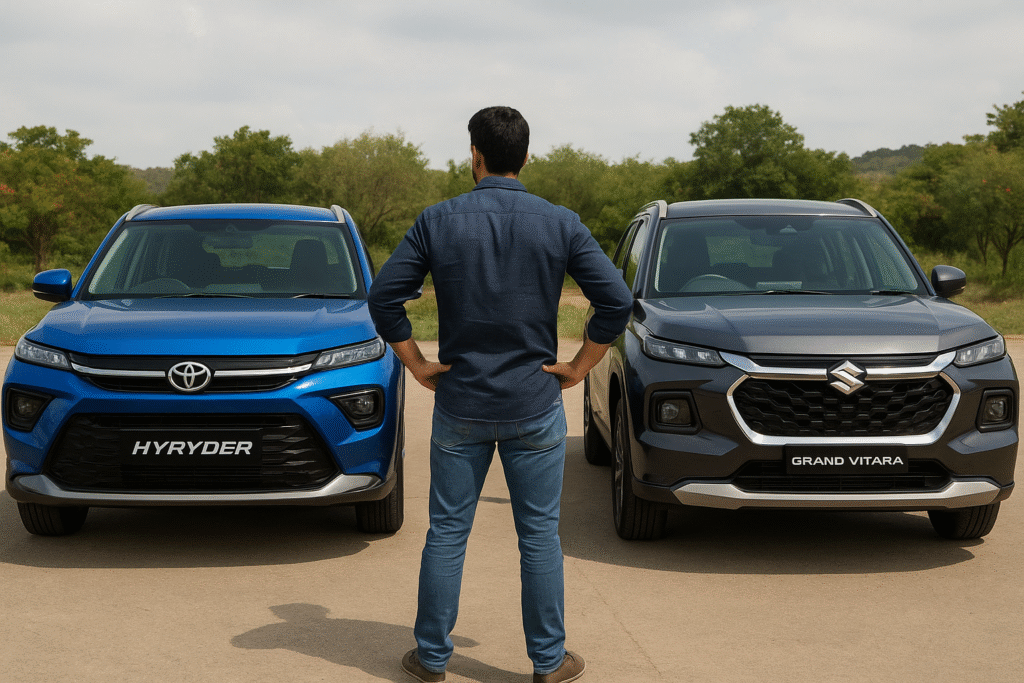
Stuck between choosing the Toyota Hyryder vs Maruti Grand Vitara for your next family SUV? You’re not alone. These twin SUVs have been creating quite a buzz since their launch, and for good reason. They’re essentially siblings sharing the same DNA but with distinct personalities that could make or break your buying decision. Let’s dive deep into what sets these two apart and help you pick the perfect SUV for your needs. The Tale of Two Brothers: Understanding the Basics Think of the Toyota Hyryder vs Maruti Grand Vitara as fraternal twins raised by different families. Both SUVs roll out from the same production line in Gujarat, sharing identical underpinnings, dimensions, and even engines. But here’s where it gets interesting – Toyota and Maruti have dressed them up differently, giving each its own character and appeal. Key Similarities at a Glance: Engine Performance: Hyryder Strong Hybrid vs Grand Vitara Mild Hybrid Here’s where the rubber meets the road, literally. The Hybrid Showdown Both SUVs offer two engine options, but the hybrid mileage story is where things get spicy. Strong Hybrid System (Both Models): Mild Hybrid System: Engine Refinement: K15C vs 1.5L NA While both use the same K15C engine, there are subtle differences in calibration. The Grand Vitara feels slightly more responsive in mild hybrid form, while the Hyryder prioritizes smoothness. Both strong hybrid versions are whisper-quiet and offer that satisfying electric-only driving experience in traffic. Hyryder vs Grand Vitara Features: The Devil’s in the Details This is where choosing between these siblings gets tricky. Technology and Infotainment: Toyota i-Connect vs Suzuki Connect Maruti Grand Vitara takes the tech crown with: Toyota Hyryder counters with: Safety and Convenience Features ADAS in Grand Vitara vs Hyryder is a game-changer. Maruti Grand Vitara offers: Toyota Hyryder provides: Comfort Features Comparison Ventilated seats availability is limited to higher variants in both SUVs. Grand Vitara edges ahead with: Hyryder counters with: Find out which SUV suits you best in the Toyota Hyryder VS Brezza comparison, exploring features, performance, and value for money. Design Philosophy: Beauty is in the Eye of the Beholder The Toyota Hyryder vs Maruti Grand Vitara design battle is purely subjective. Exterior Styling Grand Vitara rocks: Hyryder offers: Interior Design and Quality Both SUVs share the same dashboard layout but differ in: Material Quality: Family-Friendly Features Comparison When you’re buying an SUV for the family, these details matter. Best SUV for City Driving Both excel in urban environments, but here’s the breakdown: For Daily Commuting: For Weekend Getaways: Practicality Winners Storage Solutions: Rear Seat Comfort: Ownership Experience: Which SUV Has Better Resale Value? This is where Toyota’s legacy shines through. Resale Value Analysis Toyota Hyryder typically offers: Maruti Grand Vitara provides: Hyryder vs Grand Vitara Maintenance Costs Service and Maintenance: Grand Vitara wins on: Hyryder offers: Pricing: Where Your Money Goes Both SUVs are priced competitively, with marginal differences. Price Positioning: Value Proposition: Discover the best Toyota Cars Under ₹15 Lakhs, offering style, performance, and reliability at an affordable price for Indian car buyers. Castle Toyota: Your Gateway to the Perfect SUV Experience When you’re ready to take the next step in your SUV journey, Castle Toyota stands ready to transform your car buying experience. As a dedicated Toyota dealership, Castle Toyota offers more than just vehicles they provide comprehensive automotive solutions. From helping you explore the Hyryder’s impressive hybrid technology through detailed test drives to offering transparent financing options, their approach is refreshingly straightforward. What sets Castle Toyota apart is their commitment to long-term relationships rather than just transactions. Their service department ensures your Hyryder remains in peak condition, while their parts and accessories team helps you customize your SUV exactly to your preferences. Whether you’re trading in your current vehicle or exploring financing options, their team works to make the entire process smooth and transparent. The dealership’s focus on customer education means you’ll understand exactly what you’re getting with the Hyryder’s advanced hybrid system, helping you make the most of your investment from day one. The Verdict: Making Your Choice Choosing between the Toyota Hyryder vs Maruti Grand Vitara isn’t about finding a clear winner it’s about finding the right fit for your priorities. Choose the Grand Vitara if: Choose the Hyryder if: Final Thoughts The Toyota Hyryder vs Maruti Grand Vitara debate ultimately comes down to what you value most in your SUV ownership journey. Both offer excellent hybrid technology, practical family-friendly features, and competitive pricing. Your choice should align with your long-term ownership priorities and brand preferences. Whether you lean toward the Grand Vitara’s feature-rich offering or the Hyryder’s reliability promise, both represent excellent value in the competitive SUV segment, making the Toyota Hyryder vs Maruti Grand Vitara comparison a win-win situation for SUV buyers. Ready to experience the Toyota Hyryder firsthand? Visit Castle Toyota for a comprehensive test drive, transparent pricing, and expert guidance. Book your test drive today and discover which SUV perfectly matches your lifestyle and driving needs. Frequently Asked Questions Q1: Which offers better fuel efficiency – Hyryder hybrid vs Grand Vitara hybrid mileage? Both strong hybrid versions deliver identical real-world mileage of 25+ kmpl in city conditions and 22+ kmpl on highways, as they use the same hybrid powertrain technology. Q2: Is the ADAS in Grand Vitara vs Hyryder worth the extra cost? The Grand Vitara’s ADAS package is more comprehensive and user-friendly, offering better value for safety-conscious buyers who frequently drive on highways or in heavy traffic conditions. Q3: Which SUV has better resale value after 3 years? Toyota Hyryder typically maintains 5-10% better resale value due to Toyota’s brand reputation, though both SUVs hold their value reasonably well in the market. Q4: Are Hyryder vs Grand Vitara maintenance costs significantly different? Grand Vitara generally has 10-15% lower routine maintenance costs and wider service network availability, while Hyryder may require fewer repairs due to superior build quality. Q5: Which is the best SUV for city driving – Hyryder or Grand Vitara? Both excel in city conditions with light steering and
Toyota Hyryder VS Brezza: Which one to Buy

When you’re shopping for a compact SUV that balances fuel efficiency, features, and affordability, the Toyota Hyryder vs Brezza debate becomes inevitable. Both vehicles target budget-conscious buyers who want SUV styling without breaking the bank. But here’s the thing they’re actually from different segments, which makes this comparison even more interesting. The Hyryder sits in the compact SUV segment, while the Brezza occupies the sub-4-meter space. Let’s dive deep into what each offers and help you make the right choice for your needs. Price Comparison: Hyryder vs Brezza The Toyota Hyryder vs Brezza price difference is significant and reflects their different positioning. Maruti Brezza Pricing: Toyota Hyryder Pricing: The Hyryder clearly commands a premium, but you get more space, hybrid technology, and Toyota’s build quality. If budget is your primary concern, the Brezza offers excellent value. Engine Power Brezza vs Hyryder: Performance Breakdown Maruti Brezza Engine Options The Brezza keeps things simple with a single petrol engine: Toyota Hyryder Engine Options The Hyryder offers more variety: Winner: Hyryder takes this round with its hybrid option and better power delivery. The hybrid system provides instant torque and smoother acceleration, especially in city driving. Hyryder Hybrid vs Brezza Petrol Mileage: Fuel Efficiency Face-off This is where the Hyryder truly shines. Maruti Brezza Mileage: Toyota Hyryder Mileage: The real-world fuel efficiency comparison shows the Hyryder hybrid delivers approximately 40-50% better mileage than the Brezza. For someone driving 1,000 km per month, the hybrid saves roughly ₹1,500 monthly on fuel costs. Over five years, that’s ₹90,000 in savings – almost enough to offset the higher purchase price. Discover key insights in the comparison of Toyota Hyryder vs. Honda Elevate to help you choose the best SUV for performance, features, and value. Hyryder vs Brezza Features Comparison Safety Features Brezza Safety Kit: Hyryder Safety Kit: Winner: Hyryder leads with advanced driver assistance features. Comfort & Convenience Features Brezza ZXi vs Hyryder V Hybrid – the top variants comparison: Brezza ZXi Features: Hyryder V Hybrid Features: Winner: Hyryder edges ahead with premium touches like HUD and JBL audio. Boot Space Hyryder vs Brezza: Practicality Check Brezza Boot Space: 328 liters Hyryder Boot Space: 373 liters (petrol), 265 liters (hybrid) The Hyryder petrol offers more luggage space, but the hybrid variant sacrifices some boot space for the battery pack. For family trips, the Hyryder petrol wins, while the Brezza offers decent space for most daily needs. Hyryder AWD vs Brezza FWD: Traction and Capability Maruti Brezza: Front-wheel drive only Toyota Hyryder: Available with AllGrip (mild AWD system) in select variants The Hyryder’s AWD system isn’t full-time but provides better traction on loose surfaces and mild off-road conditions. For city driving, both FWD systems are perfectly adequate. If you occasionally venture onto unpaved roads or live in hilly areas, the Hyryder AWD offers peace of mind. Driving Comfort Hyryder vs Brezza: Real-World Experience Ride Quality The Brezza offers a firm, planted feel that handles bad roads reasonably well. Its compact dimensions make city maneuvering effortless. The Hyryder provides a more refined ride quality with better noise insulation. The hybrid’s silent electric mode is particularly impressive in stop-go traffic. Handling Characteristics Brezza feels more nimble around corners due to its lighter weight and shorter wheelbase. Hyryder offers more stability at highway speeds but feels slightly less agile in tight spaces. Explore the elegance and performance of the Top 5 Toyota Luxury Car in India, designed to deliver comfort, style, and premium driving experience. How Castle Toyota Enhances Your Car-Buying Experience When considering a Toyota Hyryder purchase, choosing the right dealership makes all the difference. Castle Toyota provides experienced, well-equipped, and company-trained staff across all functions to ensure a delightful customer experience. What sets Castle Toyota apart is their comprehensive digital approach. You can request test drives, download brochures, get price lists, and even submit purchase inquiries online. This streamlines the entire buying process, especially useful when comparing multiple variants like the Hyryder V Hybrid against petrol options. Their team understands the technical aspects of Toyota’s hybrid technology and can explain real-world benefits clearly. For buyers weighing the Hyryder vs Brezza price difference, Castle Toyota’s financing guidance helps you understand long-term value beyond the initial sticker price. Their after-sales service ensures your hybrid system remains optimized for maximum fuel efficiency throughout ownership. Resale Value Comparison: Long-term Investment Toyota Hyryder typically retains 60-65% of its value after 3 years. Toyota’s reputation for reliability and the growing demand for hybrid vehicles support strong resale values. Maruti Brezza holds approximately 55-60% of its value after 3 years. Its widespread service network and lower maintenance costs appeal to used car buyers. The Hyryder’s higher initial price and better retention rate often result in similar absolute depreciation to the Brezza. For someone planning to upgrade in 3-4 years, both vehicles offer reasonable value retention. Final Verdict: Which SUV Wins? Choose the Toyota Hyryder if: Choose the Maruti Brezza if: The Toyota Hyryder vs Brezza debate ultimately comes down to your priorities and budget. The Hyryder offers superior technology, efficiency, and refinement at a premium price. The Brezza provides excellent value, proven reliability, and lower running costs. Both are excellent choices in their respective segments the key is understanding which aligns better with your specific needs and driving patterns. Ready to experience the Toyota Hyryder firsthand? Visit Castle Toyota for a comprehensive test drive and expert guidance on choosing between variants. Their team can help you calculate real-world savings and find the perfect financing solution for your Toyota Hyryder vs Brezza decision. Frequently Asked Questions Q1: Is the Hyryder hybrid worth the extra cost over the Brezza? If you drive over 800 km monthly, the hybrid’s fuel savings justify the premium. The break-even point is typically 3-4 years of ownership, after which you save money. Q2: Which has better after-sales service – Toyota or Maruti? Maruti has a wider service network with 3,500+ touchpoints versus Toyota’s 700+ centers. However, Toyota generally offers longer warranties and less frequent service intervals. Q3: Can the Hyryder handle mild
Toyota Hyryder vs. Honda Elevate: Which is better

Choosing between the Toyota Hyryder vs Honda Elevate feels like picking between two equally tempting desserts both look great, but which one actually delivers the satisfaction you’re craving? You’re standing at a crossroads that thousands of SUV buyers face every month. On one side, there’s Toyota’s hybrid-powered Hyryder promising exceptional fuel economy and all-wheel-drive capability. On the other, Honda’s Elevate offers refined engineering, advanced safety features, and that legendary i-VTEC smoothness. Both SUVs target the same sweet spot families wanting a practical, feature-rich vehicle that doesn’t break the bank. But here’s the thing: despite similar pricing and positioning, these two couldn’t be more different under the hood. Let’s dive deep into this comparison and help you make the right choice for your garage. Engine Performance: Hybrid Efficiency vs Naturally Aspirated Refinement The heart of any SUV comparison lies in what powers these machines. Toyota Hyryder: The Hybrid Pioneer The Toyota Hyryder comes with two engine options, but the star of the show is the 1.5L Atkinson Cycle engine paired with Toyota’s e-CVT hybrid system. Key Hyryder Engine Specs: The hybrid system feels like having a silent co-pilot. During city crawls, the electric motor takes charge, delivering whisper-quiet operation. Highway cruising sees the petrol engine kick in seamlessly. Honda Elevate: The i-VTEC Smoothness Honda sticks to what it knows best – naturally aspirated engines with VTEC technology. Key Elevate Engine Specs: The engine refinement: i-VTEC vs K15C comparison heavily favors Honda. The Elevate’s engine feels more linear and responsive, especially during overtaking maneuvers. Winner: Hyryder for fuel efficiency, Elevate for driving pleasure. Hyryder Hybrid vs Elevate Petrol Mileage: The Numbers Game Here’s where the Hyryder absolutely dominates. Real-world fuel efficiency comparison based on user reports: Picture this: If you drive 1,500 km monthly, the Hyryder hybrid saves you approximately ₹2,500-3,000 in fuel costs compared to the Elevate. Over five years, that’s potential savings of ₹1.5-1.8 lakh. The Hyryder’s hybrid system shines in stop-and-go traffic where the Elevate’s CVT struggles with efficiency. Drivetrain: Hyryder AWD Capability vs Elevate FWD This is where Toyota plays a trump card. Toyota Hyryder AWD System The top-spec Hyryder offers intelligent All-Wheel Drive (iAWD) – a feature almost unheard of in this price segment. AWD Advantages: The AWD system automatically sends power to rear wheels when front wheels lose grip. It’s not hardcore off-road capability, but it’s reassuring for Indian road conditions. Honda Elevate: FWD Focus The Elevate sticks to front-wheel drive across all variants. Honda’s reasoning: better fuel efficiency and lower maintenance costs. For most Indian buyers, FWD suffices perfectly. The Elevate’s ground clearance and approach angles handle most Indian road challenges. Winner: Hyryder for versatility, Elevate for simplicity and cost-effectiveness. Understand the difference between Hyryder Hybrid G and V, comparing features, design, and performance to help you choose the perfect model. Interior Features: Hyryder Panoramic Sunroof vs Elevate Single-Pane Step inside both SUVs, and you’ll notice distinct philosophies. Toyota Hyryder Interior Highlights Honda Elevate Interior Features Infotainment: Honda Connect vs Toyota i-Connect comparison reveals Honda’s edge in user interface design. Honda’s system responds faster and offers better smartphone integration. The Elevate’s rear seats offer superior thigh support and recline functionality – crucial for long family trips. Winner: Elevate for overall comfort, Hyryder for that premium panoramic sunroof experience. Safety: ADAS in Elevate vs Hyryder Honda takes the safety crown convincingly. Honda Elevate Safety Package Honda Sensing Suite includes: Toyota Hyryder Safety Features The ADAS in Elevate vs Hyryder comparison isn’t even close. Honda’s Sensing Suite offers Level 2 autonomous features that genuinely enhance daily driving safety. Winner: Honda Elevate by a significant margin. Check the Pricing List of All New Toyota Cars Models in India to explore the latest features, specifications, and budget-friendly options for every buyer. Practicality: Best SUV for City Driving Both SUVs excel in urban environments but for different reasons. Toyota Hyryder City Advantages Honda Elevate City Strengths For the question of which SUV has better resale value, Toyota historically wins. Toyota’s hybrid technology and brand reliability typically ensure stronger resale values after 3-5 years. Family-Friendly Features Comparison Families need specific considerations beyond just specifications. Storage and Practicality Comfort Features Technology Integration Hyryder vs Elevate Maintenance Costs This crucial factor often gets overlooked during purchase decisions. Toyota Hyryder Maintenance Honda Elevate Maintenance Winner: Slight edge to Elevate for lower complexity and costs. How Castle Toyota Enhances Your Hyryder Ownership Experience When considering the Toyota Hyryder, partnering with an established Toyota dealership makes all the difference. Castle Toyota brings decades of Toyota expertise to your ownership journey. Their certified technicians understand hybrid technology nuances that generic service centers might miss. What sets Castle Toyota apart: The hybrid system’s complexity means you need technicians who’ve trained specifically on Toyota’s e-CVT technology. Castle Toyota’s service team receives regular updates on hybrid maintenance procedures, ensuring your Hyryder runs optimally throughout ownership. Their customer-first approach means no surprise charges or unnecessary service recommendations – just honest expertise focused on keeping your Hyryder performing at its best. The Verdict: Which SUV Deserves Your Money? After analyzing every aspect, here’s the reality check: Choose Toyota Hyryder if: Choose Honda Elevate if: Both SUVs represent excellent value propositions in the compact SUV segment. Your choice ultimately depends on whether you value efficiency and future-readiness (Hyryder) or refinement and immediate sophistication (Elevate). The Toyota Hyryder vs Honda Elevate decision isn’t just about specifications – it’s about choosing the SUV that aligns with your lifestyle, priorities, and long-term vision. Ready to Experience the Toyota Hyryder’s Hybrid Technology? today for a comprehensive test drive and discover why the Hyryder might be the perfect SUV for your family. Our expert team will help you explore financing options, trade-in values, and service packages tailored to your needs. Contact Castle Toyota to schedule your test drive and make an informed decision in the Toyota Hyryder vs Honda Elevate comparison. Frequently Asked Questions Q1: Which SUV offers better fuel efficiency between Hyryder and Elevate? The Toyota Hyryder hybrid variants deliver significantly better fuel efficiency, achieving 25-27
What Is the Difference Between Hyryder Hybrid G and V?

The Hyryder Hybrid G vs V comparison can leave many buyers stumped at the Toyota showroom. Two seemingly similar SUVs, an additional charge for the V variant, and a “how much to pay more?” question that lingers. Believe me, you are not alone here. The Toyota Hyryder has won the Indian hybrid SUV market by a landslide. However, buyers who are left to choose between the Toyota Hyryder G vs V Hybrid variant experience the whole-child puzzle moment. Hyryder G and V: All have that delicious self-charging hybrid powertrain Toyota is known for. Yet, a few extra features – or the lack thereof in the case of G – in the V variant can make or break your SUV experience. At this point, you might be wondering about the difference between Hyryder G and V. Well, you’ve come to the right place. At Castle Toyota, we do not let our customers walk around the showroom with confusion all over their faces. Without further ado, let us drive you through the Toyota Hyryder G Hybrid variant and the V variant with pros, cons, and features comparison. Discover the best 10 advantages of Toyota Hybrid Cars, from fuel efficiency to eco-friendly driving, making them a smart choice for modern car owners. Hyryder Variants: Know Your Trim Level Before we begin the Toyota Hyryder G Hybrid features vs V Hybrid variant fun ride, let us quickly review the trim levels. The Hyryder Hybrid range follows the Toyota conventional names nomenclature. In the simplest of words, G is Good and V is Very Good (but Toyota would never call it this simple). The G variant is the mid-range hybrid of the entire range that offers a standard feature set without costing a fortune. On the other hand, the V is the big boy or the most premium Hyryder Hybrid one can buy. Packed to the brim with all those extra features you want on your daily commute, the V variant offers a day-before-market luxury ride. Not to forget the overall performance is on par as both hybrid variants are powered by the 1.5-liter Atkinson cycle engine coupled with an electric motor. Pros and Cons: G vs V Hybrid Variant Explained Interior Design and Convenience Features The Hyryder G vs V interior features might seem all same. The G hybrid variant offers a fabric upholstered interior along with a manual AC unit. The V Hybrid variant takes a notch up and arrives with leatherette upholstery and an automatic climate control unit. Yes, the leatherette material gives the car that expensive cabin look and feel. On top of that, these seats are very easy to clean and more durable in the long run than the fabric upholstery. The V Hybrid variant also comes with a wireless charging pad and smart key with push-button start feature. Sounds very techy, right? Trust me; you do not know what you are missing until you get these features. The G Hybrid will make you insert your key from the ignition and turn it to start your vehicle. No sir, the V Hybrid variant lets you keep your smart key in your pocket and drive around with a button press. The overall convenience difference between the G and V Hybrid variants lie in these features. Safety Equipment The first question we get when talking about safety is: Are there any safety difference in Hyryder trims? The answer to that question is no; both the Toyota Hyryder G and V Hybrid come with Toyota Safety Sense 2.0. It means the standard features such as the pre-collision system, lane departure alert, automatic high beam, and dynamic radar cruise control. However, the V Hybrid variant comes with a slight edge as Toyota offers blind spot monitoring and rear cross traffic alert as well. Remember, Toyota makes all their cars very safe. Hyryder G Hybrid vs V Hybrid Mileage When it comes to the mileage, the Hyryder G vs V has almost the same mileage. The fuel efficiency of both variants is identical as both have the same powertrain system. Toyota takes great pride in their Toyota hybrid engine and battery pair to give the maximum mileage to the consumer. Toyota Hyryder Hybrid mileage delivers around 27–28 kmpl in real-world driving conditions. The Hybrid system works as follows: What that means is that hybrid buyers can save around ₹40,000 to ₹50,000 on fuel as compared to regular petrol SUVs. That amount can almost pay for your child’s annual school fees. Drivers can also feel the same smooth throttle acceleration the hybrid variant offers. It is completely noiseless as the hybrid system manages the battery and petrol engine use case. Exterior Design Differences Both the G and V variants are pretty much neck-to-neck in terms of exterior design elements. Hyryder SUV exterior design offers all that bold geometric design that is sharp in its lines. There are a few design highlights that distinguish a G Hybrid variant from a V Hybrid variant: It might not seem like a big deal, but the G to V variant changes add that premium aura to the V Hybrid. Explore the advantages of Toyota 7 Seater Car: Features, Pricing & Reviews, offering space, comfort, and reliability for families and long journeys. Which One Should You Choose? Go for the Toyota Hyryder G Hybrid variant if you want: Go for the Toyota Hyryder V Hybrid variant if you want: Castle Toyota Advantage The G Hybrid variant is excellent value for families as it has all the features they need. On the other hand, V Hybrid variant comes with all those little premium add-ons that add comfort to daily driving. The G Hybrid is the cheapest Toyota SUV in India. Choose between Toyota Hyryder G and V Hybrid variant with full confidence. Castle Toyota is there to assist you with knowledgeable, equipped, and company-trained staff. We cover Jalandhar, Hoshiarpur, Amritsar, Tarn Taran, Nawanshahr, and Nakodar. Our services include: Castle Toyota’s team knows that the Hyryder G vs V Hybrid decision is
Difference Between Toyota Glanza Vs Ford Freestyle

Choosing the right car in today’s competitive automotive market can be overwhelming, especially when you’re torn between two distinct segments. The Toyota Glanza and Ford Freestyle represent two different approaches to modern motoring – one focusing on premium hatchback luxury, the other on rugged crossover versatility. If you’re considering either of these vehicles, you’ve come to the right place for a comprehensive comparison. At Castle Toyota, we understand that every car purchase is a significant decision that affects your daily life, budget, and long-term satisfaction. This detailed comparison between the Toyota Glanza and Ford Freestyle will help you make an informed choice based on your specific needs, preferences, and lifestyle requirements. Understanding the Toyota Glanza: Premium Hatchback Excellence The Toyota Glanza represents Toyota’s commitment to delivering premium hatchback experiences to Indian consumers. As a rebadged version of the Maruti Suzuki Baleno, the Glanza combines Toyota’s renowned reliability with modern design and advanced features. This premium hatchback is positioned as an urban-friendly vehicle that offers excellent fuel efficiency, contemporary styling, and Toyota’s trusted after-sales service network. The Glanza comes equipped with a responsive 1.2-litre petrol engine that delivers smooth performance in city traffic conditions. Its compact dimensions make it ideal for navigating crowded Indian streets while providing adequate space for passengers and luggage. The vehicle’s design philosophy emphasises comfort, convenience, and connectivity features that appeal to modern Indian families. Ford Freestyle: The Crossover That Redefines Versatility The Ford Freestyle positions itself as a unique crossover that bridges the gap between hatchbacks and SUVs. Built on Ford’s global platform, the Freestyle offers higher ground clearance, rugged styling elements, and enhanced safety features. This vehicle is designed for Indian consumers who desire the practicality of a hatchback with the commanding presence and capability of an SUV. Ford has equipped the Freestyle with a proven 1.2-litre three-cylinder petrol engine that balances performance with fuel efficiency. The vehicle’s design incorporates crossover elements such as plastic body cladding, roof rails, and a higher seating position, making it appealing to adventure-seeking Indian families who occasionally venture beyond city limits. Design and Styling: Two Distinct Approaches Toyota Glanza Design Philosophy The Toyota Glanza adopts a sophisticated and contemporary design language that appeals to urban professionals and young families. Its sleek silhouette, chrome accents, and modern LED lighting elements create an upmarket appearance that stands out in the premium hatchback segment. The front grille features Toyota’s distinctive styling cues, while the rear design incorporates elegant tail lamps and a well-integrated spoiler. The Glanza’s interior design prioritises comfort and premium feel with quality materials, well-laid-out dashboard, and intuitive controls. The cabin features dual-tone colour schemes, premium upholstery options, and strategically placed chrome highlights that enhance the overall premium experience. Ford Freestyle Design Appeal The Ford Freestyle embraces a bold and adventurous design philosophy that immediately communicates its crossover credentials. Its higher ground clearance, robust body cladding, and prominent wheel arches give it a commanding road presence. The front fascia features Ford’s signature hexagonal grille, while the rear design incorporates distinctive tail lamps and a sporty bumper design. Inside, the Freestyle offers a spacious and practical cabin with durable materials and ergonomic design. The dashboard layout is driver-focused, with easy-to-reach controls and comprehensive instrumentation. The interior design emphasises functionality and durability, suitable for both daily commuting and weekend adventures. Performance and Engine Specifications Toyota Glanza Performance The Toyota Glanza is powered by a 1.2-litre K-Series petrol engine that produces 83 PS of power and 113 Nm of torque. This engine is renowned for its smooth operation, refined performance, and excellent fuel efficiency. The power delivery is linear and suitable for city driving conditions, providing adequate acceleration for overtaking and merging into traffic. The Glanza offers both manual and automatic transmission options, with the CVT automatic being particularly popular among urban consumers. The engine’s characteristics focus on delivering consistent performance with minimal noise and vibration, making it ideal for daily commuting and long-distance touring. Ford Freestyle Performance The Ford Freestyle features a 1.2-litre three-cylinder Dragon series petrol engine that delivers 96 PS of power and 120 Nm of torque. This engine provides slightly more power than the Glanza, resulting in better acceleration and overtaking capability. The three-cylinder configuration offers a distinctive sound character and responsive performance. Ford offers the Freestyle exclusively with a 5-speed manual transmission, which provides precise gear changes and better driver engagement. The engine’s torque characteristics are well-suited for both city driving and highway cruising, making it versatile for various driving conditions. Fuel Efficiency and Running Costs Toyota Glanza Fuel Economy The Toyota Glanza excels in fuel efficiency, delivering approximately 21.01 kmpl (manual) and 19.56 kmpl (automatic) under standard testing conditions. This impressive fuel economy makes it an economical choice for daily commuting and long-distance travel. The engine’s efficient design and lightweight construction contribute to reduced fuel consumption. Maintenance costs for the Glanza are reasonable, with Toyota’s extensive service network ensuring convenient and affordable servicing. The availability of genuine parts and skilled technicians across India makes ownership hassle-free and cost-effective. Ford Freestyle Fuel Economy The Ford Freestyle offers competitive fuel efficiency of approximately 19.0 kmpl, which is respectable for a crossover vehicle. While slightly lower than the Glanza, the Freestyle’s fuel consumption is justified by its higher power output and crossover capabilities. Ford’s service network in India, while not as extensive as Toyota’s, provides reliable maintenance support. The Freestyle’s maintenance costs are competitive within the crossover segment, with reasonable service intervals and part availability. Features and Technology Toyota Glanza Feature Set The Toyota Glanza comes loaded with modern features that enhance comfort, convenience, and connectivity. Key features include a 7-inch touchscreen infotainment system with Apple CarPlay and Android Auto compatibility, automatic climate control, push-button start, and steering-mounted controls. Safety features include dual airbags, ABS with EBD, rear parking sensors, and ISOFIX child seat mounts. Higher variants offer additional features such as LED projector headlamps, DRLs, and premium audio system. The Glanza’s feature list is comprehensive and competitive within the premium hatchback segment. Ford Freestyle Feature Offerings The Ford
Toyota Glanza Vs Tata Nexon: What’s the Difference

When it comes to choosing the perfect car for Indian roads, the decision between Toyota Glanza and Tata Nexon often leaves buyers in a dilemma. Both vehicles have carved their unique niche in the Indian automotive market, offering distinct advantages that appeal to different segments of car buyers. The Toyota Glanza, a premium hatchback, competes directly with the Tata Nexon, a compact SUV, creating an interesting comparison between two completely different vehicle categories. At Castle Toyota, we understand that choosing between these two exceptional vehicles requires careful consideration of various factors including price, features, performance, and suitability for Indian driving conditions. This comprehensive comparison will help you make an informed decision by examining every aspect of both vehicles, from their design philosophy to their real-world performance on Indian roads. Design and Exterior Comparison Toyota Glanza: Premium Hatchback Appeal The Toyota Glanza showcases a sophisticated design language that reflects Toyota’s commitment to premium aesthetics. The front grille features Toyota’s signature design elements with sleek LED headlamps that provide excellent visibility during night driving. The vehicle’s compact dimensions make it perfect for navigating through crowded Indian streets whilst maintaining an elegant profile. The Glanza’s aerodynamic body design not only enhances its visual appeal but also contributes to improved fuel efficiency. The rear design incorporates modern LED taillights and a well-integrated spoiler that adds to its sporty character. The ground clearance of 163mm ensures that the vehicle can handle Indian road conditions effectively. Tata Nexon: Bold SUV Stance The Tata Nexon presents a completely different design philosophy with its bold SUV stance. The vehicle features Tata’s Impact Design 2.0 language, which includes a distinctive front grille, muscular wheel arches, and a commanding road presence. The higher ground clearance of 209mm gives it a significant advantage over the Glanza for tackling rough Indian roads. The Nexon’s robust build quality and SUV proportions make it suitable for families who prefer a more commanding driving position. The vehicle’s design elements, including the floating roof design and bold character lines, create a modern and appealing aesthetic that stands out in the compact SUV segment. Interior Space and Comfort Toyota Glanza Interior Features The Toyota Glanza offers a well-appointed interior that maximises space efficiency within its compact dimensions. The cabin features premium materials and ergonomic design elements that ensure comfort during long drives. The front seats provide adequate support, whilst the rear seats can accommodate two adults comfortably. The dashboard layout is intuitive with easy-to-reach controls and a modern infotainment system. The vehicle offers practical storage solutions throughout the cabin, making it convenient for daily urban commuting. The air conditioning system effectively cools the cabin, which is crucial for Indian weather conditions. Tata Nexon Interior Advantages The Tata Nexon provides significantly more interior space compared to the Glanza, thanks to its SUV architecture. The higher seating position offers better visibility and a more commanding view of the road. The rear seats can comfortably accommodate three passengers, making it more suitable for families. The Nexon’s interior features premium materials and modern design elements. The vehicle offers generous boot space, which is considerably larger than the Glanza’s cargo area. The flat floor design enhances rear passenger comfort, whilst multiple storage compartments add to the practicality quotient. Engine Performance and Specifications Toyota Glanza Engine Options The Toyota Glanza is powered by a 1.2-litre K-Series petrol engine that delivers 83 PS of power and 113 Nm of torque. This engine is known for its reliability and fuel efficiency, making it an excellent choice for daily city commuting. The engine is paired with either a 5-speed manual transmission or an AMT (Automated Manual Transmission) option. The Glanza’s engine delivers smooth performance in city driving conditions whilst maintaining impressive fuel efficiency figures. The vehicle’s lightweight construction contributes to its agile handling characteristics, making it enjoyable to drive on both city streets and highways. Tata Nexon Engine Variants The Tata Nexon offers multiple engine options to cater to different customer preferences. The petrol variant features a 1.2-litre turbocharged engine that produces 120 PS of power and 170 Nm of torque. The diesel option includes a 1.5-litre engine delivering 110 PS of power and 260 Nm of torque. Both engines are available with manual and automatic transmission options. The turbocharged petrol engine provides excellent performance with strong mid-range torque, whilst the diesel engine offers superior fuel economy and robust performance for highway driving. Fuel Efficiency and Running Costs Toyota Glanza Fuel Economy The Toyota Glanza excels in fuel efficiency, delivering an impressive mileage of approximately 23 kmpl in real-world driving conditions. This exceptional fuel economy makes it an economical choice for daily commuters who cover significant distances. The vehicle’s lightweight construction and efficient engine contribute to its superior fuel efficiency. The maintenance costs for the Glanza are relatively reasonable, with Toyota’s extensive service network ensuring easy accessibility to authorised service centres across India. The vehicle’s reliable engine requires minimal maintenance, contributing to lower overall ownership costs. Tata Nexon Fuel Consumption The Tata Nexon’s fuel efficiency varies depending on the engine variant chosen. The petrol version delivers around 17-18 kmpl, whilst the diesel variant offers approximately 21-22 kmpl. Although the Nexon’s fuel efficiency is lower than the Glanza, it provides better performance and utility. The Nexon’s running costs are competitive within the compact SUV segment. Tata’s expanding service network ensures convenient maintenance, whilst the vehicle’s robust build quality contributes to long-term reliability. Safety Features and Ratings Toyota Glanza Safety Equipment The Toyota Glanza comes equipped with essential safety features including dual airbags, ABS with EBD, and reverse parking sensors. The vehicle’s body structure is designed to meet modern safety standards, providing adequate protection for occupants during collision scenarios. Advanced variants of the Glanza include additional safety features such as ESP (Electronic Stability Programme) and hill hold assist. The vehicle’s safety equipment ensures peace of mind for families whilst maintaining affordability. Tata Nexon Safety Excellence The Tata Nexon has achieved a 5-star safety rating from Global NCAP, making it one of the safest vehicles in its segment.
Toyota Glanza Vs Ford Figo: Know the Difference

When it comes to choosing an affordable hatchback in India, two popular names that frequently emerge in conversations are the Toyota Glanza and Ford Figo. Both vehicles cater to budget-conscious buyers seeking reliable, fuel-efficient transportation without compromising on essential features. However, deciding between these two options requires careful consideration of various factors including performance, features, pricing, and after-sales service. The hatchback segment in India has witnessed tremendous growth over the past decade, with manufacturers introducing feature-rich models at competitive prices. For families looking for their first car or seeking a practical city runabout, the choice between Toyota Glanza and Ford Figo represents a significant decision that impacts daily commuting, maintenance costs, and overall ownership experience. At Castle Toyota, we understand that purchasing a car is not just about the initial price tag but encompasses the entire ownership journey. This comprehensive comparison will help you make an informed decision by examining every aspect of both vehicles, from engine specifications to safety features, ensuring you choose the hatchback that best suits your requirements and budget. Design and Exterior Comparison Toyota Glanza Design Philosophy The Toyota Glanza showcases a contemporary design language that appeals to modern Indian families. The front fascia features a prominent grille with chrome accents, complemented by sleek headlamps that incorporate LED daytime running lights in higher variants. The vehicle’s side profile displays clean lines with subtle character marks that enhance its visual appeal without appearing overly aggressive. The rear design maintains the sophisticated approach with well-integrated tail lamps and a neat bumper design. The overall stance of the Glanza appears confident and proportionate, making it suitable for both urban environments and highway cruising. Available in multiple colour options, the Glanza offers choices that cater to diverse customer preferences. Ford Figo Exterior Appeal The Ford Figo, on the other hand, adopts a more dynamic and youthful design approach. The signature Ford grille, flanked by expressive headlamps, creates an instantly recognisable front end. The vehicle’s proportions are well-balanced, with a slightly more muscular appearance compared to the Glanza. The Figo’s side profile features pronounced wheel arches and character lines that add visual interest and depth to the design. The rear section incorporates wrap-around tail lamps and an integrated spoiler, giving it a sportier appearance. Ford has ensured that the Figo stands out in crowded parking lots with its distinctive styling cues. Interior Space and Comfort Features Toyota Glanza Interior Experience Step inside the Toyota Glanza, and you’ll find a thoughtfully designed cabin that prioritises comfort and functionality. The dashboard layout is intuitive, with controls placed within easy reach of the driver. The use of quality materials throughout the interior reflects Toyota’s attention to detail and commitment to providing a premium feel even in the budget segment. The front seats offer adequate support for both city driving and longer journeys, with the driver’s seat providing multiple adjustment options. The rear seats comfortably accommodate three passengers, though the middle seat is best suited for shorter trips. The cabin storage solutions are practical, with numerous compartments and cup holders strategically placed throughout the interior. The Glanza’s infotainment system features a touchscreen interface that supports smartphone connectivity, allowing seamless integration with Android Auto and Apple CarPlay. The air conditioning system effectively cools the cabin even in harsh Indian summer conditions. Ford Figo Interior Comfort The Ford Figo’s interior design emphasises a driver-centric approach with a cockpit-style dashboard layout. The build quality is commendable, with soft-touch materials used in key areas. The overall ambience feels modern and functional, though some plastic components may not match the Toyota’s perceived quality. Seating comfort in the Figo is competitive, with well-cushioned seats that provide adequate support. The rear seat space is comparable to the Glanza, offering sufficient legroom and headroom for average-sized passengers. The boot space is practical for daily use, though it may feel cramped for extensive luggage requirements. The infotainment system in the Figo includes Ford’s SYNC connectivity features, providing smartphone integration and voice command functionality. The climate control system works efficiently, maintaining comfortable cabin temperatures across various weather conditions. Engine Performance and Specifications Toyota Glanza Engine Options The Toyota Glanza is available with two engine options, catering to different performance preferences and budget considerations. The base variant features a 1.2-litre naturally aspirated petrol engine that delivers 90 PS of power and 113 Nm of torque. This engine is known for its smooth operation and excellent fuel efficiency, making it ideal for city commuting. For those seeking additional performance, the Glanza offers a 1.2-litre turbocharged petrol engine producing 100 PS of power and 150 Nm of torque. This turbocharged unit provides better acceleration and highway performance while maintaining reasonable fuel consumption figures. Both engines are mated to a 5-speed manual transmission, with the option of an automatic transmission available in select variants. The CVT automatic transmission offers smooth gear changes and enhances driving convenience in stop-and-go traffic conditions. Ford Figo Engine Performance The Ford Figo comes equipped with a 1.2-litre naturally aspirated petrol engine that generates 96 PS of power and 119 Nm of torque. This engine is designed to provide a balance between performance and fuel efficiency, making it suitable for various driving conditions. The Figo’s engine characteristics lean towards providing adequate power for city driving while maintaining respectable fuel economy figures. The engine feels responsive at low speeds and provides sufficient power for overtaking manoeuvres on highways. Transmission options for the Figo include a 5-speed manual gearbox and a 6-speed automatic transmission. The automatic variant offers convenience for urban driving, though it may impact fuel efficiency compared to the manual transmission option. Fuel Efficiency and Running Costs Toyota Glanza Fuel Economy One of the significant advantages of choosing the Toyota Glanza is its impressive fuel efficiency figures. The naturally aspirated petrol engine delivers an ARAI-certified fuel efficiency of approximately 22.35 km/l, making it one of the most fuel-efficient hatchbacks in its segment. The turbocharged variant, despite offering more power, maintains competitive fuel efficiency at around 20.01 km/l. These figures translate to lower running costs,
Compare Toyota Glanza and Honda Jazz

When it comes to choosing the perfect compact car for Indian roads, two names consistently dominate the conversation: the Toyota Glanza and the Honda Jazz. Both vehicles have carved out their own niches in the Indian automotive market, offering unique advantages that appeal to different types of car buyers. At Castle Toyota, we understand that choosing between these two excellent options can be challenging, which is why we’ve created this comprehensive comparison to help you make an informed decision. The Indian automotive landscape has evolved significantly over the past decade, with consumers becoming increasingly discerning about their vehicle choices. Today’s car buyers seek the perfect blend of fuel efficiency, comfort, reliability, and value for money. Both the Toyota Glanza and Honda Jazz tick many of these boxes, but they do so in distinctly different ways that make them suitable for different driving preferences and lifestyle needs. Understanding the Toyota Glanza: A Smart Choice for Indian Families The Toyota Glanza represents Toyota’s strategic entry into the premium hatchback segment in India. Built on the foundation of proven Japanese engineering excellence, the Glanza offers Indian consumers the reliability and build quality they associate with the Toyota brand. This vehicle is particularly appealing to first-time car buyers and young families who prioritise dependability and cost-effectiveness without compromising on modern features. The Glanza’s design philosophy centres around practicality and efficiency. Its compact dimensions make it ideal for navigating congested Indian city streets, while its spacious interior ensures comfort for both driver and passengers. The vehicle’s build quality reflects Toyota’s commitment to durability, making it an excellent choice for customers who plan to keep their car for many years. One of the most compelling aspects of the Toyota Glanza is its fuel efficiency. In a country where petrol prices continue to fluctuate, the Glanza’s impressive mileage figures make it an economically sensible choice for daily commuting. The vehicle’s maintenance costs are also relatively low, thanks to Toyota’s extensive service network across India and the availability of genuine spare parts. Honda Jazz: The Spacious Premium Hatchback The Honda Jazz has established itself as the go-to choice for Indian consumers who prioritise space and versatility in their compact car. Honda’s reputation for engineering excellence is well-represented in the Jazz, which offers a unique combination of compact exterior dimensions and surprisingly spacious interior accommodation. The Jazz’s standout feature is its ingenious Ultra Flexible Seat system, which allows for multiple seating configurations. This flexibility makes the Jazz particularly appealing to families who need to transport varying combinations of passengers and cargo. Whether you’re carrying tall passengers, large shopping bags, or need to transport bulky items, the Jazz’s adaptable interior can accommodate your needs. Honda’s focus on build quality and safety is evident throughout the Jazz. The vehicle incorporates Honda’s advanced safety technologies and robust construction methods, providing peace of mind for families who prioritise occupant protection. The Jazz also offers a more premium driving experience compared to many other vehicles in its segment, with refined ride quality and responsive handling characteristics. Performance and Engine Specifications Comparison When examining the performance credentials of both vehicles, it’s important to consider how they perform in real-world Indian driving conditions. The Toyota Glanza is powered by a 1.2-litre petrol engine that produces adequate power for city driving and highway cruising. This engine is tuned for fuel efficiency rather than outright performance, making it ideal for cost-conscious buyers who prioritise running costs over sporty driving dynamics. The Glanza’s engine delivers smooth power delivery and is well-suited to Indian driving conditions. The vehicle’s lightweight construction contributes to its nimble handling characteristics, making it easy to manoeuvre in tight city spaces. The engine’s refinement levels are impressive, with minimal noise and vibration intrusion into the cabin during normal driving conditions. The Honda Jazz offers a more powerful 1.2-litre i-VTEC petrol engine that provides better performance characteristics compared to the Glanza. This engine delivers more responsive acceleration and higher power output, making it suitable for drivers who occasionally need additional performance for highway overtaking or hill climbing. The Jazz’s engine also incorporates Honda’s advanced i-VTEC technology, which optimises performance across different engine speeds. Both vehicles offer manual and CVT automatic transmission options, catering to different driver preferences. The automatic variants are particularly appealing to city drivers who face heavy traffic conditions regularly. The CVT transmissions in both cars provide smooth acceleration and contribute to improved fuel efficiency in stop-and-go traffic situations. Interior Space and Comfort Features Interior space and comfort are crucial factors for Indian car buyers, especially those who frequently travel with family members or need to accommodate passengers regularly. The Toyota Glanza offers a well-designed interior that maximises space utilisation within its compact footprint. The front seats provide good support and comfort for medium to long journeys, while the rear seats can accommodate two adults comfortably. The Glanza’s interior design emphasises functionality and ease of use. The dashboard layout is intuitive, with clearly marked controls and good visibility of important information. The vehicle offers adequate storage spaces throughout the cabin, including door pockets, dashboard compartments, and a reasonably sized boot for weekend trips or shopping excursions. However, the Honda Jazz takes interior space to another level entirely. The Jazz’s Magic Seats system allows the rear seat cushions to fold up completely, creating a tall loading space that can accommodate items like bicycles, large plants, or furniture. This flexibility is unmatched in the compact hatchback segment and makes the Jazz particularly appealing to buyers who need occasional cargo-carrying capability. The Jazz’s rear passenger space is significantly more generous than the Glanza’s, with better legroom and headroom for adult passengers. The large windows and airy cabin design create a sense of spaciousness that belies the vehicle’s compact exterior dimensions. This makes the Jazz an excellent choice for families who frequently travel with multiple passengers or need to transport elderly family members comfortably. Technology and Infotainment Systems Modern Indian car buyers expect their vehicles to offer contemporary technology features that enhance convenience, entertainment, and connectivity. The Toyota
Toyota Glanza Vs Swift: Which One Is Better

Choosing between the Toyota Glanza and Maruti Suzuki Swift can be a challenging decision for Indian car buyers. Both hatchbacks dominate the premium compact segment, offering excellent fuel efficiency, reliability, and modern features. However, each vehicle brings unique advantages that cater to different driving preferences and budget considerations. The Toyota Glanza, essentially a rebadged Maruti Suzuki Baleno, combines Toyota’s legendary reliability with Suzuki’s proven engineering. Meanwhile, the Swift continues to be India’s favourite sporty hatchback, known for its dynamic performance and youthful appeal. Understanding the key differences between these models will help you make an informed decision that suits your lifestyle and requirements. Design and Exterior Comparison Toyota Glanza Exterior Features The Toyota Glanza showcases a sophisticated design language that appeals to buyers seeking elegance over sportiness. The front grille features Toyota’s signature chrome treatment, giving it a premium appearance that distinguishes it from its Suzuki counterpart. The sleek LED headlamps with integrated daytime running lights create a modern, upmarket look that resonates well with Indian consumers. The side profile reveals clean lines and well-proportioned dimensions, making the Glanza appear larger than its actual footprint. The 15-inch alloy wheels add to the premium aesthetic, whilst the rear design maintains the understated elegance with chrome accents around the number plate area. The overall design philosophy emphasises sophistication and maturity. Maruti Suzuki Swift Design Language The Swift adopts a more aggressive and sporty design approach that has consistently attracted younger buyers. The hexagonal grille, sharp headlamps, and pronounced bumper lines create a dynamic front fascia that screams performance. The floating roof design with contrasting black roof colour options adds contemporary flair to the overall appearance. The Swift’s compact dimensions and muscular wheel arches give it a planted, athletic stance on the road. The rear design features distinctive tail lamps and a sporty spoiler, reinforcing its performance-oriented character. The design successfully balances modern aesthetics with the Swift’s traditional sporty DNA. Interior Features and Comfort Toyota Glanza Interior Experience The Glanza’s cabin prioritises comfort and practicality with a well-appointed interior that reflects Toyota’s attention to detail. The dashboard layout is intuitive, featuring a 9-inch touchscreen infotainment system with Android Auto and Apple CarPlay connectivity. The beige and black interior theme creates an airy, premium ambience that appeals to families. Seating comfort is excellent, with supportive front seats offering good lateral support during cornering. The rear seats provide adequate space for three passengers, though taller individuals might find headroom slightly limited. Storage options are thoughtfully designed, with ample cup holders, door pockets, and a decent-sized boot space of 339 litres. The cabin materials feel premium for this segment, with soft-touch plastics used in key areas. The instrument cluster combines analogue gauges with a digital multi-information display, providing clear visibility of essential driving information. Overall, the interior emphasises comfort and user-friendliness over sportiness. Swift Interior and Space The Swift’s interior design focuses on creating a driver-centric environment that enhances the sporty driving experience. The all-black interior theme with silver accents creates a modern, youthful atmosphere that appeals to performance-minded buyers. The flat-bottom steering wheel and sporty seats reinforce the athletic character. Front seat comfort is good, with adequate support for spirited driving, though the rear seats are best suited for two adults rather than three. The boot space of 268 litres is smaller than the Glanza, which might be a consideration for families requiring more cargo capacity. However, the cabin feels more intimate and focused on the driving experience. The 7-inch touchscreen infotainment system provides essential connectivity features, though it’s smaller than the Glanza’s unit. The instrument cluster features a prominent tachometer, emphasising the car’s performance orientation. Storage solutions are adequate but not as comprehensive as the Glanza’s offerings. Engine Performance and Fuel Efficiency Toyota Glanza Engine Specifications The Glanza is powered by a 1.2-litre DualJet petrol engine that produces 90 PS of power and 113 Nm of torque. This engine utilises dual injectors per cylinder to improve fuel atomisation, resulting in better fuel efficiency and reduced emissions. The mild-hybrid system further enhances fuel economy and provides additional torque during acceleration. The engine’s characteristic is smooth and refined, making it ideal for city driving and highway cruising. The CVT automatic transmission option provides seamless gear changes and improved fuel efficiency, though it may feel sluggish during aggressive acceleration. The manual transmission offers better control and engagement for driving enthusiasts. Fuel efficiency is impressive, with the manual variant delivering approximately 22.35 kmpl and the CVT automatic achieving around 22.94 kmpl according to ARAI testing. Real-world fuel efficiency typically ranges between 16-19 kmpl depending on driving conditions and style. Swift Engine Performance The Swift comes with a 1.2-litre K-Series petrol engine that produces 83 PS of power and 113 Nm of torque. While slightly less powerful than the Glanza, this engine has been refined over multiple generations and is known for its reliability and smooth operation. The engine characteristics favour peppy city driving and responsive acceleration. The 5-speed manual transmission is well-calibrated and offers precise gear changes that enhance the driving experience. The AMT (Automated Manual Transmission) option provides convenience for city driving, though it may feel jerky during aggressive acceleration compared to the Glanza’s CVT. Fuel efficiency figures stand at approximately 23.76 kmpl for the manual variant and 23.20 kmpl for the AMT, making it slightly more efficient than the Glanza in official testing. Real-world fuel efficiency typically ranges between 17-20 kmpl, depending on driving conditions and maintenance. Discover the top Toyota Glanza features of 2025 that blend smart tech, stylish design, and fuel efficiency for an unbeatable drive. Ask ChatGPT Safety Features and Technology Toyota Glanza Safety Equipment The Glanza prioritises safety with a comprehensive suite of features across all variants. Standard safety equipment includes dual airbags, ABS with EBD, reverse parking sensors, and ISOFIX child seat anchors. Higher variants add features like side and curtain airbags, bringing the total to six airbags for enhanced protection. The Toyota Safety Sense package would be expected in future updates, though current variants focus on essential safety features.
Toyota Glanza Vs i20: Which Car Is Better

Choosing between the Toyota Glanza and Hyundai i20 can be a challenging decision for Indian car buyers. Both premium hatchbacks offer excellent value propositions, but each has distinct advantages that cater to different driving preferences and lifestyle needs. This detailed comparison will help you understand which car suits your requirements better. Introduction: The Premium Hatchback Battle The premium hatchback segment in India has witnessed intense competition over the years, with manufacturers constantly innovating to capture market share. The Toyota Glanza and Hyundai i20 represent two different philosophies in this space. While the Glanza leverages Toyota’s legendary reliability and partnership with Maruti Suzuki, the i20 showcases Hyundai’s commitment to feature-rich, contemporary design. For Indian families seeking a balance between affordability, features, and long-term ownership experience, both vehicles present compelling arguments. However, understanding their individual strengths and weaknesses is crucial for making an informed decision that aligns with your specific needs and budget. Toyota Glanza: The Reliability Champion Design and Aesthetics The Toyota Glanza presents a sophisticated design language that appeals to Indian sensibilities. Its front fascia features Toyota’s signature grille with chrome accents, giving it a premium appearance that distinguishes it from its Maruti counterpart. The LED projector headlamps and LED DRLs enhance visibility while adding a modern touch. The side profile maintains clean lines with well-proportioned dimensions that make it suitable for both city driving and highway cruising. The 15-inch alloy wheels complement the overall design, whilst the rear section features stylish LED tail lamps that ensure better visibility during night driving conditions. Engine Performance and Fuel Efficiency Under the bonnet, the Toyota Glanza is powered by a 1.2-litre K-Series petrol engine that delivers 90 PS of power and 113 Nm of torque. This engine is renowned for its reliability and fuel efficiency, making it an excellent choice for Indian driving conditions. The engine comes mated to either a 5-speed manual transmission or a CVT automatic transmission. The fuel efficiency figures are impressive, with the manual variant delivering approximately 22.35 kmpl and the automatic variant achieving around 19.56 kmpl. These figures make the Glanza an economical choice for daily commuting and long-distance travel across Indian roads. Interior Features and Comfort The cabin of the Toyota Glanza focuses on practicality and comfort. The interior features a dual-tone colour scheme with quality materials that feel premium to touch. The seats offer good support for both front and rear passengers, making it suitable for Indian families. The dashboard houses a 9-inch touchscreen infotainment system with Android Auto and Apple CarPlay connectivity. The system is intuitive and responds well to touch inputs. Additional features include automatic climate control, steering-mounted controls, and a multi-information display that provides essential vehicle information. Hyundai i20: The Feature-Rich Contender Design Excellence The Hyundai i20 showcases a bold and contemporary design that makes a strong visual statement. The cascading grille, sharp LED headlamps, and distinctive DRLs create an aggressive front profile that appeals to younger buyers. The parametric design elements throughout the body give it a unique identity in the premium hatchback segment. The side profile features a floating roofline design with distinctive character lines that add dynamism to its appearance. The diamond-cut alloy wheels and chrome door handles enhance the premium quotient, whilst the rear section with its connected LED tail lamps creates a modern and sophisticated look. Engine Options and Performance The Hyundai i20 offers multiple engine options to cater to different customer preferences. The 1.2-litre naturally aspirated petrol engine produces 83 PS of power and 114 Nm of torque. Additionally, there’s a 1.0-litre turbo-petrol engine that delivers 120 PS of power and 172 Nm of torque, providing sportier performance characteristics. The transmission options include a 5-speed manual, 6-speed manual (with turbo engine), CVT automatic, and 7-speed dual-clutch automatic. This variety ensures that buyers can choose the powertrain combination that best suits their driving style and preferences. Interior Luxury and Technology The i20’s interior represents Hyundai’s commitment to offering premium features and technology. The cabin features high-quality materials, ambient lighting, and a well-designed dashboard layout. The seats are comfortable and supportive, with the rear seat offering adequate space for Indian families. The highlight is the 10.25-inch touchscreen infotainment system with connected car technology, wireless charging, and a premium sound system. The digital instrument cluster, automatic climate control, and multiple USB charging ports enhance the overall user experience. Detailed Comparison: Key Parameters Pricing and Value Proposition The Toyota Glanza is positioned competitively in the premium hatchback segment, with prices starting from approximately ₹6.39 lakh for the base variant and going up to ₹9.69 lakh for the top-end automatic variant (ex-showroom). This pricing strategy makes it accessible to a broader range of Indian buyers whilst maintaining the Toyota brand premium. The Hyundai i20, on the other hand, commands a higher price point, starting from around ₹7.04 lakh for the base variant and extending to ₹11.40 lakh for the top-end turbo automatic variant. The higher pricing reflects the additional features and engine options offered by Hyundai. Fuel Efficiency and Running Costs Both vehicles offer excellent fuel efficiency, but the Toyota Glanza has a slight edge in this department. The Glanza’s proven K-Series engine delivers consistent fuel economy across various driving conditions, making it an economical choice for daily usage. The i20’s naturally aspirated petrol engine offers competitive fuel efficiency, whilst the turbo variant, despite offering more power, consumes slightly more fuel. However, the difference is marginal and may not significantly impact the overall ownership cost for most users. Safety Features Safety is a crucial consideration for Indian families, and both vehicles offer comprehensive safety packages. The Toyota Glanza comes equipped with dual airbags, ABS with EBD, electronic stability control, and ISOFIX child seat anchors as standard features across variants. The Hyundai i20 goes a step further with six airbags, electronic stability control, vehicle stability management, and hill-start assist control. The i20 also features a tyre pressure monitoring system and rear parking sensors, providing enhanced safety and convenience. After-Sales Service and Reliability Toyota’s service network in India is extensive, with over