
Genuine Toyota Parts vs Third-Party Parts: Why It Matters
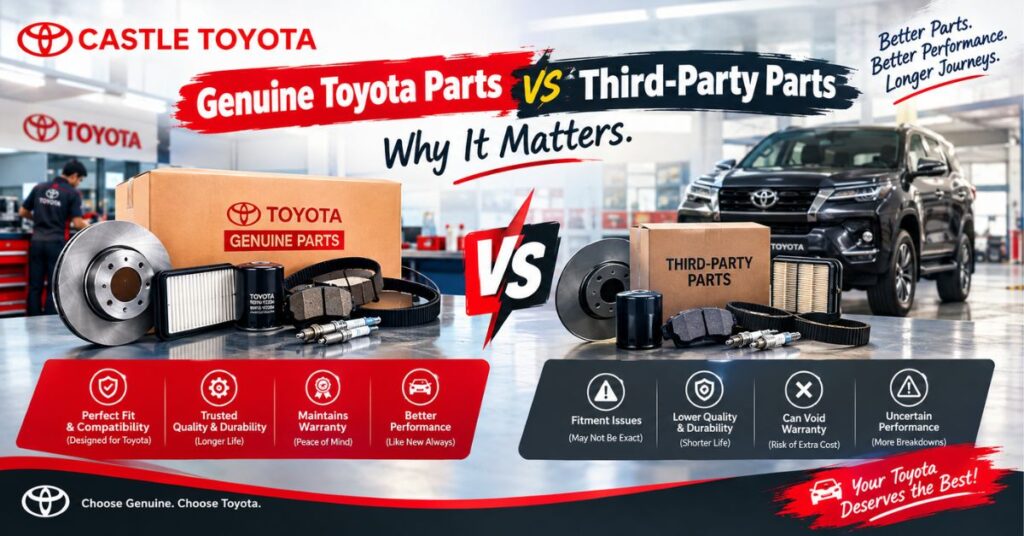
All cars will eventually need replacement parts. Oil filters, brake parts, belts, suspension parts, body parts, and many other parts wear out or get damaged over time. Then, Toyota owners usually have a choice to make: buy a Toyota Genuine Part or a part made by another manufacturer. Especially when the car is older, the price difference can make a third-party component tempting. But the purchase price is only part of the story. The real cost of a replacement can be affected by fit, material qucastality, expected life, warranty, installation, vehicle safety, and compatibility. A fair comparison of genuine Toyota parts vs third-party parts should also differentiate between reputable aftermarket parts and counterfeit parts. That’s not the same thing. A legitimate aftermarket company can manufacture and sell a part under its own name. A fake part is a copy of branding or packaging and may be sold as if it were an original Toyota part when it is not. For many years, Toyota has been warning Indian car owners about counterfeit automotive parts. Fake parts may lead to vehicle faults, poorer performance, higher fuel consumption, sudden breakdowns, and road-safety concerns, Toyota says. So as a Toyota owner, this is what you need to know before you decide on replacement parts. Genuine Toyota Parts vs Third-Party Parts: Quick Comparison If you want a quick answer, this comparison will help: Factor Toyota Genuine Parts Third-Party Parts Vehicle fit Made for applicable Toyota vehicles Depends on manufacturer and product Toyota-backed parts warranty Toyota states 6 months or 10,000 km for genuine service parts. Depends on seller or manufacturer Testing Toyota states its genuine parts undergo testing under simulated conditions. Testing differs between manufacturers. Purchase source Toyota dealers and authorised distribution routes Parts shops, garages, online sellers, manufacturers Price May cost more for some components Can be lower, similar, or higher Compatibility check Part identification can be matched through Toyota channels. Requires careful verification Counterfeit risk Lower when bought through authorised Toyota channels Depends heavily on source Suitable choice Owners seeking manufacturer-specified replacement parts May suit some applications when the part comes from a known maker and fits the exact vehicle Toyota says its genuine parts are designed and engineered for Toyota vehicles and are backed by a six-month or 10,000 km warranty subject to Toyota’s applicable terms. Toyota also says these parts are tested for quality, durability and reliability under simulated conditions. That doesn’t mean that every non-Toyota-branded part will fail. Therefore, buyers should look at the manufacturer, specification, warranty, seller and fit rather than just the price of a component. What Are Toyota Genuine Parts? Toyota Genuine Parts are replacement parts offered through Toyota’s authorised parts network for use in qualifying Toyota vehicles. “The genuine parts we have involve standard design, material choice and internal construction,” Toyota says. Its service information also says these parts are simulated-tested before sale. Toyota Genuine Parts can be parts fitted during repairs or items used during routine servicing. This may include, depending on the vehicle: Owners should still verify the exact part number. Different Toyota models may use different parts, and the same model may have part differences depending on the engine, build date, grade, or gearbox. Buying an original part does not mean all Toyotas have the same part. What Are Third-Party or Aftermarket Parts? Third-party parts are parts made by companies other than Toyota and sold for use in Toyota vehicles. Quality is all over the place. Some manufacturers make quality replacement parts and actually list the vehicles and specs their parts will fit. Other products may have questionable origins, questionable testing, poor warranty support, or poor fit. So the word “aftermarket” itself tells you nothing about quality. Before you buy one, check out: If a workshop recommends a certain component, don’t accept a vague statement that it is “just as good”. Ask why. Third-Party Parts and Counterfeit Parts Are Not the Same That distinction is important. Also, a 3rd-party component could have the branding of its manufacturer. A counterfeit part might try to look like a genuine Toyota part. The Japanese automaker launched a “No to Counterfeit” education campaign in India to warn motorists against fake automotive components. Toyota says counterfeit products can look similar to genuine ones but do not meet the standards used for Toyota Genuine Parts. Counterfeit packaging can be difficult for the average buyer to visually detect. A safer way to buy is to buy from a traceable seller, ask for an invoice, verify the correct part number, and keep the purchase records. Toyota says genuine parts are sold through Toyota dealerships in India and recognised parts distribution channels. 1. Correct Fit Can Affect More Than Installation Time A replacement part must match the vehicle it was made for. Even minor differences in shape, dimensions, connectors, mounting points, material thickness, or operating specification can be significant. A part that physically fits doesn’t always mean it matches the intended specification. Pick up an oil filter. It can seem like the right thread size, but the internal filter makeup and pressure characteristics also play a role. This also affects electrical sensors, brake components, lamps, suspension parts, and many other systems. Toyota’s genuine service parts are designed for Toyota vehicles. When buying replacement parts, be sure to provide the requested information to the seller. Some workshops may ask for the VIN, model, model year, engine, gearbox, or grade of the item so that they can help identify the correct part. Don’t pick a part just because some online title says “fits Toyota”. 2. Material and Manufacturing Quality Can Affect Service Life Sometimes two parts that look almost identical on the outside can be made of different materials on the inside. The rubber compounds, filter media, friction material, metal grades, electrical components, surface coatings, seals, and manufacturing tolerances may differ. Those distinctions might matter: Toyota claims its genuine parts are tested to mimic extreme conditions. For a non-Toyota part, look for a named manufacturer and good technical information. Don’t pick by looks.
10 Signs Your Toyota Car Needs a Service Checkup
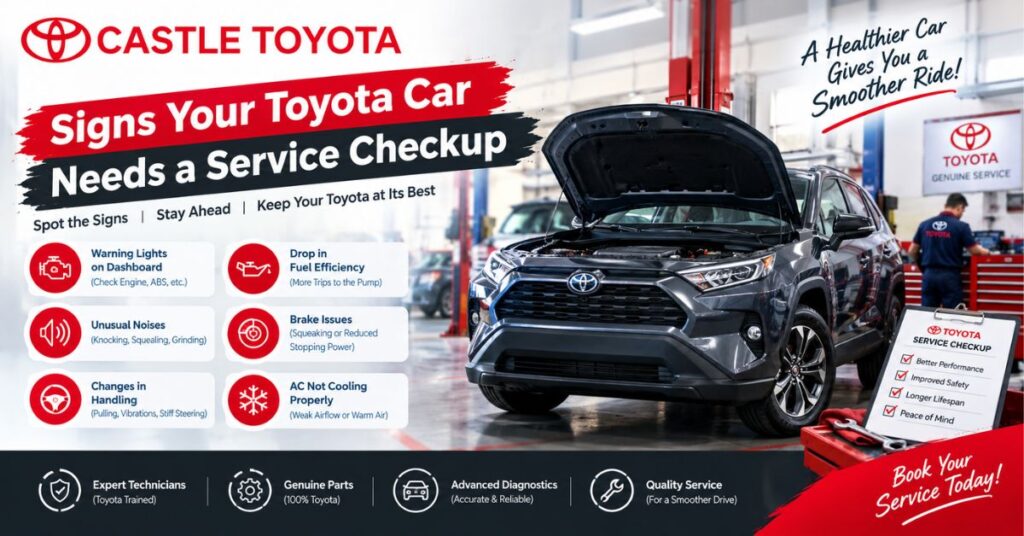
Even if a part is starting to ask for attention, a Toyota can feel normal during everyday driving. Long before you break down, you might notice slight changes in braking, steering, engine noise, fuel consumption, tyre performance, or dashboard warnings. Knowing the Signs a Toyota Car Needs a Service A checkup can help you respond earlier instead of waiting until the car becomes difficult or unsafe to drive. The point isn’t to diagnose a vehicle from the driver’s seat. It is to observe changes, to note what is occurring, and to arrange an inspection if something looks different. Toyota also recommends you follow the maintenance schedule for your particular model and year. Its online owner-manual system gives you model-specific maintenance and safety information, so service timing should be dictated by your vehicle’s manual, not by some general rule that applies to every Toyota. That’s why it matters. There are a number of things that can cause warning lights, odd noises, vibration, or a change in braking. A trained inspection can identify the source before you replace parts on a guesswork basis. Quick Answer: 10 Signs Your Toyota Car Needs a Service Checkup Look for these changes: Some symptoms may be ones for which you can book a routine appointment. Others might indicate a safety or mechanical problem that needs attention more quickly. Consult your owner’s manual for how to react to dashboard warnings. 1. A Dashboard Warning Light Stays On Modern Toyota cars are equipped with dashboard lights that inform the driver of the car’s condition and any possible problems. Toyota i-Connect can also provide vehicle warning alerts on connected models, supported by the vehicle. Not all dashboard alerts will be shown in the app, Toyota said. A warning light is not telling you that a specific part needs to be replaced without testing. It tells you the car has detected something that needs your attention. Lights relating to the engine, braking system, charging system, tyre pressure, or other vehicle systems should be interpreted with the owner’s manual for your model. Note: If you own a diesel Toyota, watch out for DPF messages. If the DPF is full and the malfunction indicator lamp is illuminated, Toyota says the vehicle needs to be inspected by a dealer. Toyota also warns that ignoring some DPF prompts can cause clogging and eventual failure. 2. Your Brakes Feel or Sound Different Brakes don’t just change character for no reason. You may have noticed: A noise alone can’t tell you if the problem is brake pads, discs, debris, or another component. The best way is to check the braking system and not try to identify the fault by the sound. Brake wear is also use-dependent. Things like stop-and-go traffic, hill driving, vehicle load, and driving habits can affect how quickly parts wear. Toyota’s advice on servicing warns that keeping your foot on the brake pedal while driving can lead to premature brake wear and overheating. When you notice a substantial change in braking performance, it’s not just about comfort. 3. The Engine Suddenly Sounds Different Drivers become acclimatised to the normal sound of their own car. That makes it easier to hear a new ticking, knocking, rattling, whistling, or unusually loud engine. First, note when the sound occurs. Does it happen? One sound means one fault assumption can limit the possible source of engine noise. Different noises can come from fluid conditions, belts and pulleys, exhaust parts, engine components, or loose fittings. Toyota owners should avoid racing a cold engine and adhere to a maintenance schedule. If you hear a new noise, see a warning light, notice overheating, smoke, loss of power, or a strong smell, don’t dismiss it as a minor nuisance and seek professional help. 4. You Feel New Vibrations While Driving “Your steering wheel, your pedals, your seat, and your body can tell you that there is a problem with the vehicle. Vibration can occur: Tyres or wheels may cause vibration at road speed. Another area can be the source of the braking vibration. If the car is sitting still and shaking, you might have to check the engine or mounts. Don’t try to guess the cause just from where you feel the vibration. If the vibration started after hitting a pothole, kerb or road debris, arrange a tyre and wheel inspection. Punjab roads can be subject to potholes, damaged surfaces, and uneven shoulders for cars, and changes after an impact deserve attention. If you have a continuing vibration, it can also make driving tiring and can affect tyre wear if wheel alignment or balance has changed. 5. Fuel Economy Drops Without a Clear Reason Fuel consumption varies naturally. Traffic, short journeys, air conditioning, driving style, tyre pressure, vehicle load, road conditions and fuel quality can affect the amount of fuel a car uses. Toyota says fuel economy can vary according to driving style, traffic and climate, fuel quality, tyre pressure and adherence to the service schedule. That means one low-mileage trip is not proof of a mechanical problem. Instead, look for a pattern. Track your fuel consumption over a few fill-ups under similar driving conditions. If you find your Toyota isn’t going as far on the same amount of fuel and your routine hasn’t changed, a service check can help you figure out why. Before you book an inspection, check simple things like your tyre pressure and any unnecessary heavy items you may have in your vehicle. Toyota’s service guidance says low tyre pressure can cause worse fuel consumption and suggests checking tyre pressure regularly, including the spare tyre. 6. Steering Starts Feeling Different Subtle changes in steering can be noticed at first. You may find: Tyres, wheel alignment, suspension components, steering parts or other vehicle systems can affect the way a vehicle steers. Don’t dismiss a sudden change after a pothole or kerb strike. Check tyres for obvious damage, and if the steering no longer feels normal, have a professional check. A steering change, coupled with strong vibration, visible
Toyota Fortuner vs Ford Endeavour (or MG Gloster): SUV Comparison 2026
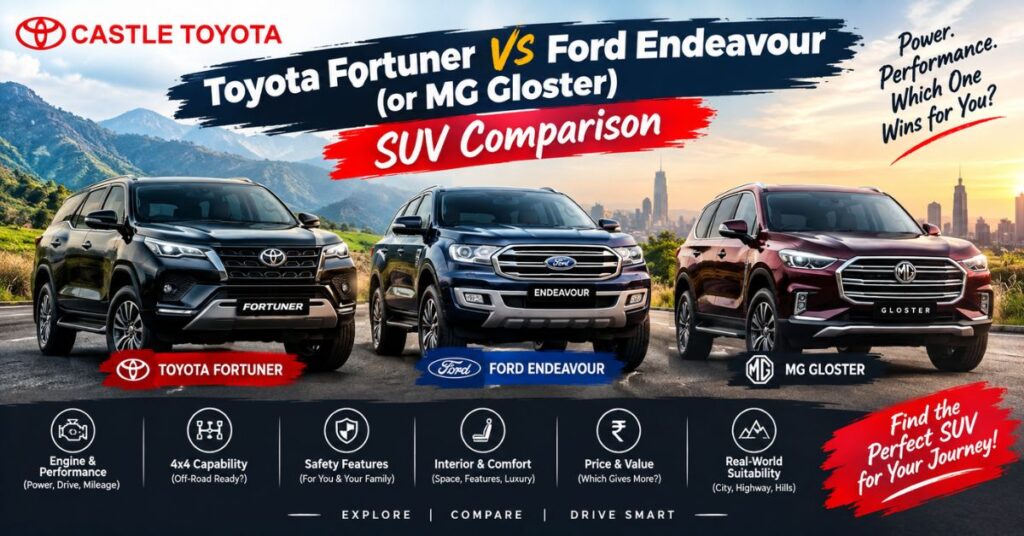
Choosing a big SUV is more than just comparing engine power or counting screens. You also need to think about who is coming with you, where you park, how often you leave paved roads, and how much uncertainty your budget can take. That’s crucial when you compare the Fortuner, Endeavour and Gloster in 2026. A showroom vehicle and a used SUV with several years of service history need different checks for the buyer. This Castle Toyota guide covers manufacturer specs, ownership questions, and family needs. It doesn’t offer a back-to-back road test, nor does it assume that one badge fits all buyers. Are All Three SUVs Available New in India in 2026? Don’t think of this as a direct comparison of three new 2026 vehicles. Ford said in September 2021 it would stop making cars for sale in the U.S. Its current Indian website is service, parts, and owner support focused. The official Indian pages checked for this story did not verify a new Endeavour retail launch. The comparison uses the India-specification 2.0-litre version from Ford’s 2020 brochure, tested as a used buy. The MG situation also needs attention. The former Gloster product URL now redirects to the Majestor that MG unveiled in May 2026. Check any Gloster offer as a private seller used car or possible remaining dealer stock. A live advertisement alone does not confirm a newly manufactured auto. The Fortuner continues to be available through Toyota’s sales network in India. So know the overview of the Fortuner model first and then ask for the current details for the exact version you are considering. How to Choose Between These SUVs Here’s a three-step comparison before you check out the discounts: A clean inspection and an affordable payment plan are more important than winning a specifications argument. Price Comparison: Use Matching Vehicles and Written Quotes The Toyota Fortuner is listed online with a starting reference of ₹34.76 lakh, ex-showroom. The current page for MG’s Majestor has a starting price tag of ₹43.49 Lakh. These headline numbers exclude equivalent variants or Punjab on-road quotes. Get quotes related to the real vehicle for the Endeavour and Gloster. Please be aware of the year of registration, mileage, number of owners, repair history, etc. Don’t take an old launch price as today’s used-car value. Castle Toyota lists the Toyota Legend range separately from the normal Fortuner. Compare two offers for the same version. Ask sellers to itemise the cost of the vehicle, registration fees, insurance, accessories and service packages. Toyota itself recommends that buyers contact their dealer for the latest prices and details before placing an order. Toyota Fortuner vs Ford Endeavour: Engines and Gearboxes Below is a comparison of Indian published specifications. It doesn’t mean that every car you see here is still available. Specification Fortuner 2.8 diesel automatic Endeavour 2.0 diesel, 2020 India model Gloster 2.0 twin-turbo diesel Engine size 2,755 cc 1,996 cc 1,996 cc Maximum power 204 PS 170 PS 215.5 PS Maximum torque 500 Nm 420 Nm 478.5 Nm Transmission Six-speed automatic Ten-speed automatic Eight-speed automatic Length 4,795 mm 4,903 mm 4,985 mm Width 1,855 mm 1,869 mm 1,926 mm Wheelbase 2,745 mm 2,850 mm 2,950 mm Figures from Toyota, Ford and MG brochures. The Gloster column is for the twin-turbo version, not the single-turbo version with lower output. PS = hp of the engine; Nm = torque The highest quoted power here is of the Gloster, while the highest quoted torque is of the Fortuner automatic. Neither figure tells you which SUV is faster off the queue with your passengers and luggage. Assessment includes gear ratios, weight, response, and condition. On a road test, check gentle acceleration, passing response at legal speeds and gearbox behaviour once the vehicle has warmed up. For a used automatic, have a technician check for hesitation, harsh shifts or unusual noises. Older versions of Endeavour require a separate specification check. Don’t use this 2.0-litre comparison and apply it to every used Ford you see, nor use the specs of the overseas Everest instead of the one you’re being offered in India. What About the Fortuner’s 48V Versions? Toyota launched the Fortuner and the Legender in 48V-assisted variants in June 2025. The system utilises the diesel engine with a starter-generator and a lithium-ion battery. The grades also received a 360-degree camera and wireless charging. Do not assume that every Fortuner is equipped with this. Don’t compare an older car to a newer one with a list of features and not address the differences. Ask what features are included in the quoted trim. Cabin Comfort, Third-Row Space, and Daily Parking Fortuner: Check the Seats and Luggage Layout The specification sheet of Toyota has seven seats, ventilated front seats, and third-row seats that fold to the sides. No panoramic sunroof is listed. Don’t judge the practicality of the empty cabin; fill it up with your usual luggage. Older passengers should be asked to rate entrance, exit, and second-row comfort. Cruise the back seats over your normal local route, not just when the vehicle sits outside the showroom. Endeavour: Check Which Features the Used Car Has Ford’s 2020 brochure boasts a panoramic sunroof, power folding third-row and an electrically adjustable front passenger seat on Titanium+ versions. The lower titanium trim does not get that equipment list. Before you settle on a used-car price, try every seat motor, window, roof function, and air-conditioning setting. Don’t promise to repair bad equipment later; put it in the repair estimate. Gloster: Consider the Seating Arrangement MG’s brochure lists six- and seven-seat layouts, three-zone air conditioning and a panoramic sunroof. And it’s also bigger than the other two vehicles we’re comparing here. And that makes it worth a look for a passenger room. But outside dimensions don’t always mean third-row comfort. Sit in each row with the front seats in their normal position. Test out whether a six-seat configuration is really right for your family. For all three, measure your parking entrance, and leave room for open doors. And if
New vs Used Toyota: What’s the Better Deal in Punjab Right Now?
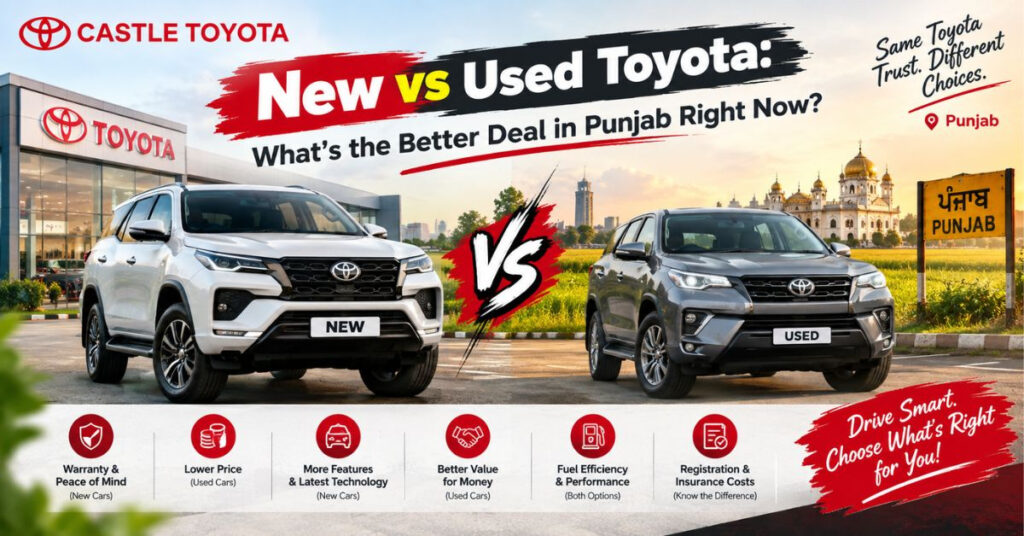
Sometimes a lower asking price doesn’t mean a cheaper car to own. A used car might save you money today, but repairs and borrowing costs can eat away at those savings. A new car may cost more upfront, but it does come with a more complete maintenance history and a new warranty. If you are comparing Toyota cars in Punjab, the right car for you will depend on the specific model and not just the badge. This Castle Toyota guide balances current price references, finance, paperwork, and ownership costs, without assuming either option always wins. New vs Used Toyota: Which Makes More Financial Sense? Choose new if the price difference is small and you want fresh warranty cover. Select ‘used’ if inspection, service records, and written cost estimates show a substantial saving. Don’t just compare the showroom prices or monthly instalments; compare like-for-like variants and overall ownership costs. Begin with what you truly need. How many people go on trips often? How long are you going to keep the car? Can your household afford a surprise repair? Those answers are more important than the last registration year your budget can afford. What Current Toyota Prices Tell Punjab Buyers Toyota’s Glanza configurator lists the E manual at Rs 6.73 lakh, ex-showroom. This is to be taken as an initial reference and not a Punjab on-road quote. Toyota also advises buyers to check current prices and variant details with their dealer. This review shows the extent to which used-car asking prices can fluctuate from the public Toyota U Trust listings: Advertised vehicle Location Listed distance Asking price 2022 Glanza V manual Mohali 46,977 km ₹5.00 lakh 2025 Glanza V AMT Ludhiana 3,087 km ₹7.68 lakh 2023 Innova Hycross Hybrid ZX Mohali 30,742 km ₹25.00 lakh These are individual advertised listings, not average Punjab prices, confirmed sale prices, or guarantees of availability. AMT = automated manual gearbox That’s why the detail matters. A used Glanza V AMT and a new entry-level Glanza don’t get matched equipment or transmissions. It would be the wrong question to look at their headline prices. Request a new-car quote that is as close as possible to the used car. Then, compare its registration date, equipment, warranty balance, condition, and payment terms. Don’t assume the ad includes all charges – ask the used seller the total amount payable as well. Compare Punjab On-Road Costs, Not Just Asking Prices If you are buying a new vehicle, break down the vehicle price, registration, road tax, insurance, finance charges, and any optional extras. The requirements for new registration include insurance, a dealer invoice, registration documents, and applicable one-time road tax, according to the Transport Department of Punjab. Ask the seller to clearly mark optional accessories and service packages. Ask for an insurance quote that shows cover, deductibles, and add-ons separately. This helps compare two offers more easily, without treating different packages as equal. Check the registration certificate, insurance, ownership transfer requirements, and any finance recorded against a secondhand vehicle. Parivahan’s guidance lists Form 29 as the seller’s transfer report and Form 30 as the buyer’s application. It also differentiates between same-state and out-of-state transfers. If a good car is advertised outside Punjab, you need your own paperwork estimate. Before you agree to buy, check with the registering authority that any necessary no-objection certificate, registration changes, and any applicable taxes are in place. Never assume the price charged in another state is final. Car Loan Rates Can Change the Answer SBI’s rate page, last updated 16 September 2026, shows that new-car loans are between 8.40% and 9.35% a year. Certified pre-owned car loan rates are between 10.45% and 15.60%. The bank links the appropriate rates to the credit ratings of the borrowers. These are ranges published by one lender, not a guaranteed personal offer. You borrow less, so even a used car can be cheaper in the end. But a higher rate eats away at its advantage. Compare the down payment, loan tenor, interest to be paid, processing charges & early repayment terms. Request from each lender a full repayment schedule. A lower monthly installment does not translate into a lower cost of loan when one agreement is for a longer tenure. What Warranty Do You Get With Each Option? Toyota offers three years or 100,000 km of new-vehicle cover, whichever is sooner. It also says that the remaining portion passes to the next owner. Buying used doesn’t reset that clock. Toyota includes the high-voltage battery cover for eligible privately used hybrid vehicles of 8 years or 160,000 km, whichever occurs first. Commercial use conditions are different. Confirm the vehicle’s actual original date of sale, mileage, applicable terms, and service records. Don’t confuse a warranty with free service. Toyota does not cover filters and brake pads under the standard warranty, as these are normal wear and tear items. Toyota U Trust provides a 203-point inspection process and warranty support for certified vehicles. Don’t assume all used listings are equally protected; ask for the specific car’s certificate and written warranty terms. A Five-Year Ownership Cost Comparison Let’s take an example to make things clear. The figures below are fictional planning assumptions and are not quotes, repair estimates, or resale predictions for a Toyota. Assuming you keep each car for 5 years and drive the same distance. Price includes the first year of insurance and initial paperwork. Later insurance is shown separately. Five-year cost item New car Used car Purchase and initial costs ₹12.00 lakh ₹9.00 lakh Loan interest and charges ₹1.60 lakh ₹1.50 lakh Fuel ₹3.00 lakh ₹3.00 lakh Servicing, repairs, and worn items ₹0.90 lakh ₹1.50 lakh Insurance after the first year ₹0.60 lakh ₹0.50 lakh Less assumed resale proceeds −₹6.00 lakh −₹4.20 lakh Net ownership cost ₹12.10 lakh ₹11.30 lakh In this illustration, the pre-owned car costs ₹3 lakh less at purchase but only ₹80,000 over five years. An extra repair bill or a lower resale price might nullify any remaining advantage. It would increase with cheaper borrowing or better conditions.
Best Toyota Cars for Long-Distance Driving in India: Comfort, Mileage and Performance Compared
Planning a long road trip changes the way you look at a car. City comfort and highway comfort are not the same thing, and a car that feels fine on a 20-minute commute can feel tiring after five hours on the same seat. This is where the right pick matters. Toyota cars for long-distance driving in India come up again and again in road-trip forums and owner reviews, and there is a clear reason for that. Toyota builds its cars around ride quality, cabin space, and long-term reliability, three things that matter more on a highway stretch than a spec sheet ever will. In this post, we will look at five Toyota models that Indian drivers actually take on long trips: the Innova Hycross, Innova Crysta, Fortuner and Legender, Camry, and Urban Cruiser Hyryder. We will compare their mileage, seating comfort, boot space, and highway manners so you can match the right car to your own driving needs. Why Toyota Cars for Long-Distance Driving in India Work So Well Here is why Toyota keeps showing up on long-drive shortlists across India: Let’s break it down model by model. Toyota Innova Hycross: The Highway-Ready Family MPV The Innova Hycross is the newer sibling of the Crysta, and it was built with families and long drives in mind. It comes with two petrol engine options: a strong-hybrid 2.0-litre unit that makes 184 bhp and 188 Nm, and a non-hybrid 2.0-litre petrol that makes 172 bhp and 209 Nm for buyers who want a simpler, lower-cost setup. Mileage and running cost The hybrid variant carries an ARAI-certified figure of 23.24 km/l, and owners report real-world numbers in the 18 to 20 km/l range on mixed routes. That is a strong number for a car this size, and it means fewer fuel stops between cities. Comfort and cabin space The Hycross measures 4755 mm in length with a 2850 mm wheelbase, which gives the second and third rows real legroom. Ground clearance sits at 185 mm, so speed bumps and rough patches do not knock the underbody around. Boot space is 300 litres with all seats up, and it grows to 991 litres once the third row folds flat, which works well for a family with luggage. The fuel tank holds around 52 litres, so a single fill can cover a long day’s drive. Higher variants add Toyota Safety Sense, which brings adaptive cruise control, lane-keep assist, and pre-collision warning, features that lower driver fatigue on long highway runs. Toyota Innova Crysta: The Old-School Road-Trip Workhorse The Innova Crysta has been a road-trip staple in India for close to a decade, and plenty of taxi fleets and families still swear by it. It runs a 2.4-litre diesel engine paired with either a manual or automatic gearbox. The ARAI-claimed mileage sits at around 16 km/l, with real-world figures usually landing between 9 and 13 km/l depending on load and driving style. The diesel engine gives it strong pulling power on inclines and while carrying a full load, which is why it stays popular for hill routes and long family trips. The cabin has a low floor, wide middle row, and a suspension that absorbs rough patches calmly, so long drives feel relaxed rather than tiring. Fuel tank capacity is 55 litres, which keeps range comfortable between stops. Toyota Fortuner and Legender: Built for Power on Long Highway Runs If your road trips mix highway stretches with rough terrain, the Fortuner and its sportier Legender trim are worth a look. Both run a 2.8-litre turbo diesel engine that makes 201 bhp and 500 Nm, paired with a six-speed automatic and paddle shifters on the Legender. ARAI mileage for the diesel automatic comes in at 14.2 to 14.4 km/l, and the fuel tank holds 80 litres, so you can cover close to 1,000 km before you need to refuel. Ground clearance stands at 225 mm, which is the highest of any car on this list, and boot space comes in at 296 litres. This is the pick for anyone who wants a commanding driving position and confidence over uneven roads on long inter-state drives. Toyota Camry Hybrid: Comfort-First Choice for Highway Cruising The Camry sits in a different category. It is not built for rough roads, but it is one of the smoothest highway cruisers Toyota sells in India. The 2025 model runs a 2.5-litre hybrid engine that produces 230 PS and 221 Nm through an e-CVT gearbox. Fuel use is where the Camry stands out. ARAI rates it at 25.49 km/l, and owners report 21 to 22 km/l in real-world mixed driving, numbers that beat most SUVs and MPVs in this price bracket. The 50-litre tank and quiet hybrid running make it a natural fit for chauffeur-driven trips or long highway runs where cabin refinement matters more than ground clearance. Rear-seat passengers get reclining seats and generous legroom, and the car comes with nine airbags along with a full ADAS suite for added confidence at highway speeds. Toyota Urban Cruiser Hyryder: Best Mileage Pick for Long Drives For drivers who want SUV looks with hatchback-like running costs, the Urban Cruiser Hyryder is worth a serious look. It comes in mild-hybrid, strong-hybrid, and CNG options, giving buyers real choice based on how they plan to use the car. The strong-hybrid automatic variant returns an ARAI figure of up to 27.97 km/l, which makes it the car with the best mileage in this list by a wide margin. The petrol manual variant still manages 21.12 km/l, and the CNG version delivers 26.6 km/kg for buyers focused purely on running cost. Ground clearance comes in at 210 mm, and boot space runs from 373 litres on the mild-hybrid variant to 265 litres on the strong-hybrid variant, since the battery pack sits under the boot floor. Owners note that the hybrid drivetrain stays quiet and stable on highways, and one common piece of feedback is that it feels highly comfortable for long drives despite its compact SUV size. Quick
Toyota Safety Features Explained: ADAS, Airbags, ABS and Driver Assistance Technologies
Buying a car is not just about mileage and looks. Safety is the part that only matters until the day it matters a lot, and by then it is too late to wish you had checked the spec sheet more carefully. This guide has Toyota Safety Features Explained in plain terms, covering airbags, ABS, ADAS, and the other driver assistance systems fitted across the Toyota lineup sold in India. By the end, you will know exactly what these terms mean and which Toyota models carry which safety kit. Why Safety Features Deserve More Attention Than They Get Most buyers spend hours comparing mileage figures and engine numbers, then glance at the safety section for a few seconds. That is backwards. Here is why it matters: Let’s break it down system by system, starting with the basics. What Is ABS with EBD, and Why Every Toyota Gets It ABS, or Anti-lock Braking System, stops your wheels from locking up when you brake hard. Without ABS, a locked wheel skids in a straight line no matter which way you turn the steering wheel, and you lose control of the car exactly when you need it most. EBD, or Electronic Brakeforce Distribution, works with ABS to send the right amount of braking force to each wheel based on load and road grip. A fully loaded Innova Crysta heading downhill needs different brake force at the rear than an empty hatchback, and EBD handles that automatically. Every Toyota model sold in India today comes with ABS and EBD as standard fitment, across all trims, not just the top ones. This is not a premium add-on. It is the baseline Toyota builds every car around. Airbags: How Many Does Your Toyota Actually Need Airbags cushion occupants during a collision by deploying instantly and absorbing impact force before it reaches the body. The number and placement of airbags change how much protection you get in different types of crashes. Here is how airbag counts stack up across popular Toyota models in India: More airbags help, but they work best alongside a strong body structure. Toyota builds several of its India models on the TNGA platform, which the brand designs for crash energy absorption and cabin rigidity, so the airbags and the structure work as one system rather than in isolation. ADAS Explained: What Toyota Safety Sense Actually Does ADAS stands for Advanced Driver Assistance Systems, a group of technologies that use cameras and radar to watch the road and step in before a crash happens. Toyota packages its ADAS features under the name Toyota Safety Sense, or TSS. The main features inside Toyota Safety Sense Here is a numbered walkthrough of what each TSS feature actually does on the road: The Innova Hycross carries the fuller version of this suite, with Toyota confirming that its ADAS setup includes Pre-Collision System, Lane Trace Assist, Dynamic Radar Cruise Control, Blind Spot Monitor and Automatic High Beam across higher variants. The Camry adds a similar suite, including a forward collision avoidance function with pedestrian detection, adaptive and standard cruise control, lane-keep assist, a road-sign read-out and an automatic high beam function, tested and confirmed to work well on Indian highway conditions. Electronic Stability Control, Hill Assist, and Other Backup Systems ADAS handles what happens up front on the road, but a separate set of systems manages how the car itself behaves during sudden moves. Electronic Stability Control (ESC or VSC): Detects when the car is about to skid sideways during a sharp turn or sudden lane change, and reduces engine power or brakes individual wheels to bring the car back in line. This is standard across the Fortuner, Innova Hycross, and Camry. Hill-Start Assist Control (HAC): Holds the brakes for a couple of seconds when you lift off the brake pedal on an incline, so the car does not roll backward while you switch to the accelerator. This is a genuine convenience feature on hill routes and multi-storey parking ramps. Traction Control (TRC): Limits wheel spin on wet, sandy, or loose surfaces by managing power delivery to whichever wheel has the most grip. Tyre Pressure Monitoring System (TPMS): Alerts you the moment tyre pressure drops below the safe range, catching slow punctures before they turn into a blowout on the highway. Toyota bundles several of these under what it calls the Star Safety System in some markets, and while the branding varies by model, the underlying features show up consistently across the Indian lineup. How Toyota Models Perform in Crash Tests Feature lists only tell part of the story. Independent crash testing tells you how the car actually behaves in a real impact. The Innova Hycross scored a full 5-star rating under Bharat NCAP, earning 30.47 out of 32 points for adult occupant protection and 45 out of 49 points for child occupant safety, with a perfect 16 out of 16 in the side impact test. The rating applies across all variants, including both the 7-seater and 8-seater layouts, which means Toyota did not hold back safety kit for the base trims. The Fortuner carries a 5-star rating from ASEAN NCAP for adult occupant protection, child occupant protection, and pedestrian protection, backed by seven airbags, ABS with EBD, and Vehicle Stability Control as standard fitment. The Camry Hybrid has not undergone a separate Bharat NCAP test as of this writing, but its safety architecture, nine airbags, a 360-degree camera, and ISOFIX child seat mounts, along with a full Toyota Safety Sense suite, place it well ahead of most sedans in its price bracket on paper. Quick Reference: Safety Features Across Toyota’s India Lineup Model Airbags ADAS (TSS) ESC Crash Rating Innova Hycross 6 Yes (higher grades) Yes 5-star, Bharat NCAP Fortuner / Legender 7 Not standard Yes 5-star, ASEAN NCAP Camry Hybrid 9 Yes Yes Not separately tested in India Urban Cruiser Hyryder 6 No Yes Not separately tested in India Innova Crysta 6 No Yes Not separately tested in India Feature availability can differ by variant. Confirm
Why Innova Crysta Is Still India’s Favorite MPV

Walk into any wedding, airport pickup line, or family road trip in India, and there’s a good chance an Innova is parked nearby. The Toyota Innova Crysta has been on Indian roads since 2016, and even with a newer sibling in the lineup, it still finds buyers every single month. That says something about how this car is built and how it holds up over time. In this post, we’ll look at what keeps the Innova Crysta India’s favorite MPV, from its engine to its resale value, and where you can go in Jalandhar to see one for yourself. A Legacy Built Over Two Decades The Innova nameplate first arrived in India back in 2005. Toyota introduced the Innova Crysta generation in May 2016, giving the car a new design, a stronger engine, and better safety equipment than the original Innova. In August 2025, Toyota marked 20 years of the Innova family in India, with combined sales of over 12 lakh units across the Innova, Innova Crysta, and Innova HyCross. That kind of track record doesn’t happen by accident. Owners keep coming back to this car because it does the basics right, and it keeps doing them right for years after the sale. What Makes the Innova Crysta India’s Favorite MPV, Even Today Here’s a quick breakdown of the reasons buyers still pick the Innova Crysta over newer, flashier options: Each of these points adds up to a car that owners trust for years, not just for the first few months after purchase. Engine and Performance That Still Holds Up The Innova Crysta runs on a 2.4-litre, four-cylinder diesel engine that puts out around 148 bhp and 343 Nm of torque, paired with a 5-speed manual gearbox. That torque figure matters more than the horsepower number. It means the car pulls well from low speeds, which is exactly what you need when you’re loaded up with passengers and luggage on a hill road or a long highway stretch. The engine also meets Bharat Stage 6 emission norms, using a diesel particulate filter and SCR after-treatment system to keep exhaust clean without giving up the low-end pull that Innova owners have always liked. Space, Comfort and Practicality for Indian Families Numbers matter, but so does how a car feels to sit in for three hours straight. The Innova Crysta measures 4,735 mm in length with a 2,750 mm wheelbase, which translates into real legroom for second and third row passengers. Depending on the variant, buyers can choose between a 7-seat layout with individual captain seats or an 8-seat bench setup for larger families. Rear AC vents, a wireless phone charger, and a touchscreen with Android Auto and Apple CarPlay support round out a cabin that’s built for long trips, not just school runs. Safety Features Built for Real Roads Toyota didn’t skimp on safety when it built this car. Depending on the variant, the Innova Crysta comes with up to 7 airbags, along with anti-lock brakes, electronic brake-force distribution, vehicle stability control, and hill assist control (Toyota Innova Crysta Specifications, CarWale, accessed 2026, https://www.carwale.com/toyota-cars/innova-crysta/). For a car that often carries a full family or a full office team, that kind of coverage matters. Strong Resale Value and Low Ownership Costs Ask anyone who has owned an Innova, and they’ll tell you the same thing: it holds its value better than most cars in its price bracket. Part of that comes from the simple, well-proven mechanicals. Diesel engines and manual gearboxes are cheaper to service than complex hybrid systems, and Toyota’s parts and service network across India keeps maintenance predictable. That reputation for low running costs is a big reason the Innova Crysta remains popular with private buyers and commercial fleets at the same time. A car that’s cheap to run and easy to resell is a car people keep recommending to friends and family. Why Fleet Operators and Businesses Still Trust It Look at any airport, hotel, or corporate transport queue, and you’ll spot Innova Crystas doing the heavy lifting. Fleet buyers care about uptime and running costs above almost everything else, and the Crysta delivers on both fronts. Even as Toyota’s newer Innova HyCross has taken over a bigger share of overall Innova sales, the Crysta still accounted for about 37 percent of combined Innova volumes through 2025, largely on the back of sustained demand from fleet operators. In FY2026, the Innova Crysta diesel sold 37,090 units on its own, even as the segment shifted toward the hybrid HyCross. For a model that’s been around this long without a full redesign, that’s a solid number. Innova Crysta vs Innova Hycross: Which One Fits You Toyota now sells the Innova Crysta alongside the newer Innova Hycross, and buyers often ask which one makes more sense. If you’re not sure which fits your daily routine and budget, a quick chat with a sales consultant makes the decision a lot easier. Know More : Toyota Innova Crysta vs. Toyota Hycross Where to See the Innova Crysta in Jalandhar If you’re based in Punjab and want to see the Innova Crysta up close, Castle Toyota in Jalandhar keeps the model on display and available for test drives. Castle Toyota is an authorized Toyota dealer offering new car sales, servicing, genuine parts, and finance and insurance support under one roof. You can browse the current Innova Crysta lineup on the Castle Toyota website, book a test drive, or ask about ongoing offers before you visit the showroom. Whether you’re comparing the Crysta against the Hycross or just want to check seating comfort for your family, the team at Castle Toyota can walk you through the variants and pricing in person. Final Thoughts The Innova Crysta isn’t the newest MPV on the market anymore, and it doesn’t try to be. What it offers instead is a proven diesel engine, a sturdy build, low running costs, and two decades of trust built up across Indian roads. That combination is why the Innova Crysta India’s favorite MPV
Why the Toyota Fortuner Holds Its Resale Value So Well

Ask anyone shopping for a used SUV in India which brand they trust the most, and Toyota comes up almost every time. Ask them to name a specific model, and the Fortuner usually wins that conversation too. It is not an accident. Fortuner resale value has stayed consistently strong for well over a decade, even as newer, flashier SUVs have entered the market and tried to steal its spotlight. If you are trying to decide between a Fortuner and a rival SUV, or wondering whether buying one now still makes financial sense a few years down the line, this guide breaks down exactly why the Fortuner holds its price so well, and what you can do to protect that value. What Resale Value Actually Means for a Car Like the Fortuner Resale value is simply the percentage of a car’s original price that it still commands when you sell it. A car that loses 50 percent of its value in three years has poor resale value. A car that holds onto 60 to 70 percent after five years, which is roughly what the Fortuner manages, sits near the top of its segment. For SUV buyers, this number matters more than it does for hatchback buyers. SUVs cost more upfront, so even a small percentage difference in depreciation translates into a large sum of money when it is time to sell or trade in. Why the Fortuner Holds Its Value Better Than Most SUVs A few clear factors explain why used Fortuner buyers keep showing up, even in a market full of newer options. A Reputation Built Over Two Decades Toyota launched the Fortuner in India back in 2009, and it quickly became the default choice for buyers who wanted a rugged, dependable SUV without worrying about breakdowns. That reputation did not happen overnight. It came from years of owners driving these vehicles past the 2 lakh km mark with only routine maintenance. Buyers shopping the used market know this, and they are willing to pay for that peace of mind. The Diesel Engine and Ladder-Frame Chassis The Fortuner’s 2.8-litre diesel engine and body-on-frame construction are built for a hard life. This is the same platform Toyota uses for the Hilux, a truck known for surviving punishing conditions across the world. Buyers looking at a used Fortuner know the mechanical bones underneath are tougher than most car-based SUVs on the market, and that confidence keeps demand high. Know More : Toyota Hilux Vs Fortuner Strong Demand in Tier 2 and Tier 3 Cities The Fortuner is not just a metro city favorite. It sells well in smaller towns and rural areas where road quality varies and ground clearance matters. This spread-out demand means a used Fortuner rarely sits unsold for long, regardless of where the seller is located. Low Running and Maintenance Costs Toyota’s service network in India is wide, and spare parts for the Fortuner are easier to find and cheaper to replace than parts for many rival premium SUVs. A buyer comparing ownership costs between a used Fortuner and, say, a used Ford Endeavour or Mahindra Alturas often finds the Fortuner cheaper to keep running, which pushes demand and price upward. Fleet and Business Buyer Interest Beyond individual buyers, the Fortuner attracts fleet operators and business owners who need a dependable vehicle for long hauls. This second layer of demand adds competition in the resale market, which keeps prices from dropping too fast. How Much Does a Fortuner Actually Depreciate? Real numbers help more than general claims. Based on data from resale platforms and dealer records, here is a rough picture of what Fortuner owners can expect: Compare that to many mainstream SUVs, which can lose 40 to 50 percent of their value in just three years, and the gap becomes obvious. Which Fortuner Variants Hold Value Best Not every Fortuner depreciates at the same rate. If resale value is part of your buying decision, keep these points in mind: How to Protect Your Fortuner’s Resale Value A car’s reputation only gets you so far. What you do as an owner plays a real role in the final number you get when you sell. A few practical steps make a measurable difference: Fortuner vs Rivals: How Resale Compares Within the premium SUV segment, the Fortuner has consistently outperformed rivals like the Ford Endeavour, Mahindra Alturas, and Isuzu MU-X in resale studies conducted over the years. Part of this comes down to brand trust, but a large part also comes down to simple math: Toyota sells far more Fortuners than its rivals sell of their competing models, which means a bigger, more active used car market and faster resale. Final Thoughts The Fortuner earns its resale value the old-fashioned way, through reliability, demand, and a service network that owners can count on wherever they are in the country. If you are weighing a new Fortuner purchase in Punjab, dealers like Castle Toyota can walk you through current variant pricing and trade-in options, which is worth doing before you finalize a decision. Whether you are buying new or eyeing a well-kept used model, understanding what drives Fortuner resale value helps you make a smarter, more informed choice. Frequently Asked Questions Does the Fortuner really have better resale value than other SUVs in its class? Yes. Multiple resale studies from Autocar India and used car platforms consistently rank the Fortuner at or near the top of the premium SUV segment, mainly due to brand trust, reliability, and strong demand across both metro and non-metro markets. How much does a Fortuner depreciate after 5 years? A well-maintained Fortuner typically retains 60 to 70 percent of its original price after 5 years. Diesel automatic 4×4 variants with clean service records tend to hold value even better than petrol or manual versions. Does the diesel or petrol Fortuner hold value better? Diesel variants generally hold value better in India, since resale demand skews heavily toward diesel for its towing capability, better mileage on highways,
Toyota Camry 2026: A Complete Buyer’s Guide for Indian Roads

If you are shopping for a premium sedan in India right now, the Toyota Camry probably sits somewhere on your shortlist. It has been sold here since 2002, and the current generation brings a hybrid-only powertrain, a redesigned cabin, and a price tag that lands right at the entry point of the luxury car segment. Here is why this car keeps showing up in serious buying conversations, and what you should know before you sign the papers. What Makes the 2026 Camry Stand Out The Camry has never tried to be a sports sedan. It sells on comfort, low running costs, and Toyota’s long track record for dependable engineering. That formula has worked for decades, and this generation leans into it even harder. Here is what sets it apart: Engine and Performance The Camry runs on a 2.5-litre Dynamic Force engine paired with an electric motor and a lithium-ion battery. Together they produce a combined output of around 230 PS, with 221 Nm of torque arriving early at 3,200 rpm. Power goes through an e-CVT transmission, and drivers can pick between Sport, Eco, and Normal modes depending on how they want the car to behave. Fuel economy is the real story. Toyota rates the car at 25.49 km/l on the ARAI cycle, and owners report strong real-world numbers too, especially in stop-and-go city traffic where the electric motor does most of the early work. At low speeds, the car can run on battery power alone, which keeps the cabin quiet during a morning commute. Ride comfort comes from a MacPherson strut front suspension and a multi-link rear setup. This combination softens bumps without turning the car floaty on the highway. Steering stays light in traffic and firms up once speed picks up. Variants and Price Toyota keeps the lineup simple. There are two variants: the standard Elegant trim and the sportier Sprint Edition, which adds a dual-tone exterior, darker alloy wheels, and a few styling touches inside. Ex-showroom prices in India fall roughly between ₹47.5 lakh and ₹48.5 lakh, depending on the variant. On-road pricing runs higher once registration, insurance, and state taxes get added, so it is worth getting an exact quote before setting a budget. Both variants share the same hybrid powertrain and most of the feature list. The choice mostly comes down to styling preference rather than performance. Interior and Comfort Step inside and the priorities become clear right away. The seats get soft leatherette upholstery, and the front seats offer 10-way power adjustment with lumbar support. Rear passengers get power-reclining seats, an armrest with touch controls, and enough legroom for long trips without complaints. A 12.3-inch multi-information display sits front and center, paired with a multimedia system that supports wireless smartphone connectivity. Add wireless charging, dual-zone climate control, and a tilt-and-slide moonroof, and the cabin feels like it belongs in a car well above this price point. Boot space comes in at 524 litres, enough for a family’s luggage on a weekend trip without much trouble. Safety Features Nine SRS airbags come as standard, along with a 360-degree camera system, ABS with EBD, and an electronic parking brake. Toyota Safety Sense adds lane tracing assist, lane departure alert, a pre-collision system, and dynamic radar cruise control, forming a genuine driver assistance suite rather than a checkbox feature list. Other touches include ISOFIX child seat anchors, tyre pressure monitoring, hill start assist, and seatbelt warnings across all seating positions. For a car aimed at families and chauffeur-driven buyers, this safety package matters as much as the badge on the boot lid. Camry vs Its Rivals At its price point, the Camry sits against a mix of German executive sedans and premium SUVs. Cars like the Audi A4 and BMW 2 Series lean harder into driving dynamics and badge prestige. The Camry takes a different approach. It trades outright sportiness for a hybrid drivetrain that costs far less to run day to day, plus a rear seat built for passengers rather than drivers. For buyers cross-shopping premium SUVs in the same budget, the Camry offers something most SUVs cannot match: a genuinely comfortable, low, chauffeur-friendly rear bench and a smoother, quieter ride on paved roads. Know More : Toyota Camry Vs Skoda Superb Who Should Buy the Camry This car makes the most sense if you fall into one of these groups: If you want a sedan that feels sporty to drive, or you need seven seats for a growing family, the Camry probably is not the right pick. For the buyer who wants comfort and low running costs wrapped in a dependable package, it remains one of the stronger options in its segment. Booking a Test Drive at Castle Toyota If the Camry sounds like the right fit after reading this, the next step is simple: get behind the wheel. Castle Toyota, based in Jalandhar, sells the Toyota Camry along with Toyota’s full lineup and handles everything from test drives to financing and after-sales service. You can check current offers, compare variant details, and book a test drive directly through the Castle Toyota website. Since the Camry comes in just two variants, a short conversation with the sales team at Castle Toyota should be enough to help you decide between the Elegant and the Sprint Edition based on your budget and styling preference. Frequently Asked Questions What is the on-road price of the Toyota Camry in India? Ex-showroom prices start around ₹47.5 lakh and go up to about ₹48.5 lakh for the Sprint Edition. On-road price depends on your state, registration charges, and insurance, so check with your local dealer for an exact figure. Does the Camry come in a petrol-only version in India? No. Toyota sells the Camry in India only as a strong hybrid. It pairs a 2.5-litre petrol engine with an electric motor and a lithium-ion battery, so there is no separate petrol-only trim to choose from. What is the fuel efficiency of the Camry? Toyota claims an ARAI-rated 25.49 km/l. Real-world mileage
Reasons to Buy Toyota Hyryder in 2026: Is This SUV Worth Your Money?

If you’re shopping for a compact SUV this year, chances are the Toyota Urban Cruiser Hyryder has already popped up on your list. It sits in one of the busiest segments in the Indian car market, right next to the Hyundai Creta, Kia Seltos, and Honda Elevate. So what makes it worth a closer look in 2026? Let’s break it down. From its hybrid powertrains to its cabin space and running costs, here are the real reasons to buy Toyota Hyryder this year, based on facts, not sales talk. What Makes the Toyota Hyryder Different The Hyryder is Toyota’s first proper compact SUV built for India, and it shares its platform with the Maruti Suzuki Grand Vitara. But Toyota built its own identity around it. You get three engine choices (a mild hybrid, a strong hybrid, and a CNG option), a design that leans more premium than most rivals, and Toyota’s long-standing name for building cars that keep running with minimal fuss. Here’s why that combination matters if you’re comparing SUVs right now. Know More : Toyota Hyryder VS Maruti Grand Vitara Top Reasons to Buy Toyota Hyryder in 2026 1. A Hybrid Engine That Actually Saves Fuel Fuel prices aren’t dropping anytime soon, and this is where the Hyryder pulls ahead of most petrol-only rivals. The strong hybrid version can return up to 27.97 kmpl on the ARAI test cycle, while even the mild hybrid petrol variants land between 19.39 and 21.11 kmpl. The Petrol models have mileage range between 19.39 kmpl to 27.97 kmpl with manual/automatic. In daily city driving, real owners report figures closer to 24 kmpl, which is still strong for a car this size the mileage came to be 24 kmpl in the real world. The strong hybrid setup also switches to electric-only mode in slow traffic, so the engine shuts off and you save fuel without doing anything different behind the wheel. 2. Toyota’s Reputation for Reliability and Resale Value Toyota cars have built their name on durability, and that reputation carries a lot of weight when it comes time to sell. Owners consistently point to low maintenance needs and cars that keep running well past the 100,000 km mark. This reliability also means the Hyryder tends to hold its resale value better than several rivals in the segment, which matters when you’re calculating the real cost of ownership over five or six years. One of the biggest advantages of Toyota cars is their durability. Many owners say their vehicles run smoothly for years with very few mechanical problems. Toyota also has a strong resale value, making it a smart long-term investment. 3. A Cabin Built for Comfort, Not Just Looks Step inside and you’ll find a 9-inch touchscreen with wireless Apple CarPlay and Android Auto, ventilated front seats, a head-up display, and a panoramic sunroof The interior offers a good number of features such as ventilated seats, 360-camera, wireless Apple CarPlay & Android Auto, panoramic sunroof and more. The rear seat reclines, splits 60:40, and gets its own AC vents and USB ports, so passengers in the back aren’t an afterthought. Toyota also added wireless phone charging and remote AC control through its app, so you can cool the cabin down before you even step in on a hot day. 4. A Safety Package That Covers the Basics Well Safety features across the Hyryder lineup include up to 6 airbags on higher variants, ABS with EBD, electronic stability control, hill hold assist, ISOFIX child seat anchors, and a 360-degree camera system This SUV comes with advanced safety features like six airbags, ABS with EBD, and ISOFIX mounts, offering reliable protection for families and professionals. Front seatbelts come with pretensioners and force limiters, which tighten automatically during a collision to keep occupants in place. It’s worth checking the exact safety kit on your chosen variant, since features like the extra airbags and 360-degree camera aren’t standard across the entire range. Know More : Toyota Hyryder VS Creta Safety Rating 5. An All-Wheel Drive Option You Won’t Find on Most Rivals Here’s something the Creta and Seltos don’t offer: an AWD variant. The Hyryder gives you the choice of an all-wheel-drive setup, paired with a manual gearbox, on select trims While the Toyota Hyryder goes up in a strongly contested segment with nameplates like the Hyundai Creta, Kia Seltos and Honda Elevate, the Japanese compact SUV manages to stand out with its powertrain options. There’s no diesel or turbo-petrol engine on offer, but the Hyryder offers mild and strong-hybrid self-charging petrol powertrains. Moreover, it also offers the option of an all-wheel setup, something which is unique to the Hyryder and Grand Vitara. If you regularly drive on loose gravel, wet roads, or light off-road trails, that added traction is a real advantage over a front-wheel-drive-only competitor. 6. A CNG Variant for Lower Running Costs Not everyone needs a hybrid. If your priority is cutting fuel bills without paying a hybrid premium, the Hyryder’s CNG variant returns around 26.6 km/kg The CNG model has a mileage of 26.6 km/kg. That’s a practical option for buyers who drive long daily distances and want to keep running costs down without changing how they drive. Toyota Hyryder Price and Value in 2026 The Hyryder’s price starts under Rs 11 lakh (ex-showroom) for the base petrol variant and climbs into the low twenties for the fully loaded hybrid with AWD-level features. Toyota Hyryder Price in India starts at Rs. 11.31 Lakh. Prices have moved slightly through the year as Toyota adjusted its lineup, so it’s worth checking the current on-road price for your city before you finalize a variant. Service costs also stay reasonable. Owners can expect to spend around Rs 11,313 across a 5-year service package, regardless of whether they pick the petrol or hybrid version The approximate service costs for Toyota Urban Cruiser Hyryder range between ₹11,313 to ₹11,313, depending on the fuel type. Buying Your Toyota Hyryder from Castle Toyota If you’re based in and around